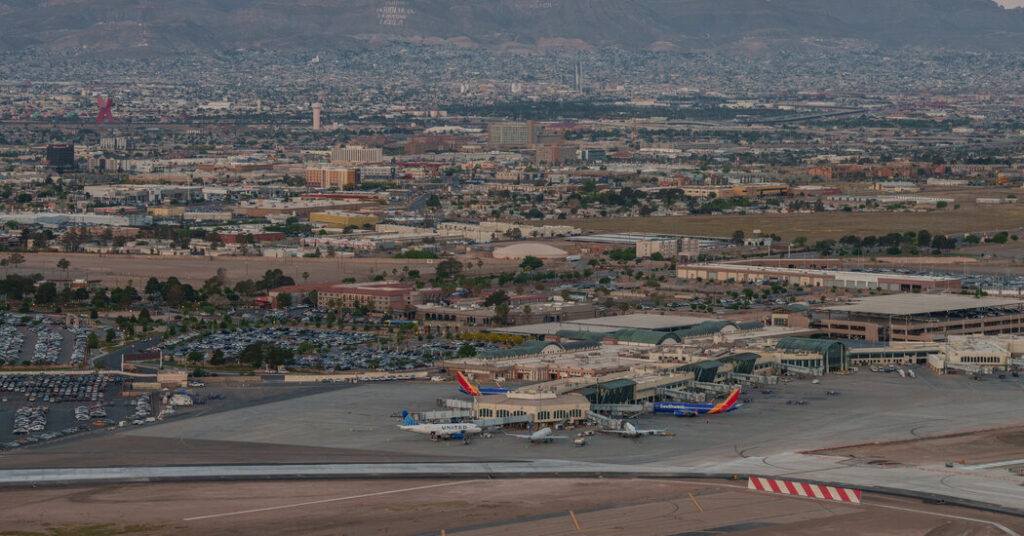
Around 9 p.m. on Feb. 10, an air traffic controller at El Paso International Airport saw an alert pop up on the tower’s computer screen. It was from the Federal Aviation Administration.
The controller beckoned the two colleagues who were sitting nearby. Together they stared at the F.A.A. advisory.
In two and a half hours, it said, a huge slice of the airspace they handled would close for “special security reasons.”
For 10 days.
The controllers could hardly process what they were seeing. The alert meant that no commercial aircraft could fly in or out of El Paso. Medical rescue helicopters couldn’t, either. Business in the city would be disrupted, vacations ruined, lives potentially lost.
“Pilots who do not adhere” to the closure “may be intercepted, detained and interviewed by law enforcement,” read the advisory.
The United States government could use deadly force against an aircraft if it was determined to pose an imminent security threat. Starting at 11:30 that night, any aircraft that flew over El Paso and its surrounding area below a certain elevation risked being shot down.
The controllers, huddling in a tower a dozen stories above the airport’s three runways, studied a map the F.A.A. had included. It featured a huge red circle encompassing the southern border area where they were standing. An 11-mile diameter roughly from Sunland Park, N.M., to Horizon City, Texas, was now off limits below 18,000 feet. Almost any plane not simply passing far overhead on a long-haul flight was forbidden.
And the El Paso airport, demarcated by an airplane avatar, was the bull’s-eye.
The first major airspace shutdown since Sept. 11, 2001, had occurred.
Sitting in the spots they occupied every day — in front of their live radar scopes, where aircraft appeared as moving dots on a screen — and talking on their radio headsets to pilots, the controllers could only guess at what was happening, recalled one person who was there that night. Had there been a terrorist attack? Was the country battling a Mexican cartel?
As it turned out, the U.S. government was at war with itself.
The conflict didn’t last long, and federal officials quickly moved on. But for the people of El Paso, the episode showed what could happen when political squabbling far away in the nation’s capital takes precedence over the public’s needs.
The F.A.A. alert helped explain what had already been a puzzling afternoon. Tower controllers typically spend their shifts keeping aircraft safely separated from one another at or near an airport. But that afternoon, the controllers had also fielded calls from airlines that were asking whether the city’s skies were still open.
Initially, they found the questions bizarre. But now they made at least some sense, according to someone who was present that evening but requested anonymity because they were not authorized to speak publicly. The controllers needed to know what was going on.
One senior controller called Representative Veronica Escobar, a Texas Democrat whose district includes El Paso, at her Washington apartment. It was 11 p.m. on the East Coast and the call woke her. She lay in her pajamas, just listening, then abruptly sat up after she heard the controller’s news.
Lacking any hard information, Ms. Escobar mentally ticked through the possibilities. Was the United States at war with Juárez, El Paso’s sister city across the border? The military had been attacking boats in the Caribbean, saying they were drug vessels; maybe now it was attacking Mexico. She also knew the U.S. Army and Customs and Border Protection had been experimenting with lasers meant to shoot down foreign drones.
“I was shocked,” Ms. Escobar said in an interview. “I was bewildered.”
She immediately started making her own calls to federal and city leaders. A U.S. Army official told her the Army and Customs and Border Protection had 10 days left in a trial run of the lasers. Maybe the two were related.
The controllers in El Paso spent the first hours notifying nearby aviators of the pending closure and steering those already flying toward the ground, where they would be safe.
One controller began calling medical evacuation services, warning that they would soon be locked out of city airspace, said the person who was present that night. At the same time, this person recalled, another controller was telling pilots they had little time to clear out before the flight restrictions took effect.
Some pilots expressed surprise to the controllers over their radios, according to air-traffic audio recordings reviewed by The New York Times.
“So is this the first time you’ve ever heard of anything like this?” one asked.
“Shutting us down? Yes,” the controller answered. “First time for us. We got caught off guard. We’re just scrambling right now.”
“I’ll bet,” the pilot chortled.
It seemed that no one in El Paso — with the possible exception of the airlines who had called about the rumors swirling that afternoon — had been given a heads-up about the shutdown.
El Paso’s mayor, Renard Johnson, learned about the closure from the city manager, who woke up Mr. Johnson shortly after he switched off the local news and drifted off to sleep. He, too, went on a frantic search for answers.
The implications were profound. Artificial joints that doctors needed for surgery were often not kept on hand, he knew, and were typically flown in by suppliers a day in advance. The city’s fire department, which sometimes dispatched emergency medical workers to far-flung accident sites by helicopter, might not be able to reach injured people quickly enough.
Around midnight, University Medical Center of El Paso, the area’s only Level 1 trauma center, became aware of the closure from local news reports. Hospital leaders in the area quickly began to talk about how they could help one another, including with air transport. The Southwest Transplant Alliance, an organ procurement group, began exploring how to deliver organs to El Paso by road.
The officials who run the airport were also lighting up their phones.
“[S]o far this is no BS,” wrote Alexander Rao, the airport’s operations manager, in a text message exchange first reported by Politico.
“Anyone else to call?” the airport’s security manager texted to Mr. Rao.
“FBI?” Mr. Rao answered.
El Pasoans are accustomed to feeling overlooked. They occupy a liberal oasis in a deep red state. Nine hours west of Dallas, El Paso has a rich mix of cultures, making it more of a cultural sibling to Albuquerque than to Midland or Lubbock. And though the city of 680,000 has a respected university and safe neighborhoods, residents complain that it is often dismissed as a crime-ridden desert wasteland.
At 12:13 a.m. local time, the El Paso airport announced the closing in a cryptic post on Instagram. Jim Dobrowolski, a father of two in a cozy middle-class El Paso neighborhood, found it after seeing a reference to the situation while browsing Reddit. Mr. Dobrowolski, who manages a dental practice, wondered if the United States might be at war with Mexico — or even under alien invasion. After scanning the local and national news and finding no answers, he briefly considered loading his wife and two young sons into their SUV and driving north to Albuquerque.
“This just seems totally unprecedented, this seems totally mysterious, and there’s no explanation from anyone,” he remembers thinking. He couldn’t think of anybody to call for advice, so after a few hours, he finally turned in.
In Santa Teresa, N.M., Daniel Manzanares was on the phone, trying to reach his contacts in Customs and Border Protection.
Mr. Manzanares, an experienced cattle rancher who runs a livestock trading co-op on the border with Mexico, had received a call from a friend. The man and his wife planned to fly on their own airplane from the Santa Teresa airport to Arizona for a medical appointment the next day, but with the airspace closed, they wouldn’t be able to. He had asked Mr. Manzanares to find out what was going on.
But when Mr. Manzanares called his federal contacts, the calls were inexplicably blocked. The one customs agent Mr. Manzanares did reach said that he could not discuss the matter.
“Hey, it’s closed,” Mr. Manzanares told his friend when he called him back. “Until further notice, can’t tell you what, don’t know.”
Around that same time, at his residence on the east side of El Paso, Mayor Johnson was working on the talking points for a speech he would give at a news conference in the morning. He was contemplating two versions. He’d give one if the airspace was reopened, an outcome he was pushing for behind the scenes. The other was meant to reassure the public if it was still closed.
Having spoken to the commanding general of Fort Bliss, the large Army Base in the area, he at least felt confident that the military was not mobilizing troops.
“We weren’t under any terrorist attack,” Mr. Johnson recalled. “We weren’t under major threat to the community. So I wanted to make sure that our community could come up, could wake up and live as normal as they could that day.”
Bianca Marino, a mental health therapist, woke at 5 a.m. to a stream of panicked text messages about whether her group yoga trip to northern India, which had been organized by a local instructor, could still occur. The group’s 8 a.m. flight on United Airlines seemed likely to be canceled. They agreed to meet at the airport anyway to come up with a Plan B, such as driving four hours to the Albuquerque airport to find an alternate flight.
At the El Paso airport that morning, airline staff members seemed overwhelmed.
“That’s all we know,” agents told passengers repeatedly. Some resorted to ignoring questions being posed by traveler groups, opting to chat with their colleagues instead.
“The scene was very chaotic and confusing,” recalled Ms. Marino, who met her group there around 6 a.m., “and there were so many rumors going around” about cartel violence spilling over the border, or even a national security crisis.
Ms. Marino, who treats adults with both trauma and obsessive-compulsive disorder, had her own theory.
“Ever since the Trump Administration took office, something crazy like this seems to happen every single day,” she said, “so I just assumed it’s just another part of their incompetence and chaotic management going on.”
Ms. Escobar, the congresswoman, had spent most of the night sitting cross-legged on her bed, using her laptop and two phones to connect with El Paso city officials, military contacts and the F.A.A. Her staff also reached out to an aide to Susie Wiles, President Trump’s chief of staff.
In the end, her hunch about drones proved to be right.
The Defense Department in recent years has been experimenting with the kind of anti-drone technology that has become an essential part of modern warfare.
The Pentagon last year established a joint interagency task force to develop innovative strategies for countering small drone threats. One is the use of anti-drone lasers, which use high-energy beams to shoot them down for a fraction of the cost of more traditional technologies.
Early on Feb. 9, the day before the F.A.A. alert was issued, Customs and Border Protection officials, operating just 16 miles west of the El Paso airport, fired just such a laser weapon in hopes of taking down a foreign object that was flying overhead. The object turned out to be a balloon.
Lt. Col. Adam Scher, a spokesman for the Defense Department’s Joint Interagency Task Force for countering drones, wrote in an email that objects like mylar balloons “have historically been used as decoys by our adversaries for decades to confuse missile defense radar systems, challenge our warfighters, and expend our stockpiles of interceptors.” The balloons have also been known to carry drugs, he added.
But the use of the weapon started a skirmish within the U.S. government. The F.A.A., leery about the potential risks of the lasers to air safety, felt it had no choice but to shut down El Paso’s airspace.
The closure hamstrung the Department of Defense, which had been experimenting with the new lasers along the border without the F.A.A.’s buy-in. Customs and Border Protection, which had been borrowing the Army’s lasers as a new layer of protection against cartel-operated drones from the Mexican side of the border, was also stymied.
Eventually, the conflict came to the attention of Ms. Wiles, who intervened. (Ms. Escobar said Ms. Wiles did so without returning her staff member’s message.) At 6:54 a.m., the F.A.A. abruptly announced on X that the airport had reopened.
“There is no threat to commercial aviation,” the agency stated. “All flights will resume as normal.”
Transportation Secretary Sean Duffy soon caused more confusion with a comment on X blaming the shutdown on a “cartel drone incursion.” This was a surprise to Kim Stewart, sheriff of Doña Ana County, N.M., next to El Paso County, who said in an interview that she would have had known about that if it had happened.
“We deal in intel, cross-border intel, every day,” Ms. Stewart said. “So, what do they think, we’re just out to lunch here?”
The White House’s intervention meant a potentially crippling 10 days was limited to less than 8 hours, most of it during the quiet of night. Southwest Airlines, one of the airport’s major carriers, canceled two flights and delayed another eight. American Airlines, which also serves El Paso, had two cancellations and a half-dozen delays. The city did not need to whisk anyone in a medical helicopter from a fire or traffic accident during those hours. And Ms. Marino and her yoga group made it to India on time.
At 8:30 a.m., Mr. Johnson, wearing a smart gray suit and accompanied by police and emergency management officials, spoke to about 20 local reporters in front of El Paso City Hall. The closure, he said, “should have never happened.” The government’s failure to communicate with city officials, hospitals and the airport was “unacceptable.”
Then, looking to reassure the public that it would be a normal day in El Paso, he strolled to a nearby Starbucks and mingled with customers as he purchased a mint tea.
Ms. Escobar; Representative Gabe Vasquez, Democrat of New Mexico; and New Mexico’s two senators have since penned a letter to the Departments of Transportation, Defense and Homeland sSecurity, asking for a classified briefing on the shutdown.
In a joint statement from the Department of Defense, Customs and Border Protection and the F.A.A., a Pentagon spokesman played down the disruption and emphasized the government’s efforts to keep America safe.
“At President Trump’s direction,” the spokesman said, branches of the government “are working together in an unprecedented fashion to mitigate drone threats by Mexican cartels and foreign terrorist organizations at the U.S.-Mexico Border.”
Some in El Paso did not think their government’s performance was unprecedented.
“It was just like another display of gross incompetence and miscommunication,” said Mr. Dobrowolski in an interview. “It’s disappointing to feel like we’re sort of left to fend for ourselves.”
Kate Kelly covers money, policy and influence for The Times.
The post The Night the Government Closed the Skies Over El Paso appeared first on New York Times.