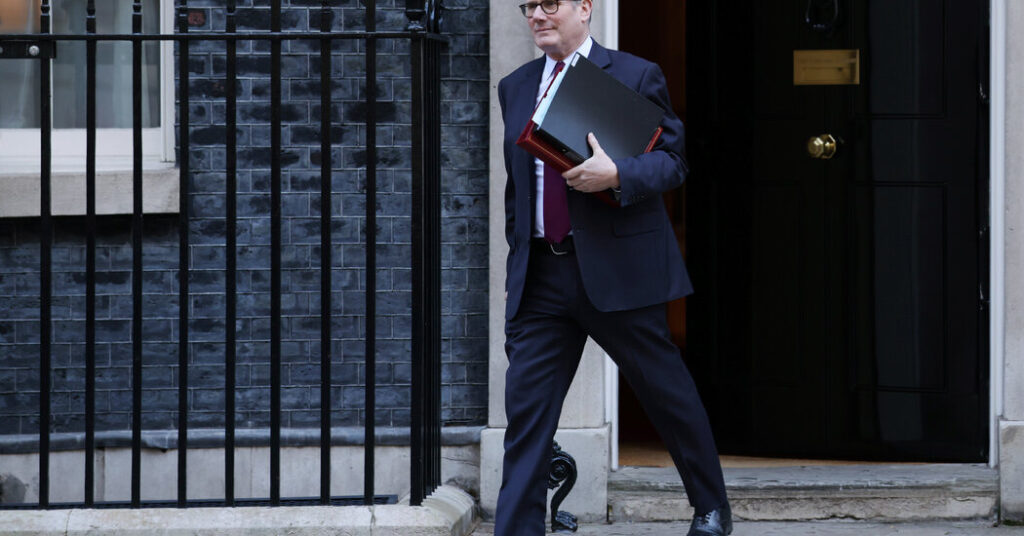
Prime Minister Keir Starmer will face Parliament on Monday afternoon as his government reels from revelations that Peter Mandelson, his pick to be ambassador to the United States early last year, initially failed security vetting.
Mr. Starmer will tell lawmakers that he was kept in the dark about the recommendation by a specialist vetting team that Mr. Mandelson should not be granted “developed vetting” — the highest level of security clearance in Britain. That recommendation was overruled by officials at the Foreign Office, the prime minister’s office said last week, and no government minister was informed.
After discovering last week what had happened, Mr. Starmer fired Olly Robbins, the top civil servant at the Foreign Office, saying that he had lost confidence in him.
Allies of Mr. Robbins fought back over the weekend, saying that British law had prohibited him from disclosing the sensitive contents of the security review. In response, officials from the prime minister’s office released a statement late Sunday night arguing that “no law stops civil servants sensibly flagging U.K. security vetting recommendations.”
In Parliament, Mr. Starmer is expected to insist that he did not intentionally mislead lawmakers over the past several months when he assured them that “full due process” had been followed during Mr. Mandelson’s appointment. The leaders of all of the opposition parties in Britain have called on the prime minister to step down, accusing him of lying to his colleagues and to the public.
Kemi Badenoch, leader of the Conservative Party, said on Friday that Mr. Starmer must resign, adding, “There can be no more cover-up, no more excuses, no more delays.”
Mr. Starmer has vigorously denied misleading Parliament, saying that he was “furious” about the situation and calling the decision not to inform him about the vetting decision “unforgivable.” The clash between Mr. Starmer and Mr. Robbins is expected to continue on Tuesday, when Mr. Robbins has been called to appear before a committee of lawmakers.
Gus O’Donnell, a former head of the British civil service, wrote in The Times of London on Sunday that in firing Mr. Robbins, the prime minister took “a very rapid decision to dismiss someone for applying what seems on the face of it to be an entirely standard, reasonable and perfectly obvious interpretation of the law.”
However, Ruth Fox, director of the Hansard Society, a pro-democracy group, said on social media that the law Mr. Robbins was operating under “doesn’t absolve him, or anyone else in the civil service, of the duty to consider ministers’ obligations to Parliament.”
The issue of the vetting is the latest controversy to erupt over Mr. Starmer’s initial decision to make Mr. Mandelson one of the country’s top diplomats. The prime minister fired Mr. Mandelson in September over his ties to Jeffrey Epstein, the convicted sex offender. Further disclosures about that relationship in the Epstein documents released by the U.S. Department of Justice have deepened the political crisis for Mr. Starmer.
The prime minister has repeatedly said that he was not aware of the nature of Mr. Mandelson’s close friendship with Mr. Epstein and would not have sent him to the United States as ambassador if he had known. But his political opponents, and some members of his own Labour Party, have said that Mr. Starmer exercised poor judgment in picking Mr. Mandelson in the first place.
Mr. Mandelson was arrested in February and then released, but he remains under investigation amid accusations that he shared sensitive information when he served in government more than a decade ago. Mr. Mandelson has not been charged with a crime and has denied any criminal wrongdoing.
Mr. Starmer’s appearance in Parliament on Monday comes less than three weeks before elections in Scotland, Wales and local councils across England where his Labour Party was already expected to do poorly. Mr. Starmer’s approval ratings in Britain are among the lowest for any modern prime minister.
The vetting issue has also diverted attention away from Mr. Starmer’s attempts to show leadership in the diplomatic fight to reopen the Strait of Hormuz. Last week, Mr. Starmer joined other European leaders at a summit on the issue in Paris.
Michael D. Shear is the chief U.K. correspondent for The New York Times, covering British politics and culture and diplomacy around the world.
The post Starmer Will Tell Parliament He Was Kept in the Dark on Mandelson Vetting appeared first on New York Times.