I’d been warned that “Project Hail Mary,” about an accidental astronaut trying to save humanity with the help of an alien who’s basically a boulder with limbs, spanned more than two and a half hours. But somewhere around the two-hour mark, I became convinced that I’d heard wrong.
The central relationship seemed to have run its, er, rocky course. I felt like I’d been in space longer than the crew of Artemis II. I’d laughed, misted up, savored Ryan Gosling’s sweetness and snark and then savored them some more. Surely, the movie was ready to release me.
Not even close. A sequence that I thought must be the big finale led to another sequence that I thought must be the big finale and then to another after that. In a highlights reel of fake climaxes, “Project Hail Mary” would have several scenes keeping company with Meg Ryan’s ersatz eruption in “When Harry Met Sally.”
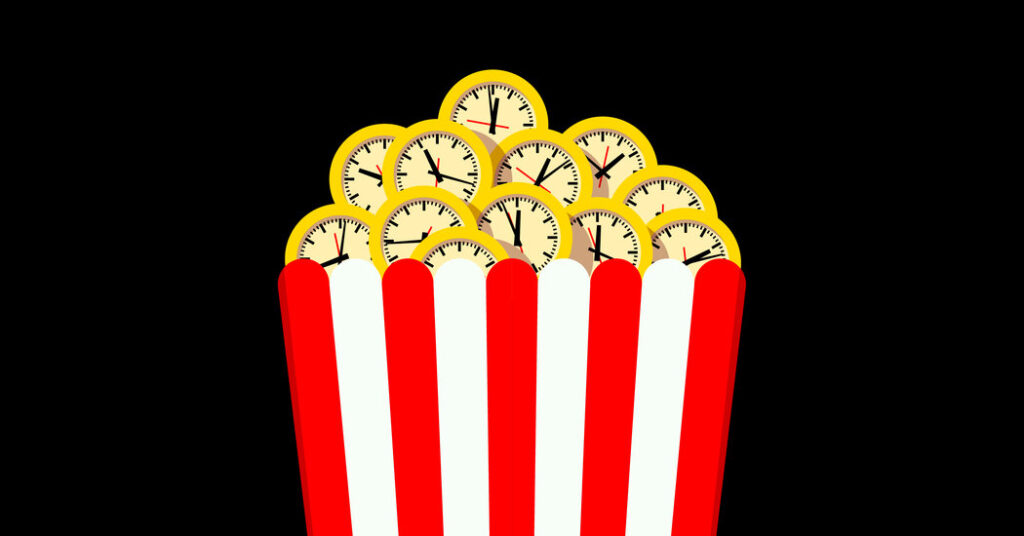
That 1989 movie, by the way, clocked in at 95 minutes. “Project Hail Mary,” which came out last month and has been a huge hit, clocks in at 156. And that’s hardly the outer limits for science-fiction, superhero and action extravaganzas over the past decade. We’re in an age of serious cinematic bloat. It’s not Hollywood stars who need Ozempic; it’s their showcases.
I liked “Project Hail Mary” until I didn’t, couldn’t, wanted to get on with my life, wanted to hit the men’s room, wanted to hit whoever had edited (or, rather, failed to edit) this needlessly epic adventure. I had a similar reaction last year to “Wake Up Dead Man: A Knives Out Mystery,” whose charm curdled badly as it crested two hours and then two hours and 15 minutes on its way to a running time of two hours and 24 minutes. Memo to the movie’s makers: There’s a difference between Benoit Blanc and “Ben-Hur.”
It’s as if Hollywood is punking us. How else to explain stretching a Tom Cruise stunt-a-thon to two hours and 43 minutes and then calling it “Mission: Impossible — Dead Reckoning Part One”? The italics are mine; read them as a primal scream. “Mission: Impossible — The Final Reckoning” lasts two hours and 49 minutes. It’s supposedly the end of impossible missions, but nothing ends anymore. By the current illogic of interminable narratives, there will surely be a “Mission: Impossible — One More Reckoning for the Road,” and it will be longer than the audiobook of “Middlemarch.” Cruise’s first “Mission: Impossible,” from 1996, is one hour and 50 minutes.
The film data researcher Stephen Follows recently analyzed the running times of 36,431 movies released between 1980 and 2025. He concluded that in the 1980s, about 14 percent of wide theatrical releases — movies that open on hundreds or even thousands of screens across North America — ran over two hours. “In the 2020s,” he wrote, “it’s 32 percent.” And the wider the movie’s release and the bigger its budget, the longer it tends to be.
The “Mission: Impossible” franchise isn’t the only one that grew flabbier with successive installments. “Raiders of the Lost Ark,” released in 1981, is 115 minutes long. “Indiana Jones and the Dial of Destiny,” released in 2023, is 154. The first James Bond movie, “Dr. No,” released in 1962, is 110. The most recent James Bond movie, “No Time to Die,” released in 2021, is 163.
Explanations vary. Many Hollywood executives and moviemakers apparently believe that if you’re going to lure people out of their homes and away from their smaller screens to the communal experience of the multiplex — and if you’re also going to ask them to fork over roughly $30 for a ticket, popcorn and a soft drink — you better promise them a real event, even a spectacle, something with a sense of amplitude. That means three hours and one minute of “Avengers: Endgame,” three hours and 12 minutes of “Avatar: The Way of Water” and three hours and 17 minutes of “Avatar: Fire and Ash.” (Beware the colon movies — or at least make sure you haven’t planned anything else that day.)
Movies at this point spend most of their lives on streaming services rather than in actual theaters, and those services want to command viewers’ attention for as long as possible. That desire is reflected primarily in limited series that sprawl to eight or 10 parts when four would do the trick. But it’s also a disincentive for movie directors to make tough decisions and trim.
Succinctness, understatement, subtlety — those belong to a lost world, before Netflix and Apple TV+ and Amazon Prime Video, whose effect on them was not unlike an asteroid’s on brontosaurs. More is more is the new less is more, and more than that is even better. I feel bullied by the bloat.
I also feel distrusted and disrespected, because that bullying and that bloat are about more than drawn-out running times and multiple endings. They’re about gratuitously explicated plot points, clumsily signposted epiphanies and other such spoon-feeding. I get it: The pervasiveness of distractions and our proven susceptibility to them mean that we might miss a big payoff — might be fiddling with Wordle, scheduling a DoorDash — so it’s arguably reasonable for a moviemaker to insist on the desired emotional reaction rather than ask politely for it.
But maybe start hectoring me at the 95-minute mark? So that we’re done by 120? Life is short. I can spend only so much of mine in space, even with Ryan Gosling.
Forward this newsletter to friends …
… and they can sign up for themselves here. It’s published every Monday.
For the Love of Sentences
In The Atlantic, Helen Lewis weighed in on Lindy West’s widely discussed and intensely debated new memoir. “‘Adult Braces’ is many things: a paean to the varied landscapes of America, an advert for #vanlife, a reminder to be grateful that your partner hasn’t talked you into a throuple with a much thinner woman. It is also the tombstone for millennial feminism — that swirling brew of media Twitter, blog snark, the great awokening, whaling on Lena Dunham, fat positivity and boring straight people identifying as queer through accounting tricks.” (Thanks to Dick Chady of Chapel Hill, N.C., for nominating this.)
Also in The Atlantic, Caity Weaver had issues with some roughage at a Texas Roadhouse restaurant: “No rabbits stealing the last of the November lettuces by moonlight ever chewed a colder salad than our Caesar.” (Jerry Tumlin, Houston)
In The New Yorker, Amanda Petrusich profiled the Vermont singer and songwriter Noah Kahan, who produces “music for people who own too much performance fleece to embrace the bombast of Taylor Swift but aren’t quite feral enough for the cacophony of Geese,” she wrote. “It’s the kind of thing that sounds really nice in a Subaru, on your way to work, with an iced coffee nestled in the cup holder.” (Christopher Feeney, Brooklyn)
In Slate, Sam Adams noted the discrepancy between the romantic conquests of the actor David Harbour and the erotic humiliations of his character in the HBO limited series “DTF St. Louis”: “If Harbour is a player, Floyd is one of life’s played, a stalled-out suburban dad who lugs around a giant beer belly like it’s a sack full of his life’s regrets.” (Judy Danielson, Boston)
In his newsletter, Ron Charles praised the new book “The Second Estate: How the Tax Code Made an American Aristocracy,” by Ray Madoff, who explains the system’s concentration of wealth and perpetuation of inequality: “Every copy should come with a coupon for a torch and a pitchfork.” (Estelle Vickery, Waynesville, N.C.)
In The Times, Sam Anderson tried out A.I. sunglasses from Mark Zuckerberg’s company. “Meta’s new gizmos are ordinary-looking Ray-Bans and Oakleys that have been juiced to the gills with hidden technology: Wi-Fi, Bluetooth, two tiny speakers, five microphones, a wide-angle camera,” he wrote. “They are basically a whole sting operation that sits on your nose.”
“Once,” Sam added, “a Cybertruck came rumbling toward me, and as I reached up to snap a picture with my glasses I felt that something momentous was about to happen — that this collision of two notoriously obnoxious technologies might rip a hole in the fabric of space-time and send confetti raining down, and we would all wake up in a new reality where everyone is kind and all leaders are competent and the world’s abundant resources end up where they belong. Instead, the Cybertruck drove on. And my sunglasses were still on my face.” (Stephen Waxman, San Francisco, and Miriam Bulmer, Mercer Island, Wash.)
Also in The Times, Clifford Winston examined the extinction of modestly priced cars: “While politicians and economists scratch their heads at voters upset about affordability in a decent economy, they seem to somehow miss the fact that for most Americans the purchase of a car has become a debt sentence.” (Joanne Hus, Vineyard Haven, Mass., and Gordon Rogers, Columbia, Mo., among many others)
And Abdi Latif Dahir evoked a recent day in Lebanon: “The mechanical growl of Israeli warplanes mixed uneasily with the soft, reverent hymns coming from the church near my home in Beirut on Easter Sunday. For a moment, the two sounds coexisted, as if the city itself were holding its breath, caught between faith and fear.” (Robert K. Leaverton, Absarokee, Mont.)
In The Wall Steet Journal, Peggy Noonan winced at President Trump’s wee-hours tantrums on social media. “Previous presidents haven’t always been lit by inner dignity, but all at least attempted to fake it in public,” she wrote. “They didn’t feel free to get revved up in the middle of the night and take their rage out for a walk to relieve itself.” (Kaylyn Koberna, Jersey City, N.J., and Jeffrey Solow, Elkins Park, Pa., among others)
And in The Atlantic, Elizabeth Bruenig remarked on the folly and futility of the president’s war with the pope and the Roman Catholic Church: “Trump, accustomed to playing the bully to forge deals, is perhaps discovering that his tactics make little sense against a power that has little need for currying favor. The Vatican is a 2,000-year-old global institution with a divine remit. The 250-year-old United States is still only a footnote, and this president’s term is barely a thought.” (Robert Depczenski, Manhattan)
To nominate favorite bits of recent writing from The Times or other publications to be mentioned in “For the Love of Sentences,” please email me here and include your name and place of residence.
What I’m Reading, Watching and Writing
-
I haven’t followed Lena Dunham’s career all that closely, and one of her most recent efforts as a writer and a director — the 2025 Netflix series “Too Much” — left me cold. But here I am listening contentedly to the audio version of her just-published memoir, “Famesick.” I was led to it by a charming excerpt in The New Yorker and by her seductively frank recent conversation with David Marchese in The Times. She has such a natural talent for narrating her own life; she doles out soulfulness, humor, self-assertion and self-deprecation in judicious measures. And her overarching message, in this book and most of her other work, is what messes we all are. The mess of me appreciates — and sometimes needs — that reminder.
-
Last week, before I’d seen the finale of “DTF St. Louis,” I wrote that I hadn’t resolved my feelings about it. I’ve now watched that episode and reached a verdict: The show’s a bust. It leaned more and more into its worst instincts as it went along and, in the end, fully surrendered to them.
-
In recent installments of the Times Opinion feature The Conversation, Bret Stephens and I discussed Kristi Noem’s tribulations and the Trump administration’s attempt to give the pope a timeout.
On a Personal Note (Dictation Gone Wrong, Pt. 1)
In response to my request for your best examples of dictation gone wrong, I received hundreds of emails about the funny, embarrassing and strange detours that words took en route from being spoken to being digitally transcribed. I also got many emails about errors of autocorrect as opposed to transcription — but those count, too, inasmuch as they’re similar illustrations of technology’s shortfall.
It will take me a while to read all of your submissions and select representative ones to share in the newsletter. In light of that, I’ll present a few chunks spaced out over coming months, starting with today. If anyone wants to send additional examples to [email protected], please remember to put Dictation Gone Wrong in the subject line and to provide not only your name but also the city or town in which you live.
My review of the first 150 or so submissions to land in my inbox suggests that many bloopers involve body parts and sex. So that’s the theme of this installment.
Cindy Sullivan of New Fairfield, Conn., wrote that she once informed a nephew of some china he’d inherited, but the transcription gods heard her wrong and fashioned this notice: “Your Aunt Patty left you my mother’s vagina. Do you want it?” Luckily, she caught the error before hitting send.
Sally Hudson of Long Valley, N.J., recalled a missive from a friend who was coming over for dinner and pledged to “bring some nipples.” Which, presumably, the friend brought — along with the nibbles that she intended to flag.
Rick Fienberg of Placitas, N.M., concluded a text message by asking if he was right. His correspondent assured him that he was indeed “colorectal,” which is apparently what happens when “correct” veers off the rails.
One half of an octogenarian couple texted Steve Yunker of San Diego to tell him that they would be around “for several days because of sexual commitments and doctors appointments.” Perhaps that made sense; some vestiges of sex can require medical attention. But the couple in reality had “several commitments” of an unspecified nature.
Just as “several” can become “sexual,” “fellowship” can take a bawdy turn. It did so when Ken Zuckerman of Tampa was informing someone via text that he couldn’t attend a meeting: “Sorry, but I have a fellatio event at that time.” Alas, that was not his conflict, and he fixed the error before it was, um, exposed.
Peter Reynen, a physician in Wilmot, S.D., noted the dangers of medical transcription: “Circumcised phallus” got a promotion (I think?) to “circus-sized phallus,” calling to mind elephants under the big top.
And mourning met mooning when, according to Stefan Krug of Mill Valley, Calif., “ash scattering” became “ass gathering.” Maybe Siri had a proctologists’ convention in mind.
The post Put the Movies on Ozempic appeared first on New York Times.