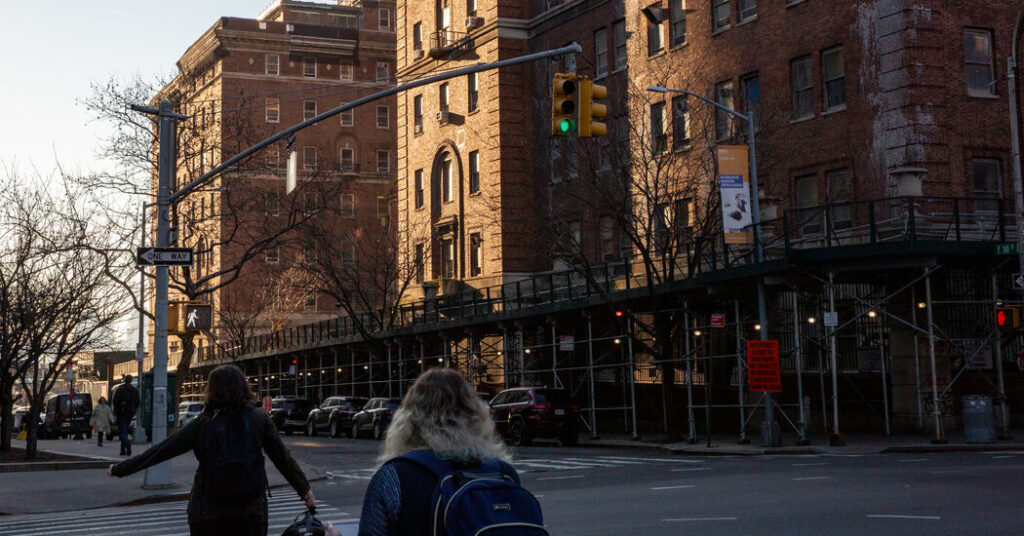
When New York City officials announced last month that the long-established 30th Street Shelter in Manhattan, for decades the first stop for men seeking shelter, would be closed, the plan was to relocate the center to the East Village.
But on Monday, 11 days before the planned relocation, a group of Manhattan residents filed a lawsuit to stop the move to East Third Street. The residents contend that the city has skipped over necessary public review and notice requirements, relying on emergency executive orders to address a situation that is not an emergency.
It was not clear if the lawsuit in State Supreme Court in Manhattan, which seeks a preliminary injunction, would affect the closure of the 30th Street Shelter and Intake Center, which was once the Bellevue psychiatric hospital. The city has already removed the shelter’s occupants, transferring them by bus weeks ago to other corners of the city. The shelter has continued its intake functions, which include giving shelter assignments to homeless people.
The facility on East Third Street has been serving as a homeless shelter and substance use treatment program for many years, run by the nonprofit group Project Renewal. According to the complaint, the intake shelter will have 117 short-term beds for men who will typically stay for less than 24 hours.
“Right now, the people we have there are much more static, they’re there for longer periods of time,” said Trisha Goff, a plaintiff in the case who lives on the block. People at the intake shelter, she said “will be very transient.”
A spokeswoman for City Hall said the conditions at the 30th Street Shelter had been “unacceptable” for years. “The decision to vacate was necessary for safety, and based on clear expert guidance,” she said. “Now, we have an urgent obligation to act. Transferring shelter intake to 8 East Third Street is critical to ensuring that every New Yorker in need has access to safe, dignified shelter without delay.”
Originally built as a psychiatric facility on the Bellevue grounds, the 30th Street Shelter was enormous, with 850 beds. It was also decrepit and sometimes dangerous. Large shelters tend to be less safe than smaller ones, and advocates for homeless people say it was not the sort of place people wanted to be. Many preferred to sleep on the streets.
The Giuliani administration considered letting a for-profit company convert the building into an upscale assisted living facility. The Bloomberg administration proposed transforming the site into a hotel and conference center.
Advocates for homeless New Yorkers have raised concerns that the city was rushing to open two intake centers — the men’s facility and a separate one for adults without children, which is slated to open at 333 Bowery next month. The Coalition for the Homeless has argued that the new site at East Third Street is not compliant with the Americans for Disabilities Act.
Despite its problems, the 30th Street Shelter did have attributes that made it functional, and it was woven into the fabric of New York City for more than 40 years. Its central location was an advantage, and homeless men knew it was their first stop if they needed a place to stay.
Elizabeth A. Harris covers books and the publishing industry, reporting on industry news and examining the broader cultural impact of books. She is also an author.
The post Opponents Sue to Block Mayor’s Plan to Move Shelter to East Village appeared first on New York Times.