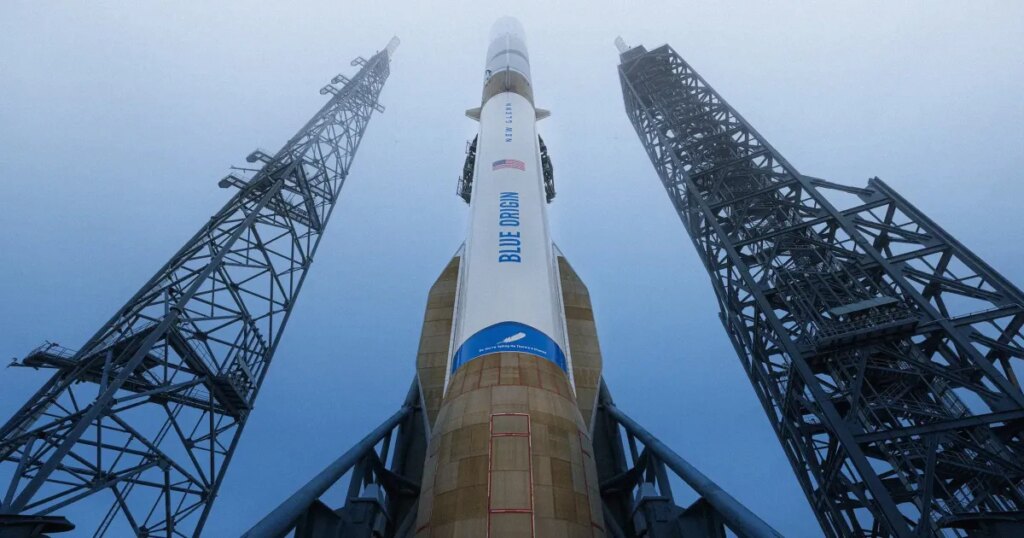
It was a bittersweet launch for Jeff Bezos’ Blue Origin.
The space company successfully reused one of its New Glenn rocket boosters for the first time, bringing it closer to competing with its archrival SpaceX. Footage shared by Bezos shows the massive rocket carefully slowing its descent to safely land on a drone ship called “Jacklyn.”
However, the rest of the planned launch didn’t go so well. The rocket failed to deliver a communications satellite for customer AST SpaceMobile, placing it “into a lower than planned orbit” that rendered it useless, the latter company admitted in a press release.
“While the satellite separated from the launch vehicle and powered on, the altitude is too low to sustain operations with its on-board thruster technology and will de-orbited,” AST SpaceMobile admitted, noting that insurance will pay the “cost of the satellite.”
It was an embarrassing setback after over a decade of development of Blue Origin’s New Glenn rocket, which made its maiden voyage to space in January 2025 but failed to recover its first stage at the time.
Bezos’ space company is still hoping to use the heavy-lift rocket to launch its Blue Moon lunar lander for NASA’s upcoming Artemis missions. While successfully reusing its booster is certainly a step in the right direction, not being able to deliver a small communications satellite into the proper orbit isn’t nearly as reassuring.
In contrast, SpaceX’s Starship, which is also being tapped by NASA to land astronauts on the lunar surface, has successfully deployed Starlink satellite “simulators” during its most recent test launches, though it has yet to deliver real ones into orbit.
The New Glenn rocket stands at 322 feet tall including both of its stages, while Starship stands at roughly 400 feet, including its Super Heavy booster. The former is rated to carry just shy of 100,000 pounds to low-Earth orbit, while SpaceX’s latest iteration of its Starship, dubbed V3, is rated for roughly twice that.
Despite its latest setback, Blue Origin is going full steam ahead with its plans to help NASA return humans to the Moon in over half a century. In fact, as TechCrunch reports, the original plan for its latest New Glenn launch was to take up an uncrewed first version of its Blue Moon lander, before settling on delivering the AST SpaceMobile satellite instead.
The company is still hoping to launch the test lander later this fall, followed by the first launches of Amazon’s internet-beaming satellites before the end of this year, as Spaceflight Now reports.
But considering its latest misfortune, those ambitious timelines may now be on thin ice.
Following its failure to deliver the satellite, Blue Origin noted that “we are currently assessing and will update when we have more detailed information.”
More on Blue Origin: There’s Something Very Weird About Blue Origin’s Device That Generates Electricity From Moon Dust
The post Jeff Bezos’ Space Company Just Screwed Up Very, Very Badly appeared first on Futurism.