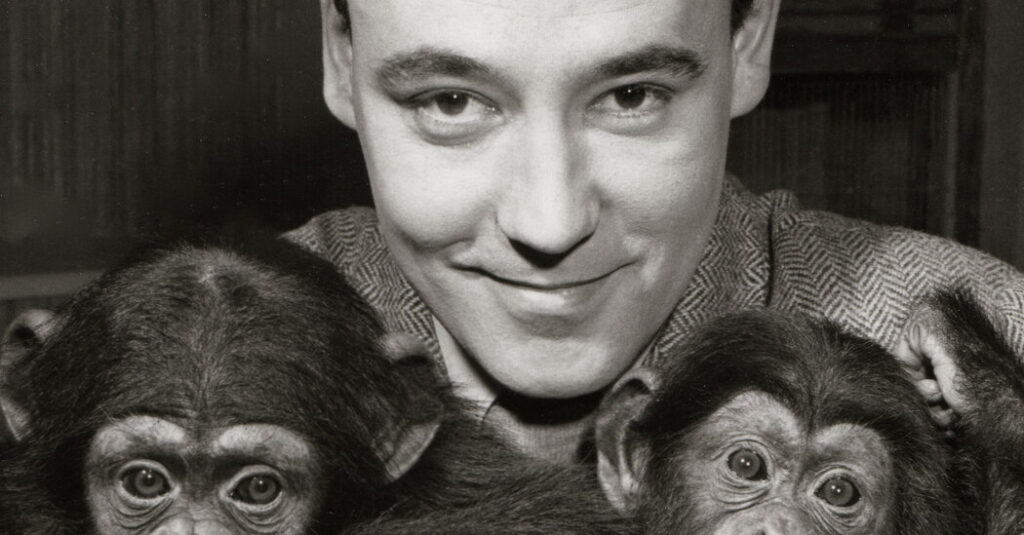
Desmond Morris, an English zoologist who used observation, logic and insight to contend in his immensely popular 1967 book, “The Naked Ape,” that humanity, stripped of civilized veneer, is just another species of ape, died on Sunday near Dublin. He was 98.
His death, at a hospital in the town of Naas, was confirmed by his son, Jason Morris.
In a career that included writing more than four dozen books and 50 scientific papers and presenting 700 television episodes, Dr. Morris used observational powers that he had honed as a zookeeper to study the ways of humans as well as those of animals. His “The Naked Ape: A Zoologist’s Study of the Human Animal,” which sold more than 20 million copies and was translated into 23 languages, argued that ancient genes, shared with apes, shape human behavior.
Dr. Morris offered new interpretations of basic human functions like sleeping, fighting, mating and child-rearing. He noted that humans had evolved not only the biggest brains among primates but also the biggest penises, compared to body size. He said this was one of many sexual adaptations that keep couples sufficiently interested to stay together.
“To make sex sexier,” he said.
Dr. Morris’s prolific output helped popularize the study of animal behavior and was sometimes likened to Carl Sagan’s work in astronomy. One of his more discussed contentions was that humans, unlike other primates, benefit by retaining youthful characteristics in adulthood. He said men keep playful brains and women youthful looks.
When readers objected, Dr. Morris responded that “The Naked Ape” was “deliberately insulting.”
“Our climb to the top has been a get-rich-quick story,” Dr. Morris wrote in the book, anticipating the objections, “and like all nouveaux riches, we are very sensitive about our background. We are also in constant danger of betraying it.”
As he might have expected, his contention that atavistic drives trump higher motives outraged laypeople and experts alike.
Anthropologists said Dr. Morris ignored culture. Linguists said he discounted language. Biologists said he omitted traits that did not further his argument. One Long Island school district banned the book. And opponents of the theory of evolution condemned the book in full.
The paleontologist George Gaylord Simpson, assessing “The Naked Ape” in The New York Times Book Review, questioned Dr. Morris’s basic hypothesis; he argued that after humans diverged from apes in evolutionary history, they could no longer be considered a species of ape. Some of the book’s assertions, Dr. Simpson wrote, were “at their best dubious and at their worst, ludicrous.”
The usefulness of comparing apes and humans gained traction in 1971, however, when the primatologist Jane Goodall published her book “In the Shadow of Man,” detailing the intricate social lives of wild chimpanzees in East Africa; genetic research has since proved the species’ closeness. Social biology, the explication of behavior in an evolutionary context, has grown in importance, even as debates over interpretations have flared.
Dr. Morris’s playfulness showed in his nimble intellectual speculation, calling gambling a manifestation of the hunting drive and cocktail parties a modern substitute for communal grooming. In 1997, he hosted a television show featuring a female orgasm photographed from inside the body.
“If I am honest, it is a struggle I have never fully resolved, the ‘ham’ and the academic in me doing battle with one another, with first one, then the other, getting the upper hand,” Dr. Morris wrote in “Animal Days” (1979), one of three memoirs.
Desmond John Morris was born on Jan. 24, 1928, in the village of Purton, in southern England, and grew up in the countryside in nearby Swindon. His father, Harry, was a writer of children’s fiction, and his mother, Dorothy (Hunt) Morris, looked after the home.
Desmond’s babyhood figured in a book published 80 years later, “Amazing Baby: The Amazing Story of the First Two Years of Life” (2008), in which Dr. Morris said he had nearly died because of stern child-rearing techniques. Heeding the advice of a baby expert, his mother left Desmond crying in a stroller on a windy day. He contracted double pneumonia. She then abandoned her strict approach in favor of the total love that Dr. Morris advocated in the book.
As a child, Desmond liked to observe worms and beetles, painted his room black to intensify his dreams, he said, and became enthralled with Darwin. He picked up an interest in art after finding a great-grandfather’s microscope and set of slides; he soon began drawing and painting patterns based on the shapes of microorganisms.
After completing compulsory service in the British Army, he graduated with highest honors in zoology from the University of Birmingham in 1951. By the early 1950s, he was selling his surrealist paintings in London and Belgium and had directed two surrealist films.
Dr. Morris subsequently attended the University of Oxford, where he studied under the animal behaviorists and future Nobel laureates Nikolaas Tinbergen, Karl von Frisch and Konrad Lorenz. Dr. Morris received a doctorate in 1954 with a thesis titled “The Reproductive Behavior of the Ten-Spined Stickleback.”
Under Professor Tinbergen, he did two years of postdoctoral research at Oxford on birds. His first job was hosting “Zoo Time,” a Granada Television series on animals in the London Zoo. He was toppled by a tortoise, attacked by a scorpion and sprayed by a urinating lion.
Off the air, his 1957 exhibition of paintings by an artistic chimpanzee, Congo, captivated the press and offended the art establishment. “Many people viewed his works as a cheap attack on the splatter paintings of Jackson Pollock and the bold abstractions of Franz Kline,” Sarah Boxer wrote in The Times in 1997. “But mockery was not Mr. Morris’s intention. He was interested in producing an ‘esthetic theory of ape art.’ ”
Dr. Morris became curator of mammals at the zoo in 1959. Though unsuccessful, his efforts to mate pandas in the London and Moscow zoos at the height of the Cold War drew worldwide attention.
During the 1960s, he wrote a stream of nature books, three with his wife, Ramona (Baulch) Morris, whom he had married in 1952. In 1967, he resigned from the zoo and was briefly director of the Institute of Contemporary Arts in London.
Dr. Morris spent four weeks writing “The Naked Ape,” racing to pay for a new house. As huge profits almost immediately materialized, he moved to the Mediterranean island nation of Malta in 1968, in part to avoid British taxes. There, he bought a 27-room villa, two Rolls-Royces and a yacht. The next year, his son, Jason, was born.
When the money ran out, Dr. Morris returned to Oxford to do more research. He sold his Rolls and rode a bicycle.
He churned out book after book, many of which were very popular — not least his quasi-scholarly guided tours, one for each sex, to the erogenous precincts of the human body. (When book reviewers complained about how difficult he made it to write around the word “penis” in “The Naked Ape,” Dr. Morris replied to Newsweek: “Newspapers commonly use the word gun. They don’t mind printing a word describing something that shoots death, but if it shoots life, they won’t have it.”)
His other books dealt with dogs, cats, horses and soccer players; he studied the last as a kind of athletic tribe deserving of anthropological study. His works on body language helped define that new field. And he continued to write late in life on myriad subjects; at age 90, he delved into the art world with “The Lives of the Surrealists” (2018).
Dr. Morris said in an interview in 2006 with The Times of London that he admired friends who were experts in spider physiology, but he was too impatient to focus on any one thing. Two decades earlier, in The Chicago Tribune, he defended his aversion to footnotes. “If you put down every detail and every chart and every figure,” he said, “I suspect people wouldn’t read it at all.”
In addition to his son, survivors include four grandchildren. His wife died in 2018.
Dr. Morris’s ideas were novel and memorable, if not always proven. One, in “The Naked Man” (2008), was his explanation for why women are shorter on average than men: They can lie with their noses near their partners’ armpits, he said. The pheromones they thus inhale relax them during lovemaking and, he maintained, trigger ovulation.
Ash Wu and Charlotte Dulany contributed reporting.
The post Desmond Morris, 98, Dies; Explored Humans’ Animal Instincts in ‘The Naked Ape’ appeared first on New York Times.