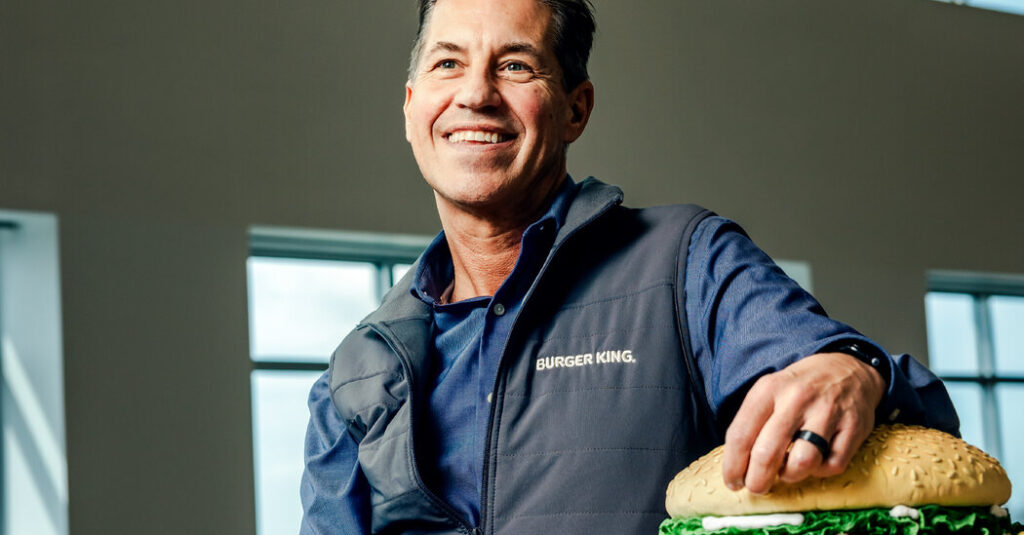
When the Burger King marketing department suggested that Tom Curtis, the company’s president, take a starring role in its latest television commercial, his answer was swift: No.
Despite regularly talking to large groups — employees, restaurant owners, investors — he was “plenty nervous” about appearing on camera and petrified about what social media visibility might mean.
But Mr. Curtis’s chief marketing officer, Joel Yashinsky, insisted. The commercial would launch a big campaign acknowledging that Burger King locations looked shabby and that quality had suffered, but promising better menus and restaurants. The leader of the company should be the face of the turnaround story.
“I said, OK, but I’m not an actor,’” Mr. Curtis, 62, recounted in an interview. “If you’re going to force me to talk to a camera and if it comes off poorly, if it’s not authentic, if it’s not the right level of humility, then you better not put it out there in social media or on TV.”
The 90-second commercial did air on TV — during the Oscars ceremony in March. Clips made the rounds on social media. As part of the campaign, Mr. Curtis shared his cell number so customers could call him directly. In the ad, the brand’s longtime mascot — The King — is kicked to the curb while Mr. Curtis, wearing a name tag, answers calls.
For two weeks, Mr. Curtis spent six hours a day wading through 41,000 voice mail messages. He talked to 1,500 callers, who asked for new French fries and complained about broken store signage. Some read poetry; a few proposed marriage (he’s already married).
The gambit, Mr. Curtis said, appears to be paying off. “A lot of Whoppers are getting sold,” he said, “and I’m walking around with a smile on my face.”
In general, customers would be hard-pressed to identify the chief executives of the brands they bought or used. In the pre-internet era, Dave Thomas of Wendy’s and Frank Perdue were well-known commercial spokesmen for their brands. But today, setting aside the billionaire bosses of tech companies like Elon Musk or Mark Zuckerberg, most corporate leaders tend to stay behind the scenes, recognizable only to analysts and the type of people who frequent the World Economic Forum in Davos. Making themselves known as the face of a brand — especially in the midst of social media unruliness — can feel both burdensome and unnatural.
It can also be risky. For one, chief executives may not be around for long. Consumer companies accounted for nearly a quarter of all chief executive turnover, according to a report released last summer by CristKolder Associates, an executive search firm. Plus, the jokey vibe and irreverence of social media are not necessarily qualities associated with suit-wearing, spreadsheet-loving executives.
But when a company needs to respond to a crisis or pull itself out of a sales slump, billing the chief executive as the face of the brand can be an effective strategy, said Mark Penn, chief executive of Stagwell, a marketing network. It signals to customers that there is a captain of the ship, navigating through challenging times. That was certainly the case with Lee Iacocca, who pulled Chrysler from the depths in the 1980s and became synonymous with the brand’s revival.
“When the C.E.O. is in an ad, it’s really akin to a political ad because political ads always feature the candidate,” said Mr. Penn, who is a longtime senior adviser and pollster to former President Bill Clinton and former Secretary of State Hillary Clinton and helped produce ads that featured chief executives like Bill Gates and Bill Ford. “That means it’s somebody who has to project authenticity, empathy and rationality kind of all at the same time.”
No easy feat. It is a strategy, Mr. Penn said, that should be used “sparingly.”
Flawless Delivery, ‘Meh’ Results
Red Lobster was in the tank. After years of bad moves, the company filed for bankruptcy in 2024 and named Damola Adamolekun, a former head of P.F. Chang’s, as its chief executive. Then 35, Mr. Adamolekun was a charismatic and telegenic messenger for the chain’s comeback publicity tour.
He appeared in television ads wearing an open-collar shirt and a trim-fit suit, promising meals under $20 and decent happy hour prices and reassuring customers that he wouldn’t touch the beloved Cheddar Bay biscuits.
He also showed up on “The Breakfast Club With Charlamagne Tha God,” a radio talk show that is not a typical platform for corporate types. Zingers he made in interviews went viral. On the “Today” show last year, Mr. Adamolekun said the endless-shrimp deal that had contributed to the company’s woes was unlikely to come back “because I know how to do math.”
His presence generated a lot of buzz on social media. However, Mr. Adamolekun’s magnetism hasn’t been enough to fix Red Lobster’s financial struggles. The company has lost money in four of its last five quarters, according to Bloomberg, which also reported that Red Lobster was considering bringing back the endless-shrimp deal.
Mr. Adamolekun, through a spokeswoman, declined an interview request. As for bringing back the shrimp promotion, a Red Lobster spokesperson said the company had nothing to announce but was “paying attention to what our guests are asking for.”
A turnaround requires more than good public relations, said Radhika Papandreou, who is president of North America at Korn Ferry, a consulting firm. “One trustworthy face” is not enough to fix a business if it’s “already broken,” she said.
The Risk of Mockery
Chief executives (and their teams) spend more time these days building a social media presence. But the videos that they post to promote one thing can sometimes end up representing something else entirely.
McDonald’s chief executive, Chris Kempczinski, has been building his Instagram following — now 125,000 — for years. He posts videos in which he gives career advice or eats items from the chain’s global menu. But a recent Instagram reel showed how quickly respect can turn to ridicule.
In the video, Mr. Kempczinski bites into a new burger. “That’s a big bite for a Big Arch,” he says while the camera reveals a discernibly small indentation in the bun.
The video went viral, for all the wrong reasons. People made fun of the tiny bite, suggested that the meat must have been bad and wondered why he referred to the burger as a “product.”
Mr. Kempczinski, through a spokesperson, declined an interview request. But he told The Wall Street Journal, “When you go onto social media in general, you have to have a thick skin.” A McDonald’s spokesperson said early sales of the Big Arch burger were beating expectations.
A Communication Channel
Reddit was in crisis in 2015 when Steve Huffman, one of the site’s co-founders, returned as chief executive after nearly six years away. Trying to get a handle on toxicity that had taken root on the platform, the company introduced a new content policy. Mr. Huffman, then 31, was in charge of getting buy-in from the highly opinionated Redditors. He posted a lot, doing frequent AMA — “ask me anything” — sessions explaining the company’s new direction, as well as engaging in the occasional lighthearted troll.
As the company’s crises subsided, he posted less, “wary of creating issues.” Advisers to chief executives generally agree with this approach, saying that there is a time and a place for deploying top bosses, but that eventually they should retreat.
Over time, Mr. Huffman re-evaluated that conventional wisdom — at least for his company — and started posting more frequently again. “Reddit is a community conversation platform,” he said. “I think by definition, I have to be present on it.”
“The risks are actually a feature,” he added.
Mr. Huffman uses different levels of formality when on Reddit. He’ll fire jokes off from his phone. When responding to Redditors after his company releases its financial earnings, he answers in a room with a team of people and a lawyer, sitting next to him, who approves each response. He is also testing out the possibility of video responses.
Tom Conrad, the chief executive of Sonos, the maker of speakers, also embraced direct communication as part of his strategy. In January 2025, he spent a lot of time responding to unhappy customers after a botched tech rollout. By last fall, Mr. Conrad and his senior leadership felt that they had turned a page.
But he still spends nights and weekends responding to people who post on the social media platform Threads. He’ll ask customers to message him directly so he can pass their issues on to Sonos’s engineering team. He sees his own engagement as a model.
“It keeps us honest about where we are,” Mr. Conrad, 56, said.
Mr. Curtis at Burger King said stepping into the limelight had knock-on effects. For one thing, it shows the level of customer service he expects from employees, including the franchisees.
“If you’re going to expect something of people that are part of your team or connected to your brand, they should see you doing the same thing,” Mr. Curtis said.
Jordyn Holman is a Times business reporter covering management and writing the Corner Office column.
The post C.E.O.s Are the Heads of Companies. Should They Also Be the Face? appeared first on New York Times.