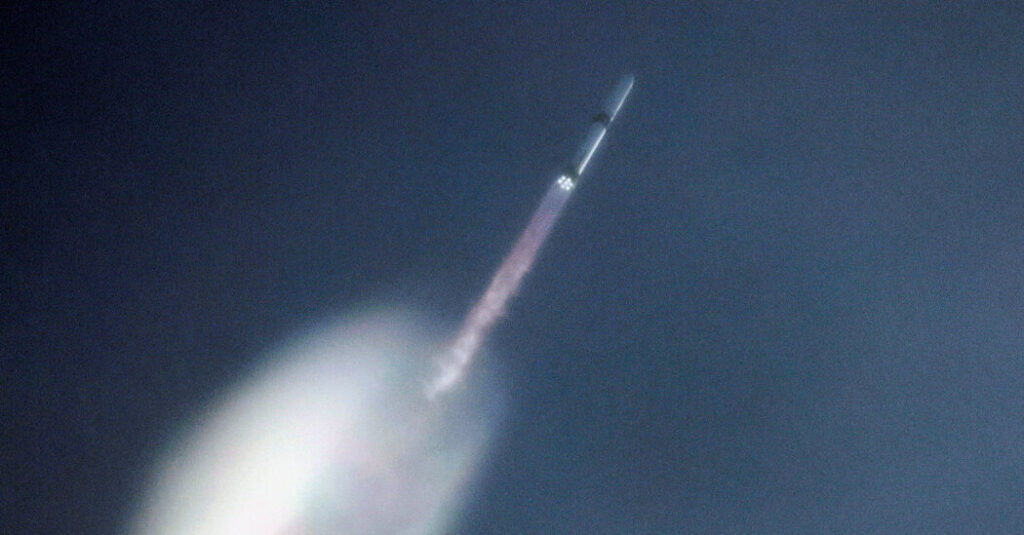
A rocket built by Jeff Bezos’ Blue Origin space company appeared to launch perfectly on Sunday, its booster even landing successfully on a barge in the Atlantic Ocean.
A few hours later, however, it became clear that all had not gone well. The massive New Glenn rocket had failed in its primary task: putting a commercial satellite into the proper orbit.
AST SpaceMobile of Midland, Texas, later confirmed that its mammoth BlueBird 7 communications satellite was doomed after ending up in an orbit “too low to sustain operations.”
This is a setback not only for Blue Origin and AST SpaceMobile, but also possibly NASA. Although the space agency played no role in Sunday’s mission, it is counting on Blue Origin to support the Artemis moon program.
Blue Origin is one of two companies that NASA has hired to provide landers that are to take astronauts from lunar orbit to the surface of the moon as soon as 2028. Since Blue Origin’s lander is to be launched on a New Glenn rocket, any delays with the rocket will throw additional uncertainties into what is already an ambitious schedule.
Blue Origin has started an investigation, with oversight by the Federal Aviation Administration, to figure out what went wrong on Sunday and how to fix the problem. Until that is complete, New Glenn will be grounded, the F.A.A. said.
“It could take them three, four months, or longer,” said Todd Harrison, a senior fellow at the American Enterprise Institute, a Washington-based think tank. “If it goes longer than that, then that’s disappointing, and that starts to impact the Artemis program.”
During Sunday’s launch from the Cape Canaveral Space Force Station in Florida, the countdown proceeded smoothly until it was stopped with less than four minutes left, for reasons Blue Origin has not explained.
The problem was declared resolved, the countdown resumed, and the rocket lifted off into the blue morning sky. After the booster pushed the rocket through the densest part of the atmosphere, it dropped away, headed to a floating platform named Jacklyn, after Mr. Bezos’ mother.
The booster was the same one used during the previous New Glenn launch in November, although all four engines had been replaced. The upper stage of the rocket continued toward space with AST SpaceMobile’s satellite.
Blue Origin ended its webcast of the launch shortly after one of the hosts said that the upper-stage engines had shut down. The upper stage was to fire again 70 minutes after launch for 68 seconds to put Bluebird 7, the satellite, into its final orbit.
During that second maneuver, one of the upper stage’s two engines “didn’t produce sufficient thrust to reach our target orbit,” Dave Limp, the chief executive of Blue Origin, said in a posting on X on Monday afternoon.
Jonathan McDowell, a retired astrophysicist who is an expert in space debris, said the United States Space Force, which tracks tens of thousands of objects in orbit, reported that an object it identified as the satellite dropped out of orbit on Monday.
The Space Force has not identified the New Glenn upper stage, and some experts felt it was possible that it had mixed up the satellite with the stage.
“The upper stage is the big mystery right now,” Dr. McDowell said.
NASA’s goal of having astronauts walk on the moon in less than two years requires that almost everything go right between now and then, with little cushion for mishaps like the one that occurred on Sunday.
The other company building a lunar lander for NASA is Elon Musk’s SpaceX. Its gigantic Starship vehicle is also behind schedule, after several failures last year. SpaceX is aiming to launch an improved version within a month or so.
Next on NASA’s moon schedule is the launch of Artemis III next year. Although the mission is to remain in Earth orbit, it involves a complex choreography of several spacecraft to allow astronauts to practice docking procedures.
Astronauts within the Orion crew capsule — the spacecraft that successfully made an around-the-moon trip during Artemis II this month — are to meet up with the SpaceX and Blue Origin landers, which will be launched separately.
That not only would require three launches in a short period of time, but also precise coordination among NASA, SpaceX and Blue Origin in operating their spacecraft.
“That’s also going to be a demonstration of whether or not we can actually pull off these multiple launch scenarios that we’re betting the farm on,” said Daniel Dumbacher, a Purdue University professor and a former NASA official.
“It’ll be new, and it’ll be the first time you’re doing all that, so that it will have its challenges.”
NASA has yet to name the astronauts assigned to Artemis III, and key details have yet to be nailed down, including the orbit.
“All the options, different altitudes, are being studied right now to see what will work,” Nujoud Merancy, a NASA official in charge of the strategy and architecture office within the mission directorate that runs the Artemis program, said in an interview last month.
Ms. Merancy described putting the Artemis III mission as “the world’s biggest, coolest Lego blocks, all being reassessed.”
If New Glenn remains grounded for months, that reduces the odds that Blue Origin will have its Blue Moon Mark 2 lander ready for Artemis III.
The New Glenn failure also raises doubts about when Blue Origin might be able to launch a smaller lander, called Mark 1. It is supposed to head to the moon this summer to test many of the technologies that will also be used in Mark 2.
If Blue Origin is delayed, NASA could decide to delay Artemis III as well, or it could decide to conduct that mission without Blue Origin. Sunday’s failure means there are a rising number of questions that cannot yet be answered.
“If I’m a year out and I don’t know what my mission profile looks like yet for something I’m doing for the first time, I’m getting nervous really quick,” Mr. Dumbacher said.
Kenneth Chang, a science reporter at The Times, covers NASA and the solar system, and research closer to Earth.
The post Blue Origin’s Failure May Hamstring NASA’s Moon Plans appeared first on New York Times.