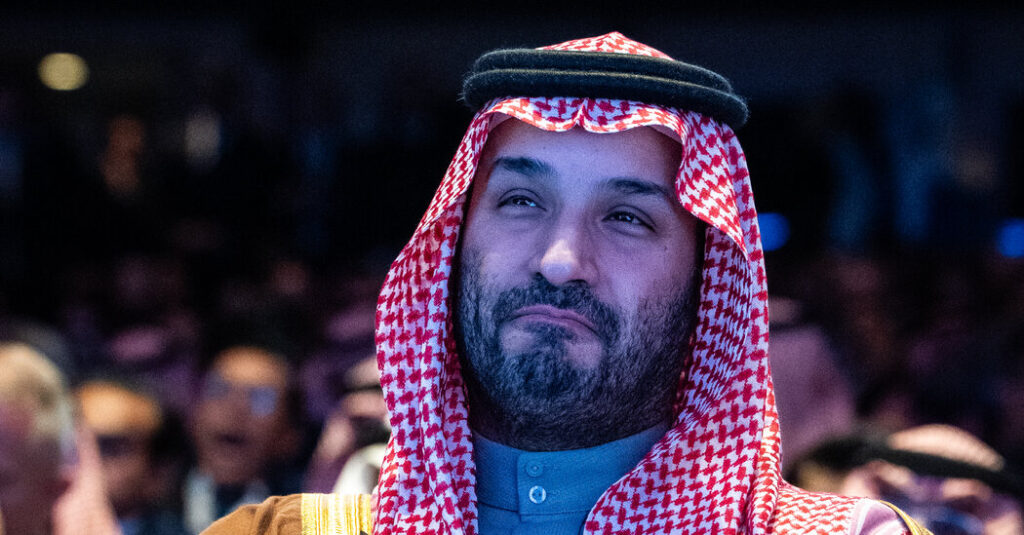
Ten years ago, a 30-year-old prince named Mohammed bin Salman announced sweeping plans to transform Saudi Arabia, declaring that he would end its “addiction” to oil.
A cascade of changes have whirled through the conservative Islamic kingdom since then. Women — once banned from driving — now drive themselves to work as baristas, sales clerks and venture capitalists. Unemployment has declined as Saudis pour into lower-income jobs previously filled by foreigners. And the kingdom’s religious police have all but disappeared.
Saudi Arabia’s dependence on oil, however, has proved more difficult to overcome. When oil prices surged in 2021 and 2022, boosting the government’s income, a flurry of splashy project launches followed: a mountain skiing town, a cube-shaped skyscraper, a breakaway golf league. And when oil prices subsequently fell, straining government finances, officials began searching for savings — canceling, delaying and scaling back plans that turned out to be too grand.
The U.S.-Israeli war with Iran, which stymied oil exports through the Strait of Hormuz and brought a slew of missiles and drone attacks on the kingdom, has not helped.
That is the position in which Prince Mohammed — now 40 and the de facto ruler of Saudi Arabia — has found himself this month, the 10-year anniversary of his program, called “Vision 2030.”
On Thursday, officials announced a new strategy for the country’s roughly $1 trillion sovereign wealth fund, emphasizing that their focus going forward would be “efficiency.” As the fund’s board reviewed initiatives, it asked executives to identify “what’s must-have,” and to set aside or delay “what’s good to have,” said Yasir al-Rumayyan, the fund’s governor.
“There needed to be a reconsideration of the timing of some investments,” Mr. al-Rumayyan said during a news conference in Riyadh, the capital.
Soon after, news emerged that the fund might withdraw financial support from LIV Golf, the upstart golf circuit it began four years ago. The mountain skiing town, called Trojena, and the cube-shaped skyscraper, called the Mukaab, could face similar fates.
In January, the kingdom’s Olympic committee announced that plans to host the 2029 Asian Winter Games in Trojena would be indefinitely delayed, with the games that year instead going to Kazakhstan, where it snows regularly. The same month, Reuters reported that officials had suspended construction of the Mukaab while re-evaluating the project’s feasibility and financing.
“The story always begins and ends with oil,” said Ziad Daoud, the chief emerging markets economist for Bloomberg Economics. “The reduction in oil prices over the last four years until the war made them rethink, because they were overstretching.”
Over the past 10 years, the government has managed to reduce its reliance on oil revenue, finding new sources of funding by introducing taxes and fees. But the prince’s plans and ambitions have grown more rapidly than the state’s financial capacity. The Finance Ministry has recorded a budget deficit in all but one of the past 10 years and expects to continue to do so for several years to come.
The sharp rise in oil prices because of the war has helped Saudi Arabia to roughly break even, despite exporting significantly less oil, Mr. Daoud said. Still, in an interview on Thursday with Al Arabiya, a Saudi news network, Mr. al-Rumayyan said that the war “increases the pressure” to reassess priorities.
“Deals and investments are being reconsidered because of the war and for other reasons, according to their economic feasibility,” he said.
Cloaked in vague corporate language and short on details, the new strategy for the fund nonetheless reflects an important shift in Saudi Arabia’s trajectory under Prince Mohammed.
In his early years, the prince compared himself to technology “disrupters” like Steve Jobs and Mark Zuckerberg, who pledged to “move fast and break things.” He spearheaded a disastrous military intervention in Yemen and oversaw an episode in which the Lebanese prime minister at the time, Saad Hariri, was effectively held hostage in Riyadh and pressured to resign. In 2018, the killing of the Washington Post columnist Jamal Khashoggi by government agents in Istanbul caused a global outcry and briefly made the prince a pariah.
But in recent years, the prince has refashioned himself as a mediator and diplomat, while pulling back on some of the most ostentatious elements of his plans.
“We are determined to achieve and complete our targets,” Prince Mohammed said in September, speaking to the kingdom’s consultative Shura council. “But we also confirm that we will not hesitate to cancel or make radical changes to any program or target if it is clear to us that the public interest requires it.”
To many proponents of the prince’s plans, that pragmatism is welcome news.
“This is very normal,” Ahmed al-Khateeb, a top adviser to the prince and the kingdom’s tourism minister, said in an interview with The New York Times in November. “You stop, you assess what went right, what went wrong, and then you improve.”
At a Riyadh conference in February, Khalid al-Falih, then the country’s investment minister, said scaling back some projects was to be expected.
“Radical, unexpected changes occur in demand, competition or the feasibility of a specific project after detailed studies,” he said. “You are then forced to withdraw that project and put forward another one because every investment entity has limits on available capital.”
But to critics of the prince, the revisions have underscored a painful lack of transparency by the authoritarian government. Some have raised questions about why officials initially announced unrealistic or infeasible plans — and how much money has already been spent on projects that might now be scrapped. In the case of Neom — a science fiction-inspired region planned on the Red Sea coast — entire communities were displaced to make way for construction that might not happen, said Maryam Aldossari, the spokeswoman for a Saudi opposition party in exile.
“Without transparency, ‘reassessment’ is just another word for evasion,” she said. “Who is accountable for the public money wasted, and for the people whose lives were shattered in the process?”
In a state where almost every project and initiative is overseen by one man — Prince Mohammed — the motivations behind direction shifts are not always clear.
Saudi Arabia’s sovereign wealth fund has continued to invest heavily in video games in recent months, even as officials started to talk about the new and more conservative direction. Last September, it announced that it would invest alongside Jared Kushner — President Trump’s son-in-law — in a $55 billion buyout of the video game publisher Electronic Arts. Prince Mohammed is passionate about video games, saying that they help him escape and “disconnect” from reality.
Other key focuses for the kingdom in coming years will be investing in artificial intelligence and delivering on plans to host the World Expo in 2030 and the World Cup in 2034, Mr. al-Rumayyan said during the news conference on Thursday. Those projects were considered “critical” and have therefore been prioritized, he said.
Still, analysts say, if oil revenue surges again, a flurry of new projects could follow.
“Ten years on, economic performance and public spending is still linked to oil,” Mr. Daoud said. “It’s not easy to break the link.”
Vivian Nereim is the lead reporter for The Times covering the countries of the Arabian Peninsula. She is based in Riyadh, Saudi Arabia.
The post A Leaner Saudi Arabia Turns From Grandiose Plans to Pragmatism appeared first on New York Times.