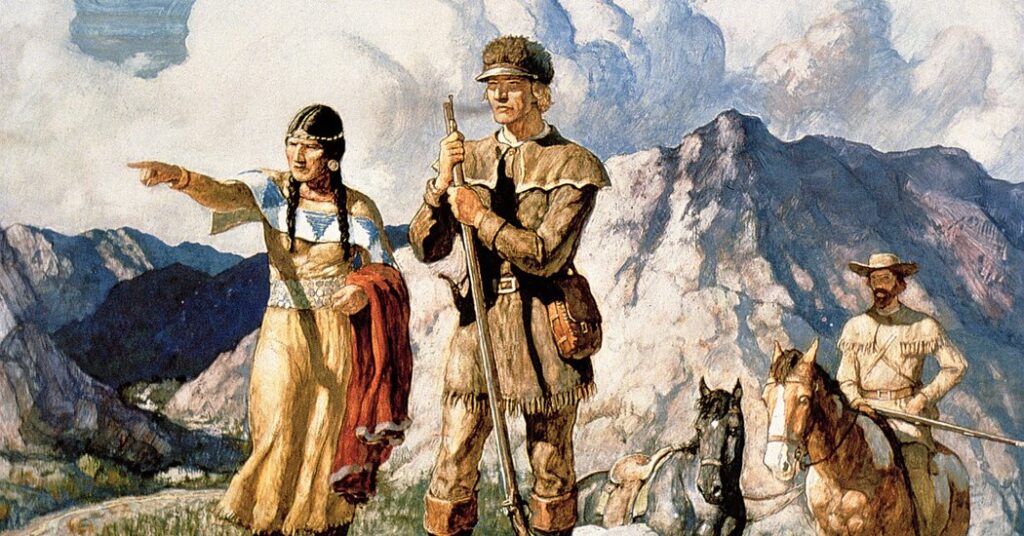
THIS VAST ENTERPRISE: A New History of Lewis & Clark, by Craig Fehrman
Do we really need another book about the Lewis and Clark expedition? Over the past two centuries, hundreds of titles have charted the journey. And yet, after reading “This Vast Enterprise,” by Craig Fehrman, my answer is an emphatic yes.
The author has done a huge amount of research, shifting the focus away from the familiar pairing of Meriwether Lewis and William Clark and widening the lens to include other members of their so-called Corps of Discovery, as well as several Native Americans they encountered along the way. Each chapter unfolds from the viewpoint of a different individual and the result is a richly woven tapestry of voices.
Many readers will know the broad outline of this intrepid 8,000-mile expedition, which was sent west by President Thomas Jefferson to find, in his words, “the most direct and practicable water communication across this continent, for the purposes of commerce.” On May 14, 1804, the group set out from St. Louis, traveling by boat along the Missouri River — against the current — rowing, poling and towing. They crossed the boundless prairie and wintered at Fort Mandan in what is now North Dakota, where they traded with the Mandan and Hidatsa tribes.
In spring 1805 they continued past dramatic cliffs of white sandstone, enduring a harrowing 11-day portage of 18 miles to haul their boats and supplies around a series of five waterfalls. They were attacked by grizzlies, crossed the mighty Rocky Mountains and followed the Columbia River all the way to the Pacific Ocean — and then back again.
Through the perspectives of 10 people, Fehrman reframes this well-known story, revealing it as more complex, and profoundly human. Of course, with five chapters between them, we still get a lot of Lewis and Clark.
Lewis was a perfectionist who spent many weeks designing a foldable iron-frame boat and overseeing just about every detail of the expedition’s preparations. He displayed a remarkable perseverance in the most adverse situation, yet he also struggled with depression, or what was then called “hypochondriac affections.” With a deep love of the natural world, he often preferred to roam alone with his beloved dog Seaman along the shore while the others paddled against the Missouri.
Where Clark reveled in the beauty of the wilderness, Lewis investigated it: “For Clark, it was the sunset that soothed him,” Fehrman writes. “For Lewis, it was studying the sunset.” Clark, friendly and affable, has often been portrayed as a rustic, practical frontiersman. In this telling, though, he is a man driven by a deep curiosity and a talented cartographer who produced remarkably accurate maps. Sifting through Clark’s college journals and a classmate’s memoir, Fehrman explains that he was in fact just as educated as Lewis.
There are two chapters told from the perspective of John Ordway, a reliable working-class sergeant whose steady presence was essential to the expedition. Fehrman takes readers into the raging Missouri alongside Ordway, who stood in the violent current from morning until night, “the towrope scoring a raw line across his shoulder,” he writes. Ordway never grumbled or complained; the closest he came was a simple expression of concern for his men: “We, to be sure, have a hard time of it.”
Another chapter follows Black Buffalo, the “shrewd and ambitious” Lakota leader who controlled much of the trade along much of the Missouri. In September 1804, during the expedition’s first autumn, a tense encounter threatened to erupt into bloodshed, but Black Buffalo persuaded the Lakota to hold back. He calmed the hostilities and urged peace, not out of fear, but because he believed it was in his tribe’s best interests.
The most famous Native American associated with the expedition is Sacajawea, whom Fehrman closely tracks in two illuminating chapters. She emerges as a strong and courageous Shoshone teenager who, despite her tragic past — kidnapped by the Hidatsa at the age of 12 and bought by a brutal French Canadian trader to be his “wife” — exerted agency and played a vital role in the journey’s success.
As Sacajawea traveled with the group from Fort Mandan to the Pacific Ocean (over territory that included Shoshone land) and back, she likely taught the team how to make double-soled moccasins to protect their feet from prickly pears, identified wild vegetables and fruit, explained Native culture, guided them through the mountains and — most important — assisted in negotiations with the Shoshone for the horses they needed to cross the Rockies.
As Clark observed, Sacajawea’s presence “reconciles all the Indians as to our friendly intentions. A woman with a party of men is a token of peace.” Unlike the men, she survived this punishing journey with her newborn son strapped to her back.
Perhaps the most fascinating and surprising tale Fehrman tells is that of York, an enslaved man who had been born on the Clark family plantation in Virginia (before they relocated to Kentucky), and who had no choice in joining the Corps of Discovery. Unlike the other members, he risked his life without the promise of pay or land.
Initially ignored by the rest of the expedition, York gradually proved himself to be indispensable. He was strong, a skilled builder and one of the best swimmers. Soon after the team left their first winter quarters in Camp River Dubois in May 1804, not far from St. Louis, they even gave him a rifle. With time, he began to be recognized as a valued member of the group. In November 1805, for instance, when Lewis and Clark asked their men to vote on where to establish their winter camp along the Columbia River — part of their radical and democratic style of leadership — they turned to York for his opinion.
By the end of the grueling journey, however, everything had changed. As they approached St. Louis again in 1806, York had to return his gun, and Clark made clear that no matter what he had achieved over the past two years and four months, he remained an enslaved man. Clark, who elsewhere comes across as a kind and fair leader, and a person who was genuinely interested in the Native Americans he encountered and their culture, was very different in his relationship with York, refusing to grant York the freedom he could have bought had he been paid like the other men.
By including characters such as York, Black Buffalo and Sacajawea — people who did not leave expansive journals like those of Lewis or Clark — Fehrman has to rely at times on conjecture. This results in a narrative peppered with “perhaps,” “must have” and “surely.”
Occasionally, he pushes this imaginative reconstruction too far. It feels unnecessary, for example, to put into words Sacajawea’s thoughts about her infant son — “Was he eating enough? Growing enough?” — or to speculate that the Blackfoot teenager Wolf Calf rolled his eyes when he heard Lewis recount the expedition at their shared camp near Two Medicine River in July 1806.
Yet if these minor reservations are the price of a fuller, more multifaceted story, it is, I think, worth paying. “This Vast Enterprise” is a page-turner and a fantastic achievement.
THIS VAST ENTERPRISE: A New History of Lewis & Clark | By Craig Fehrman | Avid Reader Press | 515 pp. | $35
The post Who Really Wore the Pants on the Lewis and Clark Expedition? appeared first on New York Times.