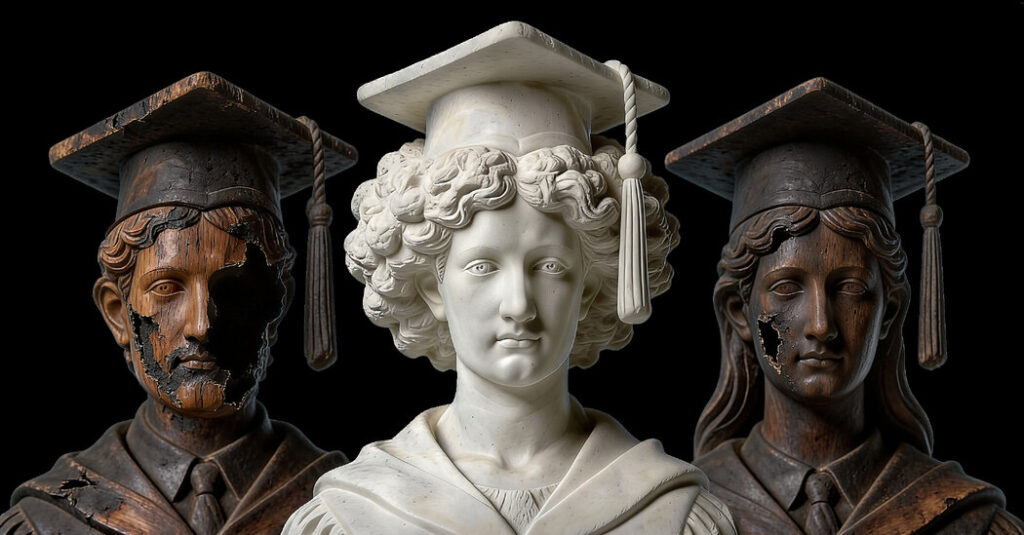
To the graduates of the Class of 2026, recent graduates and those who love you:
Congratulations and I’m sorry. You’re graduating into a job market unlike any we’ve known. The messages you’re getting about work are overwhelmingly negative. Our task, at this festive but fraught time, is to figure out how you should respond.
We raised you to scale the twin peaks of Mount College — getting in, covering the costs. Now you’re being warned that your degrees may not lead to opportunity. Or even stability.
Prognosticators say entry-level jobs will be vaporized by artificial intelligence. Economists express alarm at the rising share of the unemployed who hold college degrees. On the left, labor activists warn of exploitation. On the right, traditionalists urge women to stay home and reproduce. Both sides agree: Don’t expect work to be a source of fulfillment.
Family members hover close, reading the grim reports, texting well-meaning suggestions. Friends anxiety-bond. “Doomers” say that careers don’t matter because we’re all headed for collapse. Cynics advise just making as much money as quickly as possible. The process of looking for a job, never easy, has turned digital and much lonelier. Interviews are sometimes conducted by A.I. programs that pose questions, record video answers, then insta-score the results.
Last year at Columbia, my alma mater, students asked me to give the undergraduate commencement address and tell them: How, in this crazy environment, are we supposed to find and start our life’s work?
The question gripped me. I’ve written about employment for many years, and now my college-age daughter and her friends face the same question. I gave the speech but couldn’t stop there.
I am not a professional career counselor. Nor a labor economist. I’m an investigative reporter, a specialist in secrets, currently focused on the locked box of the United States Supreme Court. Nevertheless, I found myself rising every day at dawn, before my own workday began, to generate a book. It is a letter from an older ally who has seen a great deal, and the beginnings of an escape plan from the gloomy outcomes others may tell you are inevitable.
They are not inevitable. Robot interviews, threats to entry-level work, dystopian management schemes and intimidating housing prices are all real. But they do not come even close to representing the entire truth. I have documented some of the worst of the workplace (along with my colleague Meghan Twohey, I broke the Harvey Weinstein story in 2017), and still I am telling you: Do not give up on it.
Work is how we spend many of our minutes and hours. Perhaps you’ve met people who live happy, fulfilled lives despite being miserable at work. I have not.
I want you to have every good thing that work can bring: satisfaction, fellowship, pay.
But our stake in work is also collective.
Despite everything, work is our engine of progress. Cancer therapies, new commercial aircraft, winning political campaigns and every television show you’ve ever enjoyed were all made by groups of former strangers who labored together in shared discovery, discipline and purpose. To declare defeat on work is to surrender possibility itself — for yourself, for everyone.
Welcome to my alternate career counseling office. Sit down. Exhale. In here, we are fighting for a working life that means something. Our goal is to both protect you and propel you forward. We’re not going to let your life be directed by hollow conventional wisdom or — God forbid — robots that are not actually thinking at all. We’re establishing your life’s work as truly yours, sustaining you and others.
None of us can say what the workplace will look like in 10 or 20 years, so we are going to work with durable, time-tested materials that have the strongest chance of withstanding whatever comes next. In particular, I want you to harness two forces that power the best careers: craft and need.
How to Find a Craft
It took me many years of working life, of seeing others rise and fall in their careers, to grasp something fundamental: Most successful, fulfilled people practice a special thing they know how to do that other people do not. This is craft.
Craft guides the hand of the surgeon restoring an accident victim’s body. It’s how a composer or trial attorney holds attention for hours at a time. It’s why restaurant meals cooked by experts taste so good, and also why the best-written home recipes turn out beautifully in amateur hands. When science experiments and brand campaigns are well crafted, investment becomes more secure and likely to pay off. Craft protects us: Firefighters and psychologists rely on strict rules and knowledge passed through generations to keep us safe and lead us from devastation to repair.
When we hone our crafts, we build up protection against being regarded as disposable or interchangeable. Any employer can eliminate any job at any time. But your craft is truly yours and cannot be taken away. Maybe A.I. will turn out to be a revolution; maybe it’s a red herring; maybe it will land in between. But if you master a craft, you’ll be able to command new technologies instead of becoming a supplicant to them.
As you’re starting out, the point is not to already possess a craft; it’s to find a road to mastering one.
My own road to journalism was messy. During my senior year at Columbia, I was fired from the student newspaper.
Drawn to the mission and rigor of being a lawyer, I went to law school. Though I liked my classes and professors, legal tasks left me feeling deadened. Instead of reading cases, I found myself looking up how my favorite journalists had started their careers. I paged through a brick of a book, hundreds of pages long, listing summer jobs for first-year law students. I did not want a single one. One night at 3 a.m. during that first semester, the prospect of an unhappy life in law forced me to admit something scary. I wanted to be a journalist. I yearned for it, badly.
I dropped out of law school. Like being fired from the paper, this was mortifying, including to my parents.
But that was the moment I became the author of my own life.
And I learned to think about a career not in years or decades but minutes and hours. At 11:30 a.m. on a Thursday, do you usually feel connected to the task before you? In a fulfilling working life, the ratio of satisfying tasks to annoying ones is favorable, and all those actions add up to the performance of a craft.
College can be a surprisingly tough place to find your craft. Universities are places of hushed scholarship and secluded reading rooms. Careers are made from stimulation. Very few people meet their destinies by sitting in pretty book-lined rooms and marinating in their own aspiration and fear.
If you’re sweating about what field to enter, here are a few things you can do now. Buy a cheap, thin notebook. Keep it on you. Every week, make a practice of writing down which actions you enjoy and which ones you hate, whom you like being around and whom you can’t stand. Keep running lists of what you’re good at and what ideas move you. Notice yourself.
Your parents may be heavily invested in your career decisions. With high tuition and alarming news about entry-level jobs, it’s hard to blame them. But you need to live your life, not theirs.
Look to your friends instead. Think about what roles you take on with them: math tutor, party planner, psychologist, workout coach. These answers often reveal truths that our résumés do not. In social relationships, we aren’t bound by suffocating expectations about our future. Our friends have needs, and by noticing how we respond to them, we can learn who we are.
A Wiser Way to Seize the Future
A few times a week at my high school in exurban New Jersey, televisions were rolled into classrooms, beaming in faraway teachers through a balky, pre-Internet remote learning system. The reason, we were told, was that Japan was going to take over. Its economy would boom while ours would falter. Like teenagers all over the United States, students at Holmdel High were advised to master Japanese.
Every generation gets a version of “learn Japanese.” Here’s the path for winners. Don’t get left behind. Hurry up and learn genetics. No, computer science. Study Mandarin. Forget humanities. One word: plastics. The advice seems even louder today, and a lot of it is phrased in the negative. Don’t go into public service, you’ll get death threats. Medicine leads to burnout. Academia — now? Really?
This is savvy-sounding counsel that can crush magic, extinguish meaning and lead people to empty assignments at companies they hate. Follow it to the end and we’ll have no public servants, doctors or professors. Also: After my classmates and I graduated from high school, the Japanese stock market slumped and did not recover for 30 years.
There is a wiser way to seize the future, which is to think about need. What is your own assessment of what society will need most during your working years, the next four or five decades? What kind of care; what kind of products; what kind of information?
The people I see thriving at work are the ones who chased some bigger need — not imposed by hollow conventional wisdom, but articulated through independent observation. Craft gives their work authority. Need gives it propulsion.
Preparing the Columbia speech, I met a senior named Xxaria Makely, from an economically depressed town in upstate New York. Her mother waited tables for years, then trained as a medical technician.
Xxaria had a fierce desire to become a clinical psychologist. But a few months before graduation, the Columbia psych lab where she had lined up a work-study job said it would not be able to pay her because of budget cuts and a hiring freeze. She pushed onward, working at the lab without pay to gain experience. At night, she bartended to make up the difference.
She wanted to stay in the city after graduation and continue to do research, the entry ticket to ferociously competitive Ph.D. programs. But looking for a job was like launching paper airplanes at a brick wall. She had sent out dozens of résumés and gotten zero response. She figured she had to return home and scale back her ambitions.
“You go to Columbia, you think you’re on a path up and out,” she told me. “Maybe I just have to accept that I’m going right back to the world I came from.”
Xxaria did move home after graduation. She took a job as support staff at a halfway house. But in her off time, she applied for every research position she could. A project in the Bronx made her an offer that never fully materialized. She was offered a position at a psychiatric treatment program that she admired, but it did not involve research. She deliberated hard, then turned it down.
There was a reason Xxaria was so driven to pursue research. When she was 11 years old, her beloved older brother Keith died of an overdose. Now she was on a quest to understand how addiction treatment could become more effective.
She interviewed for a position at a Boston hospital working on a study about whether giving minors opioids for post-surgical pain relief raised their long-term risk of addiction. A few days later she got an email from the hospital with a bunch of information including parking instructions. Parking instructions? Could that mean….
Xxaria got the position, her first confirmation from the world of psychology that her ideas, labor and drive were welcome. The need she had identified was real. It had pulled her through.
Esther Perel, the psychologist, recently remarked to me that careers are like romantic relationships: To thrive, they need stability and safety on the one hand, and risk and freedom on the other. In this tumultuous environment, with soaring housing prices, many young people are running toward stability — especially if, like Xxaria, they don’t have a financial cushion. They face tremendous pressure to take the first thing available, the highest possible salary, the “safest” choice.
But careers rarely go anywhere interesting without risk. Turning down the perfectly good job at the psychiatric treatment program looked questionable for Xxaria. It was also her best move.
Now Xxaria is really on her way, because the craft she is learning in her new job will change and refine her assessment of that need. To meet that evolving vision, she will pursue higher forms of craft — more skill, new tools. Fresh needs will emerge, but the richness and strength of her craft will help her address the unexpected, and on and on, in a decades-long cycle of forward motion.
Do Not Give Up Before You Start
This graduation season, you’re likely to hear more bad news and alarm. Amid it all, here’s what I don’t want you to miss.
Technological advances are sending your generation a message: You’re not needed. That’s degrading. It’s also false.
Even if A.I. can do some of the work of a paralegal or a junior analyst, the future still rests on your talent, hard work and ideas. Workplaces must be continually refreshed with youthful energy and talent, or they decline. Everyone knows this.
The world does need you, in other words, and you must never doubt that.
You do not have to figure this out alone. A word to alumni, older adults, and especially anyone who has achieved a measure of success, authority or power: Together we must reestablish the idea that older people are advocates and protectors for those beginning their careers. In an era when young people are being treated like meatware in an anonymous employment algorithm, we need to bring them all the wisdom, encouragement and connections we can.
Graduates and young people: Do not give up before you even start. Frustration and disappointment are certain. Failure is possible. But if you abdicate the search for satisfaction now, you will put it further out of reach. Resist the urge to arm yourself with uninformed cynicism masking as oh-so-wise pragmatism that’s really just good old fear of rejection.
We do not yet know what the world will offer you. Please: Go find out. For your own sake, and for ours, too.
Jodi Kantor is an investigative reporter currently focused on the Supreme Court. Her work has spurred cultural and legal shifts in the United States and across the globe.
The post This Is a Hard Time to Start a Career. These Two Words Can Help. appeared first on New York Times.