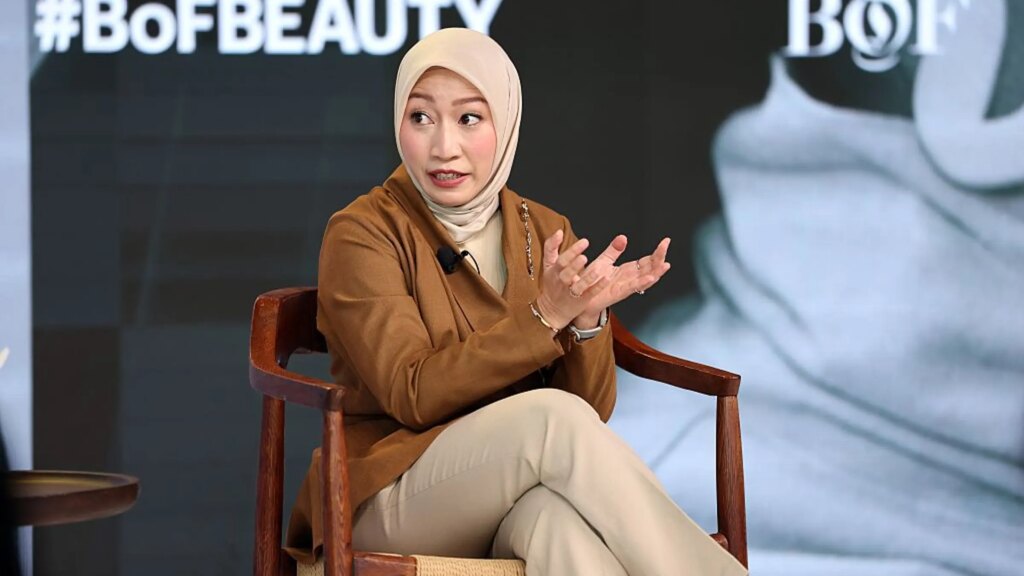
Back in 1985, Dr. Sari Chairunnisa’s family were facing tough times. Indonesia’s oil export-reliant economy was reeling from the collapse of crude prices, sending shockwaves through every industry. To make ends meet, Sari’s mother, Nurhayati Subakat, decided to set up a family business from her Jakarta home.
For years, Nurhayati had worked for Wella, the German haircare company, where she acquired the contacts and know-how to produce cosmetics tailored for Southeast Asia’s most populous nation. At the outset, the business had only five staff—all family—and the first outside employee was a neighbor.
But from these humble beginnings was spawned Paragon Corp, Indonesia’s largest cosmetics firm, which today boasts 15,000 employees and a quarter of a domestic beauty market worth $7.4 billion in 2024. It is one of the world’s foremost pioneers of “halal beauty”—products that conform with an Islamic interpretation of ethically sound production and business practices.
“Before, U.S. and European brands were the leaders in the Indonesian market,” says Sari, a dermatologist who today serves as Paragon’s deputy CEO. “But then Indonesian women start to realize, ‘OK, we have a different definition of beauty.’”
As Paragon enters its 41st year, the firm continues to push boundaries. The company received the 2024 Deloitte Award as one of Indonesia’s Best Managed Companies and is expanding its range of 14 halal beauty brands into the Middle East, with eyes on eventually breaching Europe and the Americas. A study by Grandview Research found that the global halal cosmetics market was expected to exceed $50 billion in 2025.
TIME spoke with Sari about Paragon’s journey and redefining what halal beauty means for a global marketplace.
(This interview has been condensed and edited for clarity.)
How has Paragon changed over the last four decades?
It’s been a transformation. In 1985, we started on a small scale and then after 10 years we began to manufacture from a proper factory. And then in 1998 Indonesia had an economic crisis. At that time, Paragon was mostly doing OEM [original equipment manufacturer] business. We also served some big supermarket brands. And then we entered the third phase where our own brands were increasing a lot, because of good timing, good products, right message, and new behavior in Indonesia. So it’s been a very interesting journey.
How would you explain halal beauty to someone who isn’t familiar with the concept?
We understand when you first hear “halal” it sounds very like a religious concept. But we believe this is actually a universal value. Today, people are familiar with ikigai—[Japan’s concept of “reason for being”]—but maybe 40 years ago it’s very Japanese-rooted. So, halal is not just a list of compliance of raw material sources; it is about ethical beauty or an ethical way of making a product. So if I make a product and put in 1% vitamin C but write 10% on the label, that is not halal. If I do unethical sourcing, child labor, [excessive] water consumption, or carbon emissions, environmental impact, then it’s not halal. Because in Muslim [culture] it’s common to say that your job should be halal. It’s not talking about policy; it’s talking about corruption and ethical ways of working.
That definition also means there’s some degree of interpretation. There’s some debate about how much alcohol that can be permitted for cosmetics still to be halal. What is Paragon’s take on that?
So for the halal certification from Indonesia halal council, we can have ethanol. It is not a matter of concentration, but it’s a matter of the source. The manufacture of ethanol with the same usage for beauty as for alcohol drinks is not allowed. Actually, for Southeast Asian halal, compared to other countries, like the Middle East certification, there is only one difference. In the Middle East, we are not allowed to use a pigment sourced from an insect. So they are stricter.
Do you want your products to be seen primarily as halal, or do you want them to be seen as ethical to have wider appeal?
For us, a global brand or a global product should be customized for what the consumer wants in that region. So if in that region maybe ethical beauty is more resonant, we will talk about ethical beauty. But in another region, maybe its halal beauty. In the end, beauty is about being represented; you want to see yourself in that product and that brand. You want that brand to speak to you.
Is it difficult to explain the halal concept to suppliers to ensure that everything you source for your products meets that criteria?
It’s difficult. It’s been a journey of many years, going to headquarters in Paris, in London, and then in the raw material exhibitions, explaining about halal. We also train them in our office. So yeah, it’s been a hard time, but right now, I think we can create a halal supply chain that also can be used by other beauty companies.
Is there a price premium on halal? Is it more expensive to source halal materials than for a commercial company to make a comparative product?
The cost is actually not really high. Let’s say that the process is a fermentation process. Then you must know the source of the enzyme. You have to know the source of the culture medium. But others, like powder or mica, are not critical. So the price is not high. That is how we convince our raw material suppliers; we say that this does not need a very big investment—you just have to be more conscious or more aware of the process, how you produce, and how you develop your raw materials.
Do you fear that marketing your product as halal in a Western consumer market may be seen as exclusionary and put people off because they think that is just something for Muslims?
Yes, we fully understand that this will raise some questions or some rejection. So when we enter a new region we do a proper consumer study. We will do it by ourselves but also with a third party: If people hear halal, what is actually their first reaction or their first question?
Some of your products are very popular with Indonesian men. Has that surprised you?
It surprised us, because we launched our male grooming brand [Kahf] in the pandemic era, like October 2020. And secondly, Indonesia was in minus growth. So everybody was texting me like, “Are you crazy? Why are you launching a male grooming brand in a pandemic when men don’t go to the office.” But we believe that there was a gap for male products—what is masculine, or how men see themselves—that was not represented yet by a brand before Kahf. And the results are good. That is why I think beauty is basically about brands catering to the consumer, and then they feel represented.
I understand that Paragon is concentrating more on exporting your products. Is that mainly to the Middle East or potentially to Western countries as well?
Of course, 40 years ahead we want to see our products in more countries, more regions. For the Middle East, first we see geographically—it’s nearer to Africa, Europe, compared to other regions. Secondly, regulation in the Middle East is similar between the E.U. and Indonesia, so it’s easier for us also. And we are also optimistic that the Middle East region is very familiar with the halal concept. So that’s why the Middle East region is one of our next focuses.
Is the Middle East where you see the biggest growth?
If we are talking about the beauty market, we are talking about the youth population, so we believe that the Middle East region will be an interesting region. Because talking about beauty, people think about Korea, Japan, U.S., Paris, U.K. But I think the Middle East region has a growing population and economically it is growing. They are starting to open for a new world, and beauty is already there, they have a culture of grooming rituals.
Will you aim to reach Europe and the U.S. at some point?
Right now, our products are present only in Southeast Asia, but there are many Muslim students at universities in Europe and the U.S. who bring back our [flagship] Wardah products. And we also support some events in the U.S, such as [last year’s] Harvard Asia Business Conference. And we receive good reviews. One of our sunscreens has also been reviewed by U.S influencers. So we are very happy and quite optimistic for global expansion. We have also received 11 awards for our product innovation.
The world seems to be experiencing rising Islamophobia. Do you think that halal products can help break down boundaries and show people that Muslim culture is interested in beauty, modern, and progressive?
Yes, because when we can communicate and see halal as a universal value, which is actually relevant in the modern world, modern work life, in house setting, then maybe people will see other Islamic worlds differently—and be more open.
How are you utilizing AI in your product design and research?
We use AI in R&D because it helps us to reduce the number of trials. Before everything depended on the scientist’s memory or books, but right now we put in all the data and then AI helps us more effectively trial. We also use AI when we do packaging design in-house and for producing some content.
I understand that you’re embracing e-commerce platforms such as TikTok to market your products. Why is that?
In Indonesia, e-commerce was growing before the pandemic but got bigger, of course, in the pandemic era. And then I think it grew more when they introduced the livestreaming concept. It’s interactive so you can see the product used by an actress, then you can ask questions, they can answer. So it’s all about consumer experience. Live streaming technology in e-commerce makes people more excited, [it’s more relatable] also, that’s why it helps to grow the beauty industry.
To receive weekly emails of conversations with the world’s top CEOs and decisionmakers, click here.
The post This Halal Beauty Company Boss Has Big Ambitions appeared first on TIME.