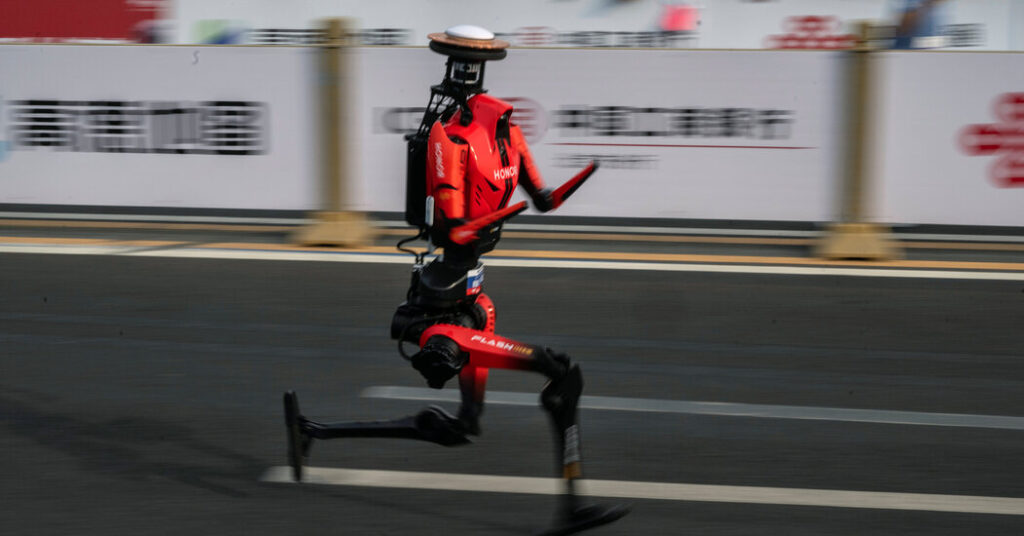
It didn’t have to carbo-load, get a good night’s rest or lace up running shoes.
Instead, the toughest challenge for the bright-red humanoid robot named Lightning was avoiding a collision with the more than 300 other robots running in a half-marathon race on Sunday in Beijing.
While the approximately 5-foot-5 Lightning crashed into a barricade and fell during its final stretch, it was able to pick itself back up with help from humans, swing its short forearms to rebalance, and stride across the finish line in 50 minutes, 26 seconds, according to the state-run China Daily.
Lightning’s time was faster than the human world-record holder, Jacob Kiplimo of Uganda, who finished a half-marathon in 57 minutes, 20 seconds last month in Lisbon.
It was also faster than the 12,000 humans running the race in a separate, parallel lane. The men’s and women’s winners needed more than an hour to complete the outdoor course.
Lightning was designed by the Chinese smartphone brand Honor, and is based on elite human athletes, with legs that are about three feet long.
Lighting’s joints are equipped with a liquid-cooling system adapted from consumer electronics, like smartphones, one of Honor’s engineers told state media.
In this year’s race, many of the robots, like Lightning, ran autonomously, though slightly more than half were operated by remote control.
In the inaugural race last year, the top robot took nearly three times as long as Lightning, finishing in 2 hours, 40 minutes and 42 seconds, according to the state-run Global Times.
While the robots were faster and more autonomous this year, Alan Fern, a robotics professor at Oregon State University, said the results said more about the state of robot hardware manufacturing in China than about any major scientific breakthrough.
“What appears to have changed this year is that some of China’s many humanoid companies have invested the engineering effort needed to make these systems robust enough for a long-duration race,” he said on Sunday. “That is genuinely impressive.”
While it’s not evidence of a major advancement in artificial intelligence, he said it reflected the robust robotics manufacturing ecosystem in China. The United States has far fewer humanoid companies and very few operating at a large manufacturing scale, he said.
At the same time, China has been pushing to make rapid advancements in robotics, propelled by government directives and significant investments.
There are already more robots at work in China than the rest of the world combined, according to the International Federation of Robotics, a nonprofit trade group for makers of industrial robots.
Last year, Beijing hosted the world’s first Humanoid Robot Games, which featured running, kickboxing and soccer. The competition showcased many advancements and featured plenty of running, kicking and punching.
But the robots also flailed around, crashed and fell over many times.
The city of Beijing called Sunday’s race “a major step forward for the robotics industry — accelerating the transition of humanoid robots from lab to large-scale, real-world application.”
But Professor Fern said he was not sure about the practical application of a robot marathoner.
“A robot winning a half-marathon may attract attention and impress a few investors, but the harder question is how that capability translates into productivity and, ultimately, profitability,” he said. “That is much less obvious.”
Adeel Hassan, a New York-based reporter for The Times, covers breaking news and other topics.
The post It Was No Sweat: A Humanoid Robot Races to a Record Finish appeared first on New York Times.