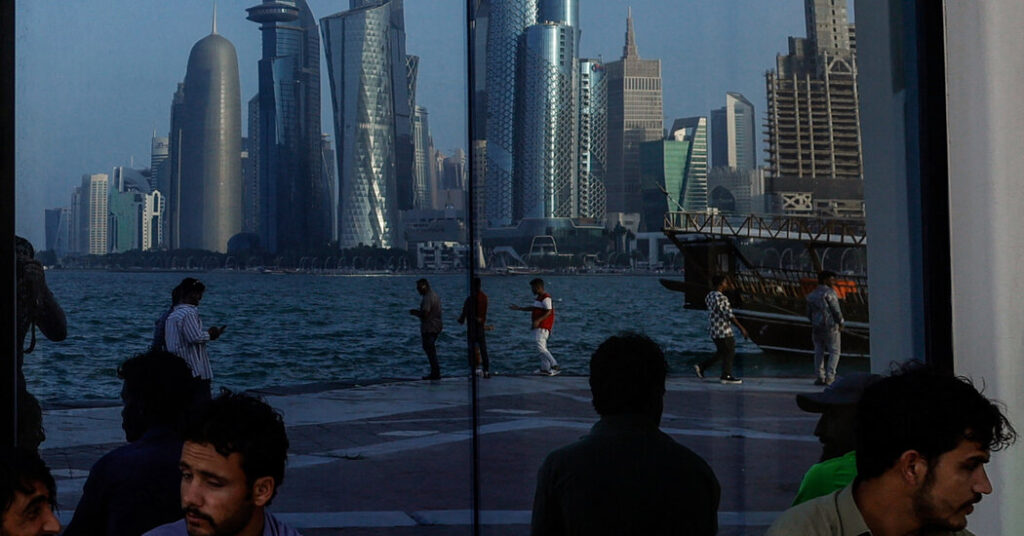
To grasp the global collateral damage from the U.S.-Israeli war with Iran, consider the Persian Gulf nation of Qatar.
A close U.S. ally and longtime mediator between Washington and Tehran, Qatar’s government sought to avert the war. When that failed, Qatari officials warned of the dangers of a prolonged conflict.
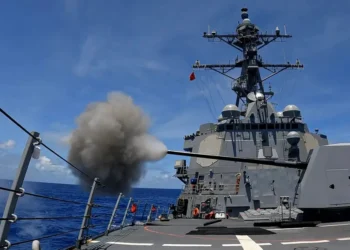
Resource-rich Qatar nonetheless faced more than 700 Iranian missile and drone attacks, which have targeted Gulf countries that host American military bases. These attacks forced Qatar to suspend natural gas production, which generates its vast wealth and normally accounts for a fifth of the global supply.
It was one of a number of disruptions caused by the war that sent economic shock waves around the world.
A fragile cease-fire announced on April 7 suspended U.S. and Israeli attacks on Iran and Iran’s retaliation against Israel and the Gulf Arab states. Yet, even if the truce holds, the war has struck at the heart of Qatar’s interests, upending the economy and shaking the nation’s reputation as a haven for business.
As it takes stock, the Qatari government will be forced to swallow a bitter pill, analysts say: Neither its strong ties with the United States nor its cordial relationship with Iran have spared it from pain.
Qatar’s case reflects the thorny position that Gulf countries have found themselves in during the war. Trapped between their chief ally and their neighbor, they are now forced to rethink their security strategies.
The war has caused a state of “strategic shock” for Qatar and its neighbors, said Rashid Al-Mohanadi, the vice president of the Center for International Policy Research, a think tank in Qatar.
“There was an assumption that such a big move in the region, like starting a war with Iran, would at least happen in consultation with the Gulf,” he said. “We thought we had a better working relationship with the United States.”
At the same time, he added, “the level of Iranian aggression on our capitals and on our cities and on our infrastructure has been just crazy.”
While many Gulf Arab countries have historically had an antagonistic relationship with Iran, Qatar — along with Saudi Arabia and the United Arab Emirates — has invested considerable political capital in building warmer ties in recent years. Many Gulf officials saw this as the most pragmatic way to contain the threat posed by Iran.
Now, all of these countries are re-evaluating their approaches to Iran.
Qatar, a peninsula roughly the size of Connecticut, has fewer than 400,000 citizens and is dwarfed by regional powers on either side: Iran across the gulf, and Saudi Arabia on its western border. The perils of being a small state in a turbulent region have shaped its political trajectory for decades.
Seeking to protect the nation, Qatar’s royal family leaned on its relationship with the United States, which has a major air base in Qatar and had pledged to defend the country. Qatari officials have also tried to make their country indispensable to the world’s economy and to global diplomacy, serving as a mediator with difficult parties like Iran, Russia and the Palestinian militant group Hamas in Gaza.
In recent years, the government sought to cultivate close ties with President Trump, donating a Boeing 747 jetliner to him. A Qatari government-owned real estate firm sealed a deal last year with Mr. Trump’s family business, the Trump Organization, to construct a Trump-branded golf course in Qatar.
And when Mr. Trump visited Qatar last May, he signed an agreement with officials there “to generate an economic exchange worth at least $1.2 trillion,” the White House announced.
Despite all of that, Qatar was able to exert little control over a war that directly involved it.
The uncomfortable realization that Israel appears to have more influence over Mr. Trump’s decisions than Gulf leaders do has reverberated through Gulf royal courts, analysts said.
“This is a very eye-opening moment for the Gulf states,” said Sinem Cengiz, a researcher at the Gulf Studies Center in Qatar University. “There is going to be a very, very significant rethinking.”
There are hard limits to how far that rethinking can go, however, because most Gulf countries have no viable alternative to U.S. protection.
“They’re just dependent, and there’s not much they can do,” said Dina Esfandiary, the Middle East geoeconomics lead for Bloomberg Economics. “It was also a bit of a slap across the face that they thought they had this sway, particularly over the Trump administration, and then clearly it was secondary to Israel’s sway.”
The war’s human toll in Qatar has been mitigated by air-defense systems that intercepted most attacks.
Qatari authorities have reported no civilian deaths.
Still, the effect has been palpable. Tourism withered. Qatar Airways planes that once crisscrossed the globe, stopping off in the capital, Doha, were grounded. Many foreign residents with the means to do so left.
Qatar’s all-important energy sector has been hit by the worst shocks.
The state-owned QatarEnergy shut down liquefied natural gas production at its main site, Ras Laffan, early in the war. The company was unable to safely export gas through the Strait of Hormuz — the only waterway through which its gas reaches global markets.
In mid-March, Iranian attacks hit Ras Laffan directly, inflicting extensive damage. Qatar’s energy minister, Saad al-Kaabi, announced that it could take up to five years to repair, and estimated that the annual loss in revenue for Qatar would be about $20 billion, equivalent to 37 percent of the total government revenue Qatar expected to bring in this year.
“This has taken the whole region back 10 to 20 years,” Mr. al-Kaabi told Reuters in an interview soon after the attacks.
The ramifications have spread far beyond the Middle East, threatening energy supplies in places as far-flung as Italy and Japan. Qatar also produces more than a third of the world’s helium, a gas needed to operate M.R.I. machines and manufacture computer chips.
Qatar itself should be able to cope with the budget hit, said Farouk Soussa, an economist who monitors the Middle East for Goldman Sachs.
“The good news is that the Qataris have deep pockets,” he said. Less certain is what the consequences will be for its model as a hub for foreign workers, investors and tourists.
“Probably the idea that confidence is lost forever and nobody is coming back is going too far,” Mr. Soussa said. “It will depend on what the postwar regional order looks like.”
Adam Rasgon and Rawan Sheikh Ahmad contributed reporting.
Vivian Nereim is the lead reporter for The Times covering the countries of the Arabian Peninsula. She is based in Riyadh, Saudi Arabia.
The post In Qatar, Trapped Between the U.S. and Iran, War Forced a Reckoning appeared first on New York Times.