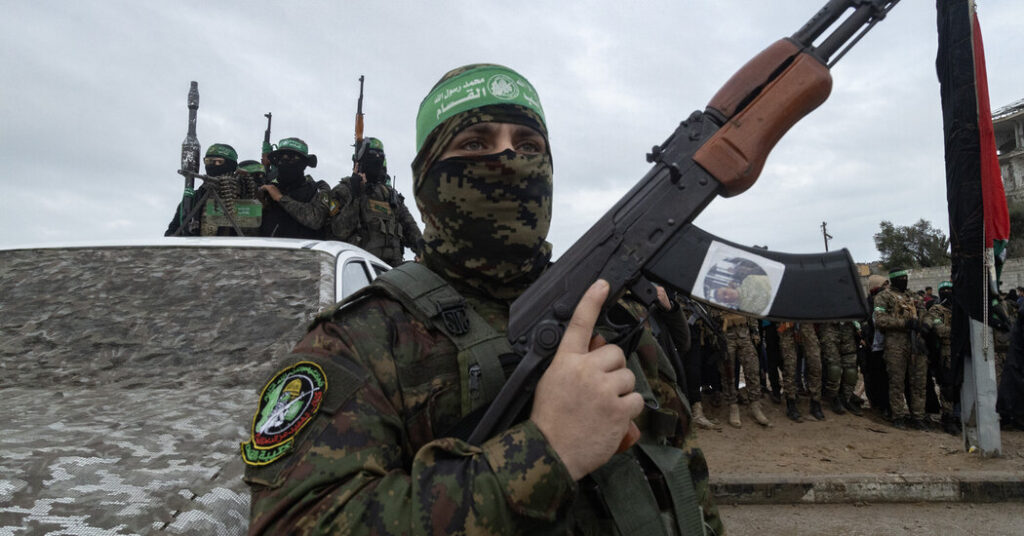
Hamas is ready to relinquish thousands of automatic rifles and other weapons belonging to its police force and other internal security services in Gaza, according to two officials of the group.
Such a step would be a remarkable concession from Hamas, which until now has publicly resisted giving up any of its arms.
The officials said Hamas would be willing to turn over these weapons to the Palestinian administrative committee that has been set up to govern Gaza by the Board of Peace, the international organization led by President Trump to oversee the cease-fire.
Hamas has said previously it is willing to turn over the burden of providing public services in Gaza to the U.S.-backed committee. But the group has not disbanded its battalions of armed fighters, suggesting it wants to maintain influence in the territory despite Israeli and American opposition.
The proposal from the two officials falls well short of the full disarmament and demilitarization of Gaza — a core demand by Israel and a pillar of Mr. Trump’s peace plan for the territory. That plan would also remove Hamas from power and bar it from any role in governing.
Asked whether the committee would also be able to confiscate weapons belonging to Hamas’s military wing, the two officials did not provide a clear answer.
Experts estimate that Hamas’s military wing has many more weapons than its police force, including tens of thousands of automatic rifles and heavier weapons like anti-tank rockets. And it has resisted demands for full demilitarization of Gaza.
The two Gaza-based officials from Hamas’s political leadership, who responded in writing to questions from The New York Times, both spoke on condition of anonymity to discuss a sensitive issue. Their comments came as Hamas and Board of Peace officials were negotiating this past week in Cairo.
Since the Hamas-led attack on Israel on Oct. 7, 2023, which ignited the war in Gaza, Hamas officials in Gaza have rarely spoken to the international media, in part out of concern that Israel could intercept communications and use that information to locate and target them.
Instead, Hamas leaders in Qatar, Turkey and Lebanon have generally spoken for the group. Even so, the Gaza-based leaders are powerful voices within the group in decision-making on a permanent cease-fire or Hamas’s future role in the territory.
The Board of Peace has demanded that Hamas give up all of its weapons in exchange for a withdrawal of Israeli troops from Gaza and the reconstruction of vast areas destroyed in the war.
Armed struggle against Israel has long been central to Hamas’s ideology and a means to stay in power. Many members view any deal in which they would give up their weapons as tantamount to surrender.
Analysts said that the officials’ statement to the Times represents a shift on disarmament. It could be an initial concession that leads to more or simply an attempt to deflect international pressure.
“Hamas may only be trying to avoid turning down Trump’s plan,” said Mkhaimar Abusada, a political science professor at Al Azhar University in Gaza who now lives in Cairo. “But if they accept giving up police weapons, it could open the door to further negotiations over the rest of its weapons.”
The Hamas-run government in Gaza controls the police and internal security services. The offer from Hamas did not specify which of those services would relinquish weapons in addition to the police, but it could refer to a domestic intelligence agency.
The Hamas officials said that representatives of the group had already met three times in Gaza City with other armed factions and government officials to lay the groundwork for transferring the territory’s governance to the new administrative committee.
Asked about the group’s role in future governance, the officials did not demand Hamas representation in the new Gaza administration. But they indicated that Hamas still intends to participate in Palestinian politics and to resist Israel until an independent Palestinian state is established.
Hamas “completed all preparations for a full handover of power,” the officials wrote, with the sole obstacle being the absence of the new administration on the ground in Gaza. The new governing committee has been operating provisionally from Cairo.
In anticipation of the handover, the officials said, the authorities in Gaza have frozen new appointments and promotions. They said they expected many Hamas members to be able to reintegrate into the new system of governance.
The Board of Peace appears open to employees of the Hamas-run government’s taking some positions under the authority of the new committee, such as the police.
With Prime Minister Benjamin Netanyahu of Israel vowing to disarm Hamas by force if necessary, many in Gaza fear a new round of hostilities.
“We, the innocent people in Gaza, want an end to this situation,” said Saed Abu Aita, 45, whose two daughters were killed in an Israeli airstrike early in the war and who is still displaced from his home in Jabaliya and living with his family in a tent in central Gaza.
“We want Hamas to give up their weapons and the Israelis to withdraw,” he said.
Natan Odenheimer is a Times reporter in Jerusalem, covering Israeli and Palestinian affairs.
The post Hamas Officials Say Group Is Ready to Hand Over Some Weapons appeared first on New York Times.