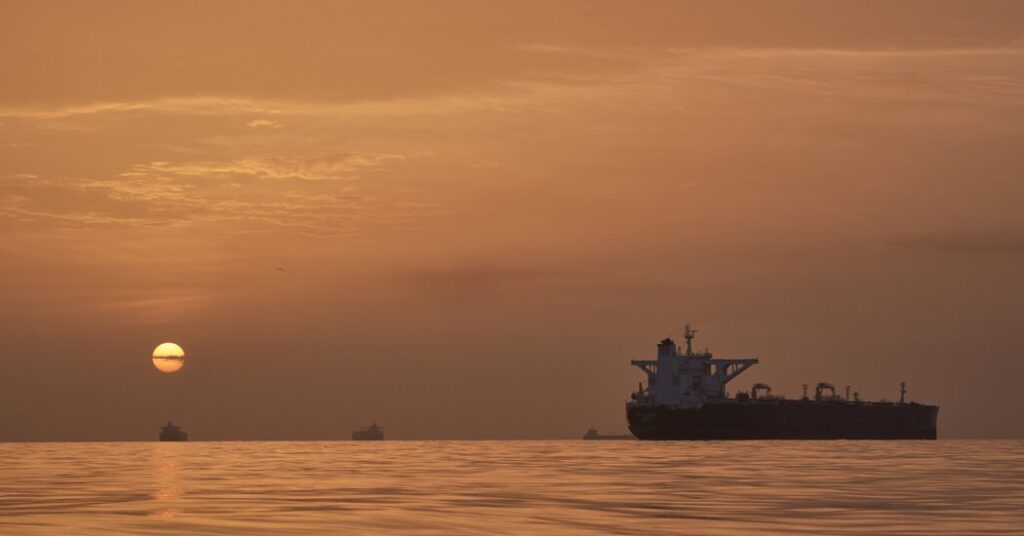
The United States military last week extended its blockade on vessels coming in and out of Iranian ports to the waters of the wider world, declaring that it would pursue any ship aiding Iran, regardless of location on the high seas or flag.
The U.S. “will actively pursue any Iranian-flagged vessel or any vessel attempting to provide material support to Iran,” Gen. Dan Caine, chairman of the Joint Chiefs of Staff, said Thursday, noting that the American troops beyond the Middle East will engage in operations to thwart Iranian shipping.
The extension of the blockade comes as the economically vital Strait of Hormuz remains all but closed to commercial traffic and the two-week cease-fire between the United States and Iran nears an end. The move aligns longstanding American economic policies targeting Iran with the current military campaign against it, maritime and military law experts say.
But it raises a host of legal and practical questions.
“War is a messy thing not just on the combat side but under national and international law,” said James R. Holmes, chair of maritime strategy at the Naval War College.
“From a legal standpoint, a blockade is an act of war, so the blockade probably is legal to the extent Operation Epic Fury is,” he said using the name of the U.S. military campaign against Iran.
Since Congress has not declared war against Iran, no formal state of war exists between the United States and the Islamic Republic. But Mr. Holmes noted that “undeclared wars are more the rule than the exception in U.S. history,” with joint resolutions of Congress, United Nations Security Council resolutions and NATO decisions invoked to justify fighting.
“This campaign may be more unilateral than most, but it is not without precedent,” he said.
Under international law, the legality of the blockade is “more ambiguous,” said Jennifer Kavanagh, a senior fellow and director of military analysis at Defense Priorities, a foreign policy think tank in Washington.
For a blockade to be legal, Ms. Kavanagh said, it must be “effective,” meaning that it is both enforceable and enforced. Some would argue that a “‘global blockade’ is not permissible in conception” because it is overly broad, she said.
Still, expansive blockades have taken place throughout history, including during World War II, when states enforced naval blockades worldwide other than in neutral territorial seas. Over the centuries before that, the British blockaded France throughout the Revolutionary and Napoleonic Wars, and during the War of American Independence, the colonies and their allies raided British shipping as far away as the Indian Ocean.
Enforcing expansive blockades is difficult, however.
“The seven seas are a big place, and the largest navy or coast guard is tiny by comparison,” Mr. Holmes said. Whether the U.S. blockade ultimately is deemed “effective,” legally speaking, will depend on whether the U.S. has enough assets like ships, aircraft, boarding crews and intelligence gathering to enforce it.
The blockade does not have to be “airtight” to meet the legal test, Mr. Holmes said, and assessing its effectiveness will be tough for outside observers in any case.
Enforcement may also have to be somewhat selective, he suggested.
“Now, it is possible our leadership might quietly let a ship proceed when it suits the national interest,” Mr. Holmes said. “For instance, with a summit coming up between President Trump and General Secretary Xi” — Mr. Trump is to meet with China’s leader, Xi Jinping, in May — “Washington might not want to ruffle feathers by obstructing China’s oil imports.”
The expanded blockade is part of a longstanding economic campaign against Iran, but it represents something of a tactical change for the Trump administration.
Earlier in the war, the United States temporarily lifted sanctions on Iranian oil at sea to ease the pressure on global energy prices. And before imposing a blockade on Iranian ports last week, the U.S. allowed Iranian tankers to transit the Strait of Hormuz for the same reason.
Now Washington seems to be returning its focus to keeping pressure on Iran.
“The blockade is a wartime extension of existing U.S. economic sanctions against the Iranian regime,” said James Kraska, professor of international maritime law and a visiting professor at Harvard Law School. In peacetime, he said, the sanctions were a “powerful tool to weaken the Iranian economy.” Now, he said, the blockade serves as a “kinetic expansion.”
General Caine’s announcement about the expanded naval blockade came one day after Treasury Secretary Scott Bessent announced “Operation Economic Fury,” an effort he called the “financial equivalent” of a bombing campaign. It includes secondary sanctions on institutions internationally, like banks, that have dealings with Iran.
The expanded blockade “marks a notable escalation by the United States,” said Ms. Kavanagh.
Still, she said, it is unlikely to significantly change Iranian calculations.
“For Iran, this war is existential and it is not going to cave easily or quickly,” she said. “Economic pressure may work over the very long term, but Trump seems too impatient for a deal to wait it out.”
Ephrat Livni is a Times reporter covering breaking news around the world. She is based in Washington.
The post Can U.S. Blockade Iranian-Linked Ships Anywhere in the World? Yes, But … appeared first on New York Times.