This article is part of our Museums special section about how institutions are commemorating the past as they move into the future.
As kidSTREAM prepares to open in Ventura County, it joins a national wave of new children’s museums, expansions of existing institutions and a broadened lineup of programming aimed at young visitors.
Utica Children’s Museum, Utica, N.Y.
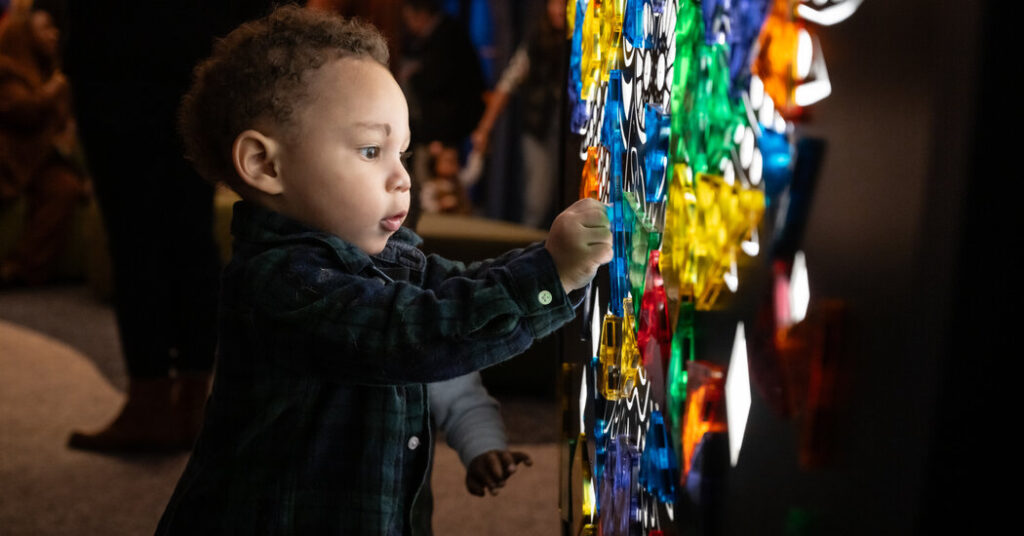
Originally opened in 1963 as the Junior Museum of Oneida, the institution has relocated several times and reopened last May in a 14,000-square-foot space. A two-story climber anchors the main floor, allowing children to navigate ramps, platforms and woven rope pathways. The museum houses five themed galleries, including World Market, which introduces music, art and cultural traditions from around the world, and Let’s Experiment, devoted to STEAM-based learning through prism and light exploration, an animation station and other hands-on activities.
Children’s Museum of Franklin, Franklin, Mass.
Founded by two mothers, Erin Gallagher and Meg Hagen, the museum opened last September in a former farm and garden center. They set out to establish a dedicated children’s institution to serve as an anchor for the community. The 6,400-square-foot space includes 12 exhibit areas focused on STEM exploration, art, engineering, imaginative play and sensory activities. It also offers family and after-school programs, as well as designated sensory-friendly hours. An additional 4,000 square feet of outdoor play space is expected to open in late spring.
Children’s Museum Houston
In March, the 90,000-square-foot museum expanded with the Gallery of Wonder, a 9,000-square-foot early childhood space designed for children from infancy to age 5. The gallery includes five interactive environments. Into the Woods invites climbing, swinging and fort building in a forest setting, while Under the Waves offers a softly lit ocean cove with sensory-focused light and sound where children can play with puppets. Viva Village centers on community life, encouraging children to role-play everyday helpers. Tot*Spot, reimagined as an oversized garden, caters to infants and toddlers, while the outdoor Treetop Terrace is a space for active play.
Port Discovery Children’s Museum, Baltimore
The museum debuted two permanent exhibits in October as part of a broader transformation. Galactic Builders is a 1,788-square-foot space-themed environment that invites children to design rockets, engineer rovers and explore physics concepts through hands-on exploration. SKIES is a quieter, sensory-focused space featuring reading nooks, a dedicated area to rest and recharge and immersive visuals of sunrises, sunsets and drifting clouds. Together, the additions expand the museum’s interactive footprint by more than 4,500 square feet and mark the first phase of a multiyear effort to update its learning environments for young visitors.
Kansas Children’s Discovery Center, Topeka, Kan.
In November, the museum unveiled a $11.6 million expansion that doubled its footprint to more than 30,000 square feet. The addition includes three galleries, two of which house permanent exhibits. The Sunflower Gallery is a hands-on environment where children can explore the prairie ecosystem and includes a two-story sunflower structure they can climb. The Hall of Bright Ideas celebrates creative Kansans with engineering-based activities. A third gallery will host traveling exhibitions, and the expansion adds three laboratory classrooms for STEAM programs and camps.
Portland Aquarium, Portland, Ore.
Conceived by a former preschool teacher and children’s cartoon artist, Mike Bennett, the Portland Aquarium opened last June as an animal-free, cartoon-style aquarium. Bennett said he wanted marine science to feel like “stepping inside a hand-drawn cartoon.” The 5,000-square-foot space showcases six ocean biomes, including the Wreck, focused on deep-sea carnivores and mysterious creatures, and the Open Ocean, highlighting some of the largest animals that swim in the seas. Throughout, visitors encounter illustrations of more than 100 marine species, including sea otters, jellyfish and great white sharks. Each child receives a guidebook created in collaboration with marine biologists to use throughout the galleries.
The post A Time of Growth for Museums for Children appeared first on New York Times.