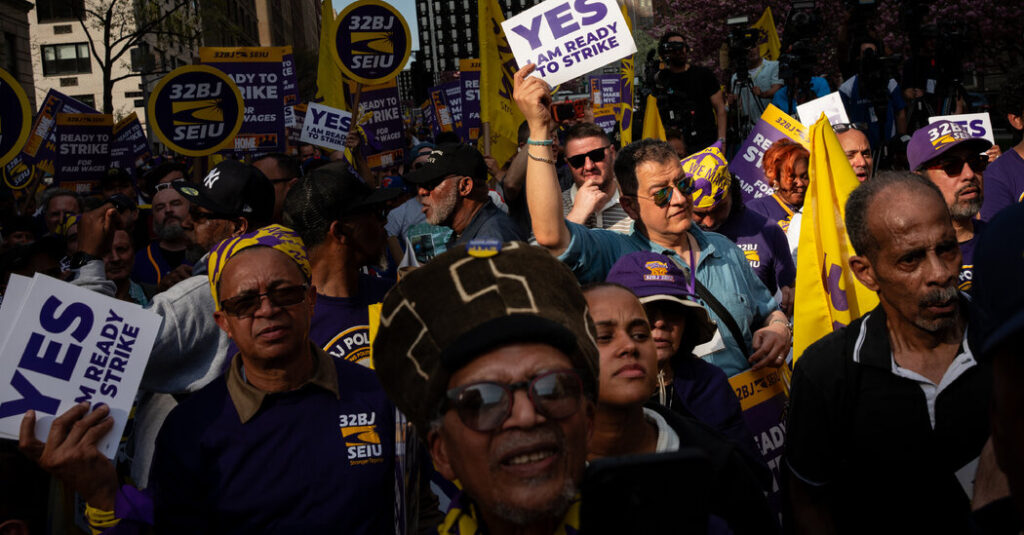
Just two days after staging a raucous rally on Park Avenue in Manhattan, a union representing about 34,000 doormen and other residential-building service workers in New York City said it had averted a looming strike by reaching a tentative contract deal with the owners of roughly 3,500 apartment buildings.
The workers’ union, Local 32BJ of the Service Employees International Union, had threatened to strike as soon as Tuesday if it could not come to terms on a new contract with the Realty Advisory Board on Labor Relations, which represents the building owners. The current contract expires on Monday and both sides had reported that negotiations were tense and an agreement did not appear imminent.
But by Friday afternoon, leaders of the two sides stood together at a lectern in a Midtown hotel to announce the basic terms of a new four-year contract that would quash any more talk of a walkout and relieve apartment-dwellers across the city of responsibility for hauling out trash or sorting packages. Sign-up sheets had circulated among tenants, seeking volunteers to perform those duties in the event of a strike.
“If there was a strike, everyone loses,” Howard Rothschild, the president of the Realty Advisory Board, said. “We wanted to figure out a way to win.”
The tentative agreement was a victory for the owners and residents, and for the union and its workers, Mr. Rothschild said. And it would maintain “labor peace” in the industry, which had not coped with a strike by its employees since 1991, when there was a 12-day walkout.
The union got most of what it sought in the negotiations, including wage increases that would boost salaries by $4.50 an hour over the life of the contract, said Manny Pastreich, the president of 32BJ. He said that the owners had also agreed to continue covering all of the costs of providing health care to the workers and their families, an exceptional benefit that few American workers receive, and to increase pension benefits by 15 percent.
“Both parties had to come together, because at the end of the day, no one wants to strike,” said Michael Cartagena, an Upper East Side doorman who said he had been a member of 32BJ for 38 years. “I went out 30 years ago, and I lost three weeks’ pay. I never got that back.”
Mr. Cartagena said he was pleased that the employers had agreed to continue paying for the workers’ health coverage. “We were trying not to pay into our medical, because 95 percent of the work force pays into the medical. We’re one of the 5 percent,” he said.
Mr. Rothschild said that the proposed raises would increase the typical employee’s pay from about $62,000 a year to more than $71,000 by 2030.
The union will mail ballots to its members for a vote on the tentative contract and will count the returns on May 28, Mr. Pastreich said. He said that he and the bargaining committee would strongly recommend that members approve the terms.
Union leaders drew the support of a large group of elected officials, including Mayor Zohran Mamdani, at their rally on Wednesday. Mr. Mamdani called New York “a union town” and said that increasing union density was the “best tool” for reducing income inequality.
But Mr. Rothschild said that the sentiments of Mr. Mamdani and the other officials did not influence the negotiations. “We do not let outside forces exert themselves,” he said.
Tara Terranova contributed reporting.
Patrick McGeehan is a Times reporter who covers the economy of New York City and its airports and other transportation hubs.
The post N.Y.C. Doormen and Building Owners Reach an Agreement to Avert a Strike appeared first on New York Times.