Thousands of displaced Lebanese returned to the country’s devastated south on Saturday for the second day, as a cease-fire between Israel and Hezbollah appeared to be largely holding despite sporadic Israeli strikes.
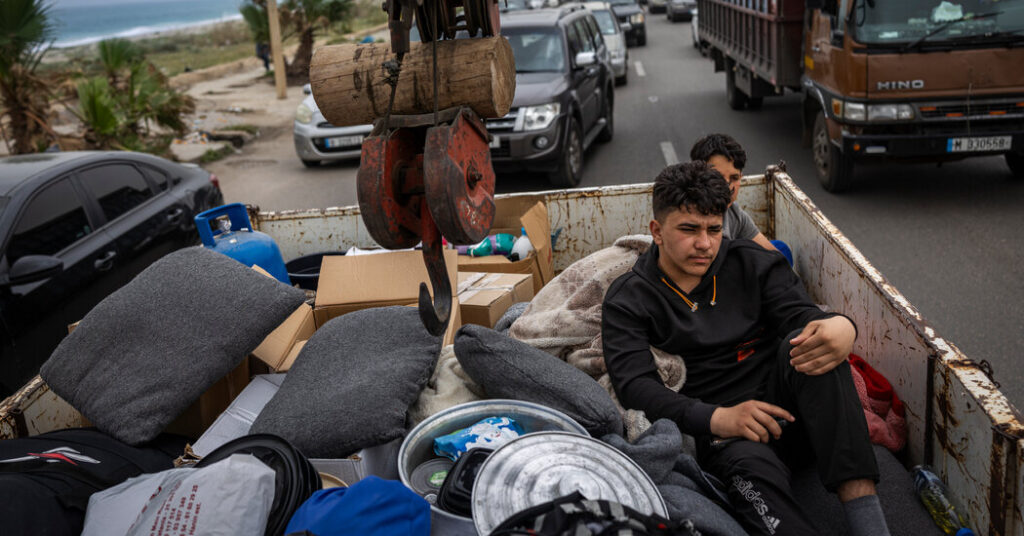
Lebanon’s coastal highway was still clogged with miles of bumper-to-bumper traffic. Cars piled high with mattresses and personal belongings moved at a snail’s pace. Some people flashed peace signs from their car windows. Others paused to stretch their legs.
“I didn’t ask anyone to check on my house or send me pictures. I want to do that myself,” said Zakri Zakaria, 55, who had stopped to buy essentials as his family headed home to the southern town of Kfar Tebnit, which was heavily bombarded during the war.
“We are heading there not knowing what we will find — or what we might not,” he said.
The 10-day U.S.-brokered cease-fire between Israel and Hezbollah, the Iran-backed Lebanese militant group, came into effect in the early hours of Friday morning. The truce has brought a much-needed reprieve for Lebanon after weeks of war, despite uncertainty over whether it will hold.
Roughly 2,300 people were killed in Lebanon during the latest war, said the country’s health ministry, warning that the death toll could rise as bodies are recovered from under the rubble. At least 13 Israeli soldiers have also been killed, along with two civilians, according to Israeli authorities.
Prime Minister Benjamin Netanyahu of Israel said this week that Israeli forces, which invaded southern Lebanon during the war, would remain in what he called a “security strip” stretching more than six miles into Lebanese territory.
That could prevent many of the one million displaced people displaced by the fighting from returning to their homes, prolonging a humanitarian crisis and potentially destabilizing the truce. Hezbollah ,demanding that Israeli forces withdraw, has warned that it was keeping its “finger on the trigger.”
The Israeli military said on Saturday that it had carried out strikes over the past 24 hours on what it described as “terrorists” who had approached areas in southern Lebanon where Israeli troops remain deployed, which the Israeli military said violated the truce.
Israel has also continued artillery fire and demolitions, the military said.
The continued Israeli strikes have added to confusion over the scope of Israel’s military operations under the cease-fire. Israel will “preserve its right to take all necessary measures in self-defense, at any time, against planned, imminent, or ongoing attacks,” according to the State Department. But it will not carry out “offensive military operations,” the agreement says.
Israel Katz, the Israeli defense minister, has said Israel would continue to destroy homes in Lebanese towns and villages close to Israel’s northern border. Mr. Katz has previously vowed to level swaths of southern Lebanon, signaling plans for an indefinite occupation there.
Separately, a French soldier with the U.N. peacekeeping force in Lebanon, or UNIFIL, was killed and three others were wounded in the country’s south on Saturday, according to President Emmanuel Macron of France, who suggested that Hezbollah was responsible. Hezbollah denied involvement.
UNIFIL said the “deliberate attack” was carried out by “nonstate actors” during a patrol in the town of Ghandouriyeh, as peacekeepers were clearing explosive ordnance from a road leading to a UNIFIL position.
U.N. forces have come under a string of attacks in the latest conflict. Three peacekeepers were killed last month in separate incidents, including one by Israeli tank fire, according to a preliminary U.N. investigation.
Aaron Boxerman contributed reporting.
Euan Ward is a Times reporter covering Lebanon and Syria. He is based in Beirut.
The post More Displaced Lebanese Head Home as Cease-Fire Is Tested appeared first on New York Times.