This article is part of our Museums special section about how institutions are honoring the past as they move into the future.
At 9:30 a.m. on Sunday, Oct. 19, intruders disguised as construction workers broke a window of the Louvre Museum’s Gallery of Apollo, cutting through display cases and fleeing with eight of France’s Crown Jewels.
They included the Empress Eugénie’s bow brooch, encrusted with more than 2,500 diamonds, her pearl-and diamond-packed tiara and a sapphire necklace, earrings, and tiara worn by, among others, Queen Marie-Amelie and Queen Hortense.
Surveillance footage later revealed that, while the intruders immediately set off alarms, by the time guards arrived the thieves were long gone. The museum’s director, Laurence des Cars, resigned on Feb. 24, after mounting pressure followed what had become a national scandal in France.
Major art thefts like this are rare but unforgettable. The 1990 robbery at Boston’s Isabella Stewart Gardner Museum — in which thieves disguised as police officers stole 13 masterpieces, including works by Vermeer, Rembrandt and Degas — remains the largest art heist in American history. The case has inspired dozens of books, documentaries and investigations over the decades.
But smaller incidents occur far more frequently. For instance, just four days before the Louvre robbery in Paris, thieves stole more than 1,000 objects from an off-site storage facility of the Oakland Museum of California, including Native American baskets, daguerreotypes, political memorabilia and modern jewelry.
More recently, on March 16, a man broke into Chihuly Garden and Glass in Seattle, damaging an estimated $240,000 in glass sculptures and attempting to stab a security guard with the shards, according to the police. And on the night of March 22, thieves broke into the Magnani-Rocca Foundation, a private art museum in the countryside outside the northern Italian city of Parma, and made off with works by Renoir, Cézanne and Matisse worth millions of dollars, Italian officials said.
Security is serious business. But the central challenge for most museums today, be they international destinations or local institutions, is not simply preventing theft. It is doing so without undermining their growing aspiration to feel open, welcoming and community centered. In response, designers and consultants alike are developing systems to protect priceless collections without turning museums into fortresses.
“Transparency, porousness — all the buzzwords of architecture today are antithetical to security. It’s a paradox implicit to museum design today,” said David Allin, a principal at Diller Scofidio + Renfro, a New York-based architecture firm that has designed some of the world’s most high profile museums. Its projects have included the expansion of the Museum of Modern Art in New York, the creation of the Broad in Los Angeles, and the new V&A East Storehouse in London, where it transformed a former media center in the Queen Elizabeth Olympic Park into a new kind of storage and immersive art viewing experience.
Security, Allin and other designers point out, needs to be integrated from the earliest stages of a project.
“When I work with architects, I like to get involved as early as possible,” said Steve Keller, a veteran museum security consultant who has advised institutions like the Getty Center in Los Angeles, the Smithsonian in Washington, D.C., and the Art Institute of Chicago. “Once the architect has a vision in his head of what he wants to do, it becomes very difficult to change it.”
Architectural decisions, Keller added in a phone interview, can have major security consequences. Glass facades create visibility but also vulnerability. Skylights provide dramatic natural light but can become entry points. Vast open galleries offer memorable experiences but can create blind spots for monitoring.
Achieving both security and openness, many in the field say, often means thinking in terms of subtle layers, not monolithic moves.
Building and landscape design can guide visitors away from vulnerable areas or discourage climbing or wandering. Lighting and signage can clarify where the public is welcome — and where it is not. Cameras, motion sensors and object-level alarms monitor artworks in ways visitors often never notice.
Reimagining a Museum’s Front Door
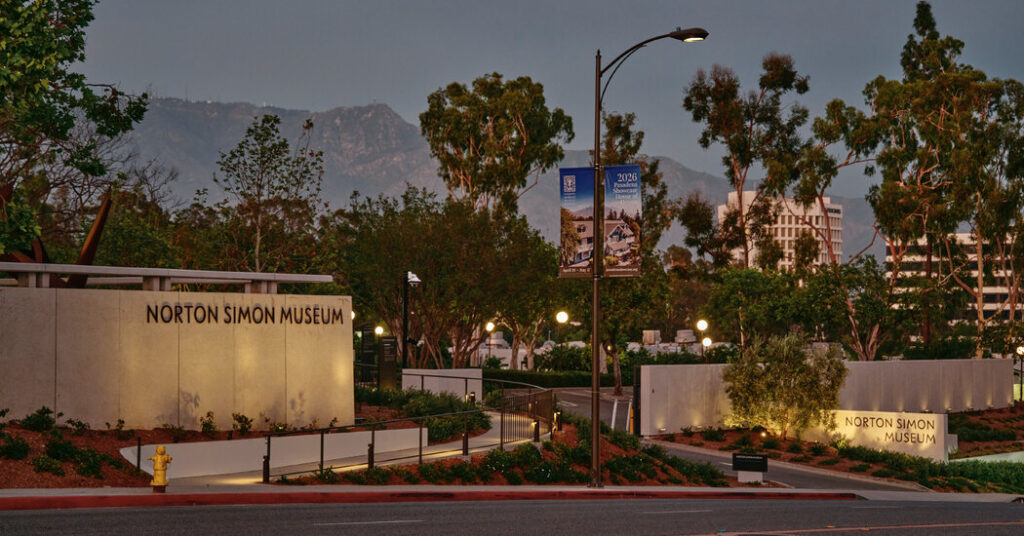
In Pasadena, Calif., the Norton Simon Museum reveals how these strategies generally begin beyond the building itself — at the perimeter.
The museum’s collection includes Rembrandt portraits, Goya paintings, Degas sculptures, and one of the most significant collections of South and Southeast Asian sculpture in the nation. Priceless sculptures sit outside the museum including “The Thinker” and more than a half dozen other works by Auguste Rodin. Yet for decades, the museum’s campus was surprisingly open.
“Before, you could really just walk right in,” said Leslie Denk, Norton Simon’s senior vice president of operations and strategy, during a recent walk through the museum grounds. While there was always 24-hour security, staff just stretched chains across driveways after hours to dissuade people from entering the grounds.
When the museum recently redesigned its campus — a project by Architectural Resources Group, which focuses on historic preservation, and the landscape architects SWA Group — “improving curb appeal while improving security on the site,” as Denk put it, became one of the central challenges.
Instead of installing a huge fence dominating the museum’s public-facing frontages on Colorado and West Orange Grove boulevards, the design team developed a multipart strategy.
A variety of new walls step along the sloping site, including a textured white concrete barrier in various segments, to the east and a matte white wall to the west (which also helps block traffic noise for the museum’s rear sculpture garden). Behind the midcentury podium, at a particularly important pinch point, is a curving extension of the museum’s famed Heath ceramic tile facade, with new tiles painstakingly matched to those of the original building.
Strategic exterior plantings subtly discourage visitors from wandering into restricted areas, while in some places, rows of shrubs help soften new perimeter walls. A curving pathway guides visitors toward a newly secured entrance.
And new lighting, gates, signage and cameras — installed in close collaboration with the design team — reinforce the perimeter. New lighting washing the new walls also helps create a much more dynamic exterior at night. “The Thinker,” meanwhile, was moved closer to the entrance, where it would be more visible — and behind the new line of security.
“We really touched almost all areas of the campus by the end of the project,” said Liz MacLean, a principal at Architectural Resources Group.
Opening the Storage Vault
At the V&A East Storehouse, Diller Scofidio + Renfro has helped make more than half a million objects — from medieval stone carvings and Renaissance furniture to stage costumes, textiles and fragments of historic buildings — viewable to the public in an open warehouse, blurring the line between museum and storage space.
Securing this novel type of museum space meant carefully choreographing access, and subtly threading in security so that it is often invisible. “There’s a real sense of generosity, but also a sense of trust in the public to treat the collection with care,” said Allin.
Visitors arrive at an open, highly accessible lobby, which Allin describes as a “radical welcome.” Staff greets the guests but security guards and cameras are stationed out of eyesight. Visitors then pass through what Allin described as a secure “wrapper”— a vault-like perimeter — and make their way into the cavernous storage hall, where towering racks hold dense rows of artifacts.
Certain aisles can be closed off at any point with steel mesh screens that bolt to storage racks. Other zones are separated by controlled access points or elevated perches — like the conservation overlook, a glass-walled viewing area that allows visitors to view conservators at work — that keep the public at a distance from fragile artifacts.
Serving More Than One Purpose
Designers must consider security for all situations — be it inside, outside, during peak hours or when museums are closed.
Stephanie Dwyer, a principal at Machado Silvetti — an architecture firm that has worked on the Getty Villa, the Denver Art Museum, and the Ringling Museum of Art, among many other museums — said that knowing a museum’s staffing plans helps her and her colleagues lay out spaces more effectively.
With fewer guards, she said, design needs to be more open, “so that one person has a sight line to every point of entry on that floor or in that space.” She added: “We’re always having these conversations like, could someone hide here?”
Some design elements, Dwyer noted, can do double duty. A sunken courtyard, for instance, can become both a community focal point and a subtle security barrier. Retractable fences, like ceiling-mounted mesh screens or overhead coiling doors, similar to garage doors, are valuable for both security and fire safety, limiting fire’s spread and directing visitors to safe zones more quickly.
“You’ve got the security and safety of the art, but then you also have security and safety of people,” Dwyer said. “Sometimes those things overlap, and sometimes they don’t.”
Technology and the Human Element
Security consultants confirm that technology, which almost invariably supports these designs, has come a long way. Paintings carry tiny radio frequency identification tags that trigger alarms if moved. Sensors employ both microwave radar to detect motion and infrared to detect temperature changes. Some camera systems can monitor entire walls of artworks simultaneously, sounding alerts if a hand reaches too close.
But even the most sophisticated systems and designs require someone to respond.
“Once something happens, you still need someone there,” Keller said. “A camera can’t get off its chair and go check out the bad guy.”
Security personnel, often among the largest operating expenses in a museum’s budget, can be difficult to recruit and retain. And as budgets continue to shrink, particularly in the aftermath of Covid and cuts to public funding, they are often the first line item to get cut — creating a weak link in the system, as they did at the Louvre.
Another weak link at the Louvre, added Brian Gouin, senior security consultant at Nationwide Security Corporation, who specializes in protecting cultural institutions, was that cases were too easy to break.
But neither he nor Keller have noticed an uptick in concern or security investment at American museums in the aftermath of the Louvre. In fact, Gouin noted that a major part of his job is convincing museums of the need for security at all. “Hoping nobody steals anything is not a strategy,” he said.
The post After the Heists: Securing Museums Without Closing Them Off appeared first on New York Times.