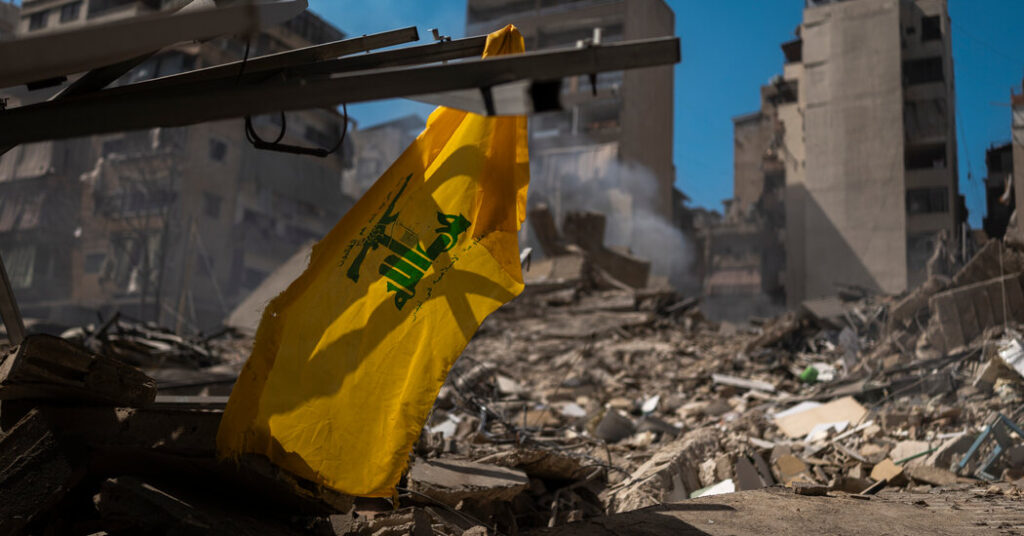
A 10-day cease-fire that Lebanon and Israel agreed to appeared to be holding on Friday, but absent from the agreement was one of the two warring parties: Hezbollah, the Iran-backed, Lebanese militia that the Israeli military had been fighting.
In statements after the U.S.-brokered truce was announced, Hezbollah made vague reference to the cease-fire but did not commit to adhering to it. The group set off the latest round of fighting last month by attacking Israel in solidarity with Iran, soon after the start of the U.S.-Israeli bombing campaign there. Israel responded to Hezbollah’s attacks by launching airstrikes across Lebanon and widening a ground invasion of the country’s south.
The truce’s viability could hinge on Lebanon’s ability to curb Hezbollah, which it has struggled to do for decades.
For years, the Lebanese government has been caught between Western demands to disarm the group, which the United States has long designated a terrorist organization, and fears of inflaming sectarian tensions, which were at the heart of a bloody 15-year civil war in Lebanon that ended in 1990.
Hezbollah is a Shiite militant group that emerged in the 1980s with Iranian backing and grew into Lebanon’s most powerful fighting force. To its supporters, it was a protector of the Shiite Muslims of Lebanon from Israel, which occupied southern Lebanon for nearly 20 years, as well as from other sects’ militias in the country. It also ran a network of social services like schools, clinics and hospitals.
Hezbollah still has political influence in Lebanon, though less than it once did. The group exerts de facto control over large areas of the country’s south and poses a credible challenge to the Lebanese government’s authority.
In 2023, Hezbollah attacked Israel in solidarity with Hamas, the Palestinian group that is also backed by Iran. Israel responded with brutal force, wiping out many of Hezbollah’s top commanders, including its leader, Hassan Nasrallah; razing much of its infrastructure; and forcing it to use a chunk of its weapons arsenal.
In December 2024, the rebel uprising that toppled Bashar al-Assad — Syria’s longtime dictator and a key regional patron of Hezbollah — dealt the group another blow.
“Over the course of the 2000s, 2010s, and even into the 2020s, there was a sense that the balance of power was in favor of Hezbollah,” said Andrew Arsan, a professor of Arab history at Cambridge University. “But the war between Israel and Hezbollah from October 2023 weakened the party, both militarily as well as politically.”
After a 2024 cease-fire with Israel, Hezbollah largely avoided retaliating even as the Israeli military maintained forces in southern Lebanon and carried out near-daily airstrikes.
So, many were surprised by the intensity of Hezbollah’s barrages against Israel beginning in March. It indicated that the group had kept a sizable arsenal of rockets, missiles and drones, as well as the capacity to produce weapons locally — which was increasingly crucial for its survival as a fighting force without Syria’s backing.
The 2024 truce with Israel mandated that Lebanon take steps to disarm Hezbollah. Lebanon’s army said in January that it had made progress in efforts to restrict Hezbollah’s access to weapons, which Israel called encouraging but far from sufficient.
During the most recent fighting, the Lebanese government in effect designated Hezbollah an outlaw group by declaring its military activities illegal. The government also pushed to root out Iranian influence more broadly, including by ordering the expulsion of Tehran’s ambassador in Lebanon.
But Hezbollah’s response to those moves underscored the limits of Beirut’s authority. The group issued veiled threats to reignite domestic strife, and Iran’s ambassador, Mohammad Reza Shibani, refused to leave.
The post Why Lebanon Has Long Struggled to Contain Hezbollah appeared first on New York Times.