South America’s bustling seaports have never been under more watchful eyes.
They are patrolled by armed soldiers and monitored by thousands of cameras. Drones look for divers stashing cocaine onto ships. Sniffer dogs, special agents and scanners powered by artificial intelligence sweep containers stuffed with coffee and beef for signs of drugs.
Yet, the painstaking work of intercepting cocaine before it leaves South America for the rest of the world is often a futile cat-and-mouse chase.
“We discover a route, and they’ll change to another,” said Rômulo Pereira Brandão Neto, a customs agent at the Santos port in Brazil, the busiest in Latin America. “We improve our process, they improve theirs.”
South American nations have never had a more powerful arsenal of tools, from advanced technology to military might. But the authorities say they are fighting an uphill battle against deep-pocketed criminal groups that are global in scale and that reap enormous windfalls from record demand for cocaine.
Vowing to crush drug trafficking, the Trump administration has struck dozens of boats off the coast of South America since last year, claiming they carried drugs to the United States. The attacks have killed at least 177 people.
But experts say much of the cocaine that winds up in American cities is actually smuggled largely aboard cargo ships, first to Central America or Mexico across the Pacific Ocean, then trafficked over the southern U.S. border.
Forging alliances with Mexican cartels, South American drug gangs are using new routes and methods to send vast amounts of cocaine to the United States, experts and officials say, while also moving huge quantities to Europe, Asia and Australia.
The many novel ways smugglers avoid detection lay bare the challenges facing South American nations trying to placate a U.S. president who has made drug smuggling a centerpiece of his Latin America policy.
The ease with which criminal groups circumvent law enforcement strategies also raises questions about how effective U.S. strikes on boats will prove in making any meaningful dent in the drug trade.
“It’s a Whac-a-Mole strategy,” said Jana Nelson, a former top U.S. defense official who served in the Biden and Obama administrations. “The people you’re targeting are at the bottom of the totem pole,” she added, referring to the boat strikes. “So it’s not really dissuading anyone.”
For one, after the Trump administration began its maritime campaign, traffickers started moving more cocaine through rainforest routes in Guyana and Suriname before sending it north from less monitored ports in those countries, said a South American intelligence official speaking anonymously to discuss sensitive information.
“Criminal groups have made large investments in cocaine production,” said Vanda Felbab-Brown, an expert on organized crime at the Brookings Institution. “And they’re not going to just throw that away.”
A cocaine boom
Most of the world’s cocaine is produced in Colombia, Bolivia and Peru, before it is transported by truck, boat and small plane across South America to major ports like Guayaquil in Ecuador and Santos in Brazil.
There, the drugs are often stashed with legitimate cargo, like orange juice or soybeans, or surreptitiously attached to the hulls of freight vessels.
The vast majority of cocaine is smuggled out of South America this way, exported together with thousands of containers passing through commercial ports each day, according to law enforcement and data from the United Nations Office for Drugs and Crime.
“This is by far the most convenient method for them,” said Ms. Felbab-Brown, estimating that authorities can only inspect 2 to 3 percent of containers each day. “It’s a really low risk of detection.”
(Drug groups also use submersible vessels to transport drugs.)
Cocaine seizures at major global ports have more than tripled over the last decade, according to U.N. data, a rise experts attribute to more effective policing. At the same time, more cocaine than ever is being made, with global production reaching a record 3,708 tons in 2023, the most recent year for which U.N. data is available.
“The impression you get is that we’re seizing more,” said Silvio Loubeh, a Brazilian prosecutor leading the counternarcotics task force in São Paulo state, where Santos is located. “But it’s also because they’re sending more drugs.”
Cocaine use has also risen sharply worldwide, reaching 25 million users in 2023, up nearly 50 percent from a decade earlier, according to U.N. data. The United States is the world’s biggest consumer of cocaine, closely followed by Europe.
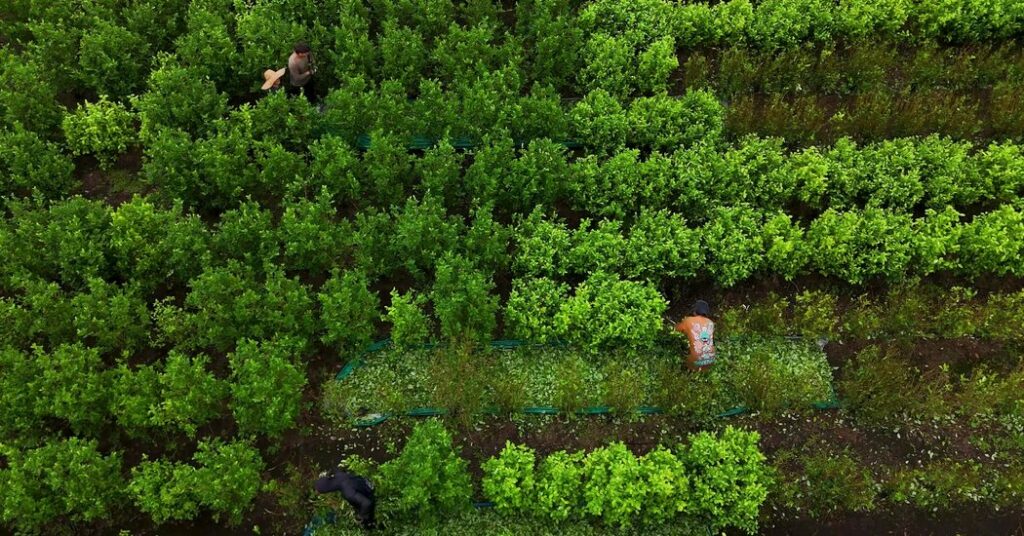
In the Putumayo region of Colombia, where cocaine drives the economy, this drug boon is unmistakable. The coca plant is swiftly stripped of its leaves by workers whose hands are wrapped in packing tape to shield them from jagged branches. In thousands of rudimentary labs dotting the forest, other workers grind coca leaves, mix the powder with chemicals and distill it into bricks of cocaine paste resembling bars of soap.
With persistently high poverty rates and few legal ways to earn a living, many people here say they have no other choice but the cocaine trade. “It runs the entire economy,” said Carlos Fernández, a local representative of Amazon Watch, a nonprofit. “And so, it matters very much to people here what prices cocaine is fetching.”
Experts say a kilogram of cocaine typically costs about $2,000 to make, but can be sold for more than 20 times that in Europe or the United States.
“You can lose a ton of cargo but, if just one gets through, it covers all the losses,” said Mr. Loubeh, the Brazilian prosecutor. “And there will still be cash left over.”
New routes, novel tactics
Amid this flood of cocaine, Mr. Trump has warned countries to stop the flow of drugs — or risk U.S. military intervention.
In Colombia, where two-thirds of the world’s cocaine is produced, authorities have destroyed hundreds of makeshift labs like those in Putumayo in recent months and joined forces with the United States to share intelligence and carry out military operations.
Ecuador also recently launched a joint military campaign with the United States, aimed at drug cartels the Trump administration has designated as terrorist organizations. In one case, however, The New York Times found that Ecuadorean forces targeted what appeared to be a working dairy farm.
The United States has also set its sights on Brazil: it is considering designating the nation’s most powerful drug trafficking groups, the First Capital Command and the Red Command, as terrorist organizations, according to U.S. and Brazilian officials.
These Brazilian gangs send very little cocaine to the United States, but the country is a major transit route for cocaine heading to Europe. Still, eager to show Mr. Trump it is doing its part, Brazil has conducted sweeping operations against drug trafficking groups and ramped up surveillance on major seaports along its 5,000-mile coastline.
On a recent weekday in the Santos port, these expanded efforts were on full display. A pair of federal agents led two sniffer dogs who whined in front of six containers flagged as suspicious by analysts with the help of A.I. Packed with coffee, paper and leather, the cargo was headed to Italy, Germany, Togo and Colombia.
“It’s like looking for a needle in a haystack,” said Mr. Neto, the customs agent. “It’s impossible to stop them all. But you do your best.”
(On the day that The Times visited the port, authorities didn’t find drugs in the containers inspected. But days later, they intercepted 540 pounds of cocaine hidden in a container of soy oil heading to Portugal.)
To avoid detection, Mr. Neto added, criminal groups have begun hiding smaller amounts of drugs or finding ways to disguise them. In one cargo seized by agents, cocaine was stashed in the cooling system of a beef container. In another, it was chemically infused into leather.
With well-trodden routes to the United States and Europe under closer watch, smugglers also appear to be turning their attention to Asia and Australia, where surveillance is often more lax and cocaine less plentiful, fetching larger profits. In one example, four Ecuadorean men were arrested several weeks ago in Fiji, nearly 7,000 miles from home, after the police seized over two tons of cocaine.
“Now is the time for traffickers to be exploring other destinations,” said Antoine Vella, a research officer at the U.N. drugs agency.
Simón Posada contributed reporting from Bogotá and Lis Moriconi contributed research from Rio de Janeiro.
Ana Ionova is a contributor to The Times based in Rio de Janeiro, covering Brazil and neighboring countries.
The post Trump Wants to Stop Drugs Coming From South America. Is That Possible? appeared first on New York Times.