The Supreme Court agreed on Friday that energy companies facing lawsuits over environmental damage to Louisiana’s coast from oil and gas production can move the challenges from state courts into friendlier federal venues.
The ruling is a significant victory for oil companies, led by Chevron and Exxon Mobil, in their legal battle with Louisiana state officials over who should pay for the state’s coastal erosion. The companies have been supported by the Trump administration.
The justices unanimously agreed to allow the oil companies to fight the lawsuits in federal court rather than state court.
“Congress has long authorized federal officers and their agents to remove suits brought against them in state court to federal court,” Justice Clarence Thomas wrote.
The case, Chevron USA Inc. v. Plaquemines Parish, La., focused on a narrow question: whether the oil companies could remove cases over environmental damage from state to federal court. But the case has been closely watched by litigants in other climate lawsuits because state courts are generally thought to be more receptive to people who sue over damages caused by climate change, including climate activists and state officials.
Justice Thomas explained that the oil company had cleared the bar required to move the case into federal court because the lawsuit dealt with oil production in Louisiana dating back to World War II, when Chevron refined crude oil into aviation gasoline for the U.S. military.
He wrote that Chevron had shown that its wartime production of crude oil related to its wartime aviation-gasoline refining for the military, a federal priority.
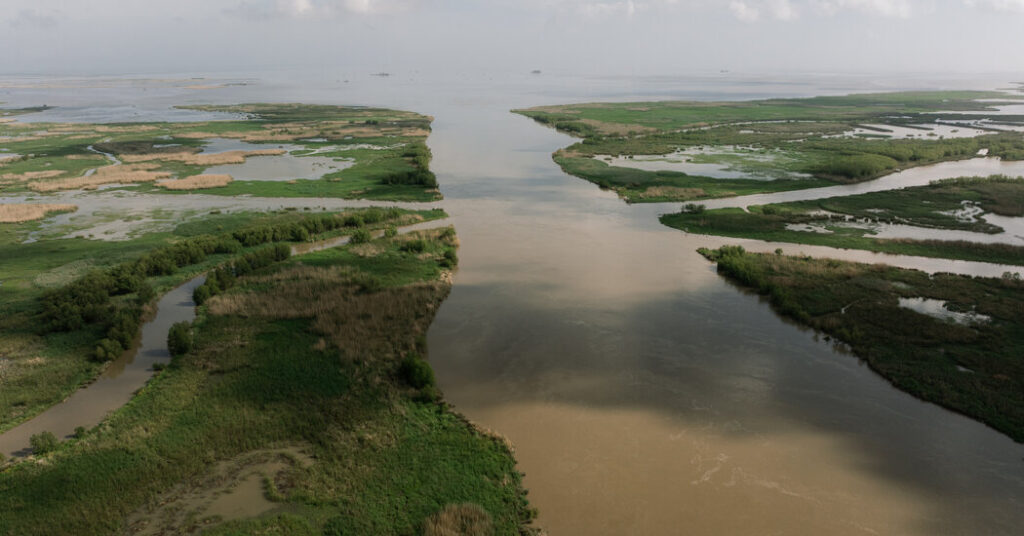
Louisiana has lost about 2,000 square miles of land to coastal erosion since the 1930s — a land mass about the size of Delaware.
Plaquemines Parish, the state’s southernmost parish, juts into the water where the Mississippi River meets the Gulf of Mexico. The parish, which is crisscrossed with oil and gas canals, has already lost nearly half of its size in the last century as sea levels rise because of climate change. The parish has also become more vulnerable to storms, in part because levees built to shield New Orleans from flooding also deprive the delicate coastal ecosystem of fresh water and sediment. Canals that aid in oil and gas production have also weakened the ecosystem, experts have said.
Louisiana has a $50 billion master plan to try to preserve coastal land, including more than 100 projects to dredge sand, to rebuild marshes and to add flood protection measures, including levees and storm surge barriers. The plan is designed to create tens of thousands of acres of new land and to shore up what remains.
So far, much of the money has come from a settlement that followed the 2010 Deepwater Horizon oil spill, but that fund is running out.
Local parishes, entities similar to counties in other states, have filed more than 40 lawsuits since 2013, seeking billions of dollars in damages from oil companies, which the parishes accuse of damaging the state’s coast line over decades of production.
They argue that the companies have illegally drilled, dredged and engaged in waste disposal without proper permits.
The lawsuits have gained support from Louisiana Republican leaders, including those who have otherwise endorsed President Trump’s “energy dominance” agenda. Gov. Jeff Landry and Attorney General Liz Murrill, both Republicans, have supported the legal challenges.
The parishes sued under Louisiana’s State and Local Coastal Resources Management Act, arguing that the companies violated a provision of the statute that requires companies to make sure that work areas are “cleared, revegetated, detoxified and otherwise restored.”
The fossil fuel companies have fought back, arguing that their actions did not damage the coastline. They have also argued that the state law was put into place decades after the companies began their work in the area, initially extracting oil under federal contracts during World War II. The work played a key role providing aviation fuel to the United States and its allies, they have argued.
These war efforts, the companies said, meant the lawsuits should be heard by federal courts, not state ones. They pointed to what is known as the federal officer removal statute. That statute authorizes lawsuits against federal officers or people “acting under” them “for or relating to” the officers’ official duties to be moved from state to federal court.
Lawyers for the oil companies had argued that the companies’ actions fit within the statute because of their federal contracts to refine aviation gasoline.
A federal trial court judge concluded that the oil companies had failed to show that they extracted the oil under the order of a federal officer and that the federal contracts were unrelated to the oil production at issue.
A divided panel of federal judges on the U.S. Court of Appeals for the Fifth Circuit, which is based in New Orleans, upheld the lower court’s decision that the cases belonged in state court.
The Trump administration had joined onto the case on the side of the oil companies, also arguing that the cases should be heard in federal court.
Only eight of the nine justices heard the case when it was argued before the court in January. Justice Samuel A. Alito Jr. recused himself in the days before the oral argument, pointing to a financial interest he holds in ConocoPhillips, the parent corporation of Burlington Resources Oil and Gas Company. While that company had withdrawn from the court filings before the justices, it has remained a party to the case in a lower court, according to a letter from the court clerk.
Abbie VanSickle covers the United States Supreme Court for The Times. She is a lawyer and has an extensive background in investigative reporting.
The post Supreme Court Sides With Oil Companies in Louisiana Coastal Lawsuits appeared first on New York Times.