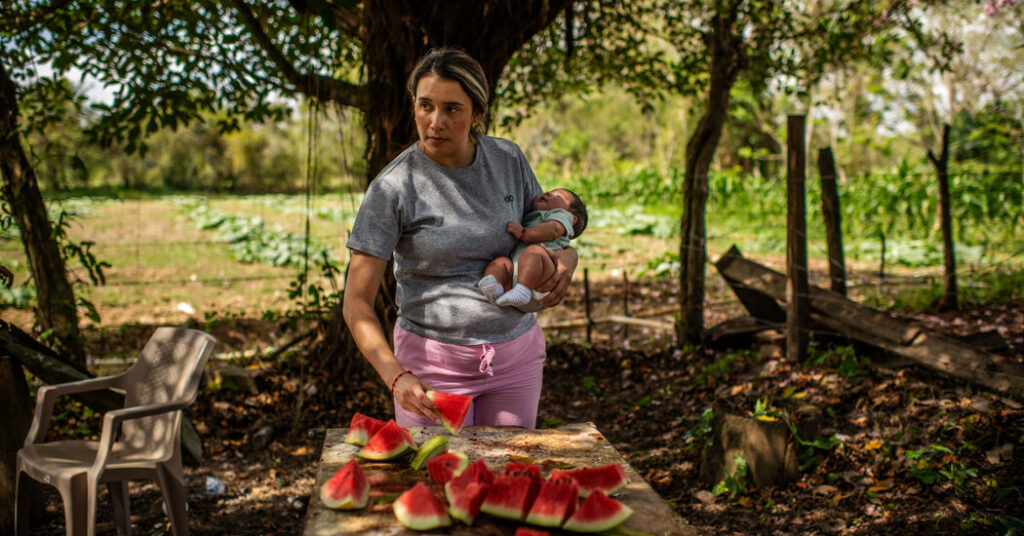
Diana Acosta Verde received the order from the detention officer less than 24 hours after she gave birth.
“Leave the baby in the crib,” Ms. Acosta recalled the officer saying as she held her newborn son. “You need to go.”
Her baby, Gael, was born a month early in a South Texas hospital. As Gael slept, the officer explained that a bus had arrived to take Ms. Acosta back to the detention center where she had lived for the past three months.
It was time to say goodbye.
Ms. Acosta felt her whole body tremble as she moved away from her son. A 27-year-old immigrant from Honduras, she and her partner had crossed the southern border in the fall, when Ms. Acosta was about six months pregnant, after being deported from the United States the previous spring. The couple knew they were taking a chance when they began their 1,700-mile journey back to the United States. But to give their first child together a chance at American citizenship — to be born on U.S. soil — they had agreed that they would do anything.
In arguing at the Supreme Court this month to overturn birthright citizenship, which many see as central to the country’s identity, the Trump administration asserted that the practice acts as a “powerful pull factor,” encouraging people to cross the border illegally and give birth in the United States. With a majority of justices appearing likely to uphold birthright citizenship, Ms. Acosta’s experiences reflect the often fraught choices and questions inherent in the policy.
Ms. Acosta and the baby’s father, Jaime Murillo Padilla, made decisions that put themselves and their future child at risk — desperate for their son to achieve citizenship in a stable country rich with economic promise. They also encountered an immigration system ill equipped to deal with the consequences of a practice that creates strong incentives for noncitizens to have children in the United States, with detention policies and conditions that can put mothers and their babies in jeopardy.
Of all the potential perils they had contemplated, the couple never imagined they would be separated from their newborn. Gael was in the hospital without a family member for more than 24 hours before his grandmother, a U.S. resident, came to collect him.
“I felt so much pain that I didn’t really know where it hurt,” Ms. Acosta said in an interview. “I wanted to vomit. I felt like my world was falling to pieces.”
U.S. Border Patrol does not track childbirths. Lauren Bis, a spokeswoman for the Department of Homeland Security, said that Border Patrol encountered over 15,000 pregnant women in 2023 under President Biden. She added that the number of pregnant women crossing the border dropped by 81 percent after President Trump took office.
The Biden administration issued extensive guidance on how to handle childbirth and pregnancy in Customs and Border Protection custody, including directives that required parents to be processed within 12 hours of a birth and stressed the importance of families remaining together. Much of that guidance has been rescinded by the Trump administration.
Ms. Bis said the Biden-era policy was “no longer needed.”
“With the most secure border in history, C.B.P. is not prioritizing releasing individuals into the country,” she said.
Ms. Acosta and Mr. Padilla were initially arrested by Border Patrol, according to court records, then transferred into the custody of the U.S. Marshals Service while awaiting prosecution for crossing the border illegally. Before and after Ms. Acosta gave birth, she was held at the East Hidalgo Detention Center, a facility in La Villa, Texas, operated by the GEO Group, a private company that runs immigration detention centers across the country. The GEO Group did not respond to a request for comment.
Brady McCarron, a spokesman for the U.S. Marshals Service, said pregnant prisoners have access to obstetric care, including prenatal and postpartum follow-up, and that the prisoners are responsible for arranging custody of the child immediately after birth. If the mother cannot find someone to take custody, Mr. McCarron said, the Marshals Service will notify child protective services.
Ms. Acosta said she was not given the option to keep her baby with her in detention.
When Gael was born, Ms. Acosta and Mr. Murillo achieved the goal they had gambled so much for: Their son was an American citizen. He would never have to sneak across the border, or get deported. He had full access to the country Mr. Murillo saw as the world’s “greatest nation.”
But back at the detention center, Ms. Acosta did not know if she would ever see her son again.
A Clear Path Forward
As soon as she found out she was pregnant last summer, Ms. Acosta started to cry.
“I’m scared,” she’d said, holding out the positive test to show Mr. Murillo.
Ms. Acosta and Mr. Murillo had just been deported to Honduras from the United States, where Ms. Acosta had lived for four years after seeking asylum under the Biden administration. Mr. Murillo, 34, had lived in the United States since he crossed the border at 10 years old, qualifying for Deferred Action for Childhood Arrivals, or DACA, the Obama-era program that shielded from deportation undocumented immigrants who came to the country as children.
The couple had always planned to have a baby in the United States — far from the violence they had come to expect in Honduras. Ms. Acosta’s brother was killed there a few years ago, they said.
But then the couple was picked up by ICE in early 2025, arrested after the police found drugs in the glove compartment of a relative’s car Mr. Murillo had been driving. He was charged with possession of a small amount of cocaine — which he said was not his — and deported in March. Ms. Acosta, against whom all charges were dropped, was deported a few months later.
Back in Honduras, expecting a baby, Mr. Murillo saw a clear path forward.
“Our daughter or son is not going to be born here,” he recalled telling his partner.
Mr. Murillo, who ran a restaurant business in Chicago, where he had lived, started calling people he thought could help them get back into the United States.
“We knew the importance of that birth certificate,” he said. Mr. Murillo was also eager to return to his family. He has three other children in the United States from previous relationships who are American citizens.
The last time Mr. Murillo and Ms. Acosta had crossed into the United States, they had felt welcomed into the country. Ms. Acosta had obtained asylum papers. In 2002, when a 10-year-old Mr. Murillo first immigrated, he nibbled happily on a bologna sandwich he got from a Border Patrol officer, who had assured him that everything would turn out OK.
They knew it would be different under the Trump administration. But friends assured them that they could still find a way to cross safely.
Five months later, Mr. Murillo said, he and Ms. Acosta were sleeping in a shed just south of the border with blood stains on their mattress and AK-47s stashed in the corner. The man he had promised thousands of dollars to shuttle them across had lied to them, he said, by promising that they would be staying with families and traveling in a private car, far from the cartels.
A Border Patrol agent found them hiding in a bush on Nov. 3, he said, less than five minutes after they had crossed the border.
Ms. Acosta texted Mr. Murillo’s mother, who had been awaiting their arrival in Chicago, right before they got arrested.
“They got us,” she said.
Delivery and Detention
Three months later, on Friday, Jan. 30, Blanca Padilla Tejeda received a call from a U.S. marshal in South Texas.
Ms. Acosta had delivered her baby that day, the marshal said. Ms. Padilla, Mr. Murillo’s mother, had to get to the hospital by Sunday to take custody of her grandson, the marshal said in text messages reviewed by The New York Times.
Ms. Padilla had no idea how she would come up with money to travel to Texas in two days. But she feared her family could lose Gael if she didn’t.
“Is the boy OK?” Ms. Padilla asked the marshal on the phone. “Is Diana OK?”
“Yes,” she recalled him saying. “But you have to come for him now.”
At the hospital, a social worker noted that the baby was premature and would be kept in the nursery for monitoring, according to medical records. Medical providers had already designated Ms. Acosta as a “high-risk” patient, writing that, before arriving at the hospital, she had received “inadequate or lack of prenatal care.”
Ms. Padilla arrived at Knapp Medical Center in Weslaco, Texas, on Sunday morning, ready to pick up her grandson.
At that point, Ms. Acosta was in solitary confinement at the detention center — unable to talk to Ms. Padilla or anyone who could give her news about her son. She said she sat in a freezing cell for more than two days without anything to cover herself, afraid to bathe in a bathroom covered in mold, hair and vomit. When she told officers her breasts were in pain, she said, they prohibited her from touching them to pump her breast milk, instructing her to bandage and ice her chest.
“I didn’t know if my baby had been taken by the state,” Ms. Acosta said. “I told them that, please, I need to communicate with my family. They gave me nothing. Nothing, nothing, nothing.”
Medical experts provided with the details of Ms. Acosta’s case stressed the importance of newborn babies staying close to their mothers in their first weeks, especially those born prematurely. Separating the two can affect a baby’s neurological development and ability to bond, said Dr. Rose Molina, an obstetrician-gynecologist and fellow at the American College of Obstetricians and Gynecologists.
“The mom and newborn should always be together,” said Ms. Molina. “Especially in those first days.”
Mothers who are unable to pump their unused breast milk are at a higher risk of contracting an infection, Ms. Molina added.
That Sunday morning, Ms. Padilla, who is 53 years old and walks with a cane, collected her grandson from the hospital and took him back to a small house her other son had reserved on a remote country road. They planned to stay there until she could pick up her grandson’s birth certificate.
Within a few days, Ms. Padilla said, the baby turned bright red and started throwing up phlegm.
“I began to ask God not to take him away from me,” she said.
Ms. Padilla knew her grandson needed his mother and father.
When she took him to the detention center, she said, officers allowed the baby to see his parents for less than half an hour, separated by glass.
‘Your Future Is Set’
Gael was nearly 2 months old when his father held him for the first time at an airport in Honduras, where the couple had returned in February after being deported. The baby had just arrived on a plane with his grandmother — and his U.S. birth certificate.
The baby did not cry as Ms. Padilla handed him over, wrapped in a blue velvet blanket. First to his mom, then to his dad.
Mr. Murillo thought about the guns officials had pointed at the mother of his child in Mexico. The masked men at the house that he assumed was run by a cartel. The days Ms. Acosta had to spend in a cold, dark room alone.
To Mr. Murillo, it had all been worth it.
“Every day we get up and we thank God for the opportunity of our son being born over there,” he said. “It’s the biggest win for us. All we can think about now is, your future is set.
“He is a U.S. citizen.”
Kitty Bennett contributed research.
Caroline Kitchener is a Times reporter, writing about the American family.
The post She Made Sure Her Baby Was Born an American. Then Federal Agents Separated Them. appeared first on New York Times.