This article is part of our Museums special section about how institutions are commemorating the past as they move into the future.
When Claes Oldenburg — with his wife, Coosje van Bruggen — first created “Soft Shuttlecock” for the artist’s 1995 retrospective at the Guggenheim, the sculpture dominated the museum’s Frank Lloyd Wright rotunda, flopping over one of the ramp’s parapet walls like a giant badminton birdie that had collapsed midflight.
In the exhibition “Guggenheim Pop: 1960 to Now” that opens on June 5, “Soft Shuttlecock” will exemplify the 1960s Pop chapter of art history in which Oldenburg elevated banal items like hamburgers and clothespins into sculpture and in which art was often physical, whimsical and immersive.
To provoke new perspectives, “Shuttlecock” — which has not been on view in New York for 25 years — will also be presented in a very different context: a trapezoid-shaped tower gallery that will barely contain the sculpture’s spray of nine oversized feathers.
“Placing the work in this gallery invites a more intimate and exploratory encounter with the work,” said Lauren Hinkson, the Guggenheim curator who organized the show. “Visitors can move up close to and beneath the feathers, experiencing the sculpture as something gradually revealed in relation to the body and the space. This installation foregrounds how scale shifts in an enclosed gallery compared to the openness of the rotunda.”
Hinkson hopes such experiences will be prompted not only by the work of famous Pop artists, but by their juxtaposition with examples of contemporary art that the museum has recently acquired.
“We have this core historic defining period,” Hinkson said of the museum’s Pop Art holdings, which were initially focused on New York. But the museum’s contemporary acquisitions tell “the story of how our institution has shifted” to become global and expansive.
To that end, the exhibition — which is organized thematically with works ranging from sculpture to performance to photography — will span the Middle East, Latin America and Asia. “Every collecting group is represented,” Hinkson said.
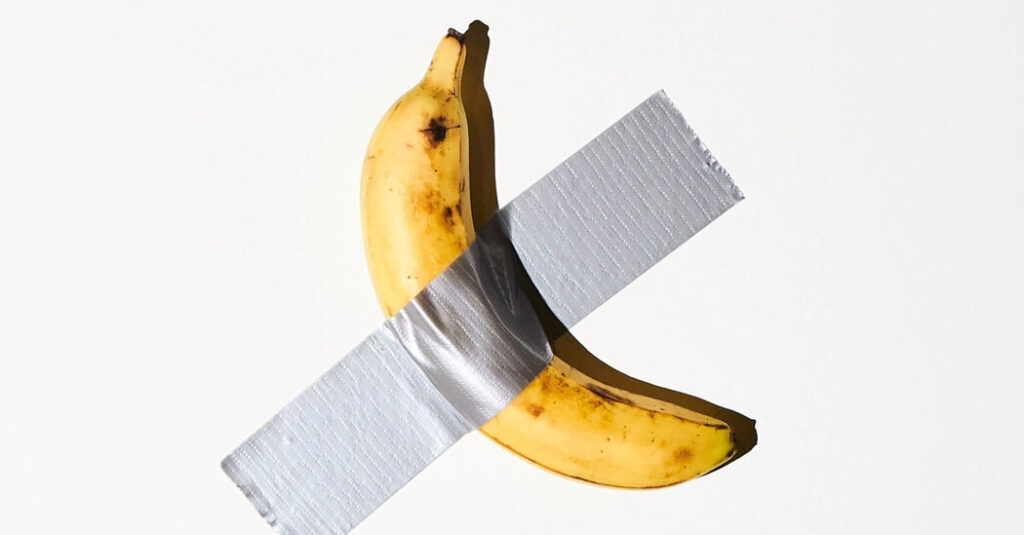
In addition to recognizable works by the likes of Roy Lichtenstein and Andy Warhol, the show — which runs through Jan. 10, 2027 — will include pieces by the conceptual artists Maurizio Cattelan and Lucia Hierro, along with works by the Iranian American multimedia artist Sheida Soleimani.
“These artists aren’t necessarily identifying as related to Pop directly, but pulling on those legacies,” Hinkson said, adding that the contemporary works in the show are “deploying strategies of color and visual languages from that period, but critiquing it and pushing against it and activating that familiarity in interesting ways.”
Hierro, 38, a Dominican American conceptual artist, said that she considers her work — which features everyday grocery store items — to be in conversation with Pop legends like Oldenburg and Tom Wesselmann.
“When I enter the studio, it’s like I’m going to a bar with these guys,” she said in a phone interview, saying of the Guggenheim show, “People are going to come for the main canon figures and they’re going to leave with a knowledge of new artists.”
The exhibition is in part informed by the important role played by Lawrence Alloway, who resigned as a Guggenheim curator in 1966 after clashing with Thomas Messer, then director of the museum, over artistic differences.
It was under Alloway that the Guggenheim presented “Six Painters and the Object” in 1963, an important institutional presentation of Pop Art. While the Guggenheim did not acquire any pieces in that exhibition, Hinkson said, the museum eventually acquired works by all the artists in that show — which included Jasper Johns, Robert Rauschenberg and James Rosenquist — in building its own Pop collection.
Alloway had great admiration for Yayoi Kusama — the show will feature a Kusama infinity room — one of several artists who resisted the Pop label, although she influenced contemporaries like Oldenburg and Warhol.
She instead “was bridging Abstract Expressionism and different postwar movements,” Hinkson said, “and was more interested in performance and Happenings and her immersive art practices.”
The exhibition will explore the Happenings movement of the early 1960s, when artists like Kusama, Oldenburg and Jim Dine experimented with collective art making and performance.
Other artists in the show eschewed the Pop moniker, namely Chryssa, the Greek-born American sculptor who helped establish neon as an art form and had a solo show at the museum in 1961.
Chryssa’s work was inspired in part by the energy of Times Square, which she viewed as a place of Byzantine icons, Hinkson said, adding that Chryssa felt her expression was “closer to the ideas of Dada and Neo-Dadaism and found objects, rather than Pop.”
The contemporary pieces in the show will include an example from Martine Gutierrez’s “Demon” portraits, in which the artist transforms herself into mythical women from ancient and Indigenous cultures.
Cara Romero, a photographer of the Chemehuevi tribe, will be represented by her take on the American Girl doll trope, reclaiming the doll from an Indigenous perspective with objects that signify identity.
“The goal with presenting the recent acquisitions was to continue this conversation around our collection and how it’s a living collection,” Hinkson said, “a place that continues to be rethought, recontextualized, studied in different ways.”
The show will also give the Guggenheim an opportunity to highlight lesser-known classics, such as all three of its Richard Hamilton fiberglass reliefs of the Guggenheim facade (1965-66) and Warhol’s “Orange Disaster #5” (1963), a grid of silk-screened electric chair photographs.
The museum rarely shows its piece from Lichtenstein’s “Mirrors and Entablatures” series of the early 1970s — his take on the classical architectural details of New York — because it is so large and not as recognizable as the artist’s dot paintings.
“A Greek and Roman building facade is not something you would necessarily think of when you think of Lichtenstein,” Hinkson said.
While Pop Art has come to be considered a crowd pleaser — often marked by accessible subject matter, a sense of humor and vivid colors — it did not gain immediate acceptance. Early reviews of Lichtenstein’s “Entablature,” for example, “called it, ‘acrid,’ ‘an embarrassment to the institution,’” Hinkson recalled, and questioned, “‘How can you take the window on the street and put it inside the art museum?’”
Over time, institutions, collectors and the public have developed an affection for Pop Art, which often recalls the totems of childhood, like comic strips and stuffed animals.
The exhibition will include Oldenburg’s “Freighter and Sailboat” from 1962, a lumpy but whimsical early example of the artist’s interest in everyday things and a precursor to the larger soft sculptures that became his signature.
“We hope drawing people in with these core anchor pieces and then broadening the story around those works will lead to some surprising connections,” Hinkson said, “and a chance to learn something new.”
Robin Pogrebin, who has been a reporter for The Times for 30 years, covers arts and culture.
The post Pop Art Engages With Art of the Present at the Guggenheim appeared first on New York Times.