As recently as last year, America’s allies and strategic partners in Asia steered clear of buying Russian oil in order to comply with Western sanctions. And many had limited interactions with Iran, another major producer.
The U.S. and Israeli war on Iran has upended those dynamics.
For many Asian countries reeling from the oil shock caused by the war, securing a meeting or phone call with officials in Moscow and Tehran is now top of the agenda. On Monday, a special envoy from South Korea began meeting officials in Iran to discuss the fate of South Korean vessels stuck in the Persian Gulf. That same day, President Prabowo Subianto of Indonesia arrived in Moscow to buy oil.
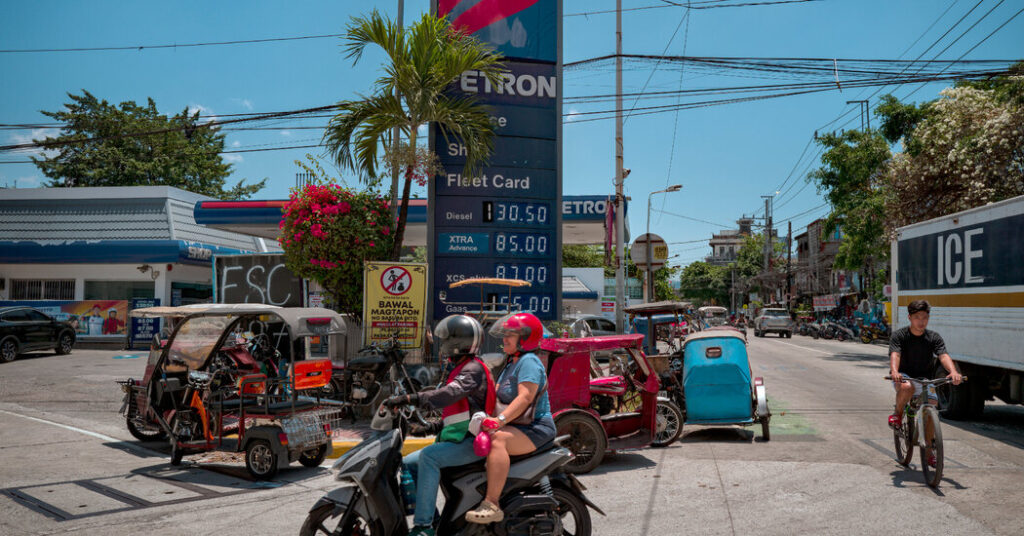
Before the war, about 80 percent of the oil that passed through the Strait of Hormuz was destined for Asia. The sudden shortfall caused by the war has left countries with small oil reserves, like the Philippines, scrambling to figure out how to shore up supplies. Many leaders in the region are turning to America’s adversaries for their needs, as President Trump sends mixed signals about how long the war will last.
That means that for some countries in Asia, oil from Iran and Russia is returning for the first time in years, after Washington suspended some sanctions on its rivals. Last month, the Philippines received its first shipment of Russian crude oil in five years. This week, Iranian crude oil officially returned to India after a seven-year pause.
These transactions do not signal a break from Washington, but they are helping America’s rivals.
“U.S. foreign policy under Trump is to push many away from the U.S. to seek other alternatives,” said Huong Le Thu, the deputy director of the Asia program for the International Crisis Group.
Even so, how much oil can flow from Iran and Russia to Asia is unclear. The U.S. Navy has imposed a blockade of Iranian ports. The Trump administration did not extend the sanctions exemption on Russia and may similarly let a temporary license allowing Iran to sell oil expire on April 19.
The reality for many countries in Asia is there are few sources of oil that don’t sail through the strait. One is Russia.
That has given Russia’s leader, Vladimir V. Putin, a renewed prominence on the global stage. On Monday, Mr. Prabowo praised him for playing “a very positive role in dealing with this uncertain geopolitical situation.”
After Mr. Putin launched the full scale invasion of Ukraine in 2022, some of America’s allies in the region — including South Korea and the Philippines — stopped importing Russian oil, in solidarity with the United States and Europe. That helped push down the price of Russian oil steeply.
But Russian barrels are now fetching a double-digit premium above the global benchmark price for oil, according to Emma Li, an analyst at Vortexa, a data analytics firm specializing in oil and gas shipments.
“I’m afraid that, given the current situation, no matter how expensive the oil is, there is no choice,” Ms. Li said.
Here is what some countries are doing to shore up their oil stocks:
South Korea
For countries like South Korea, one option is to wait for the United States or Europe to release some of their strategic petroleum reserves. But shipping oil from those places would be expensive, and shipments would take up to two months to arrive, Ms. Li said.In contrast, shipments sent from ports in the Russian Far East could reach South Korea in just a few days, she added.
On March 30, South Korea allowed some companies to import from Russia 27,900 tons of naphtha — a refined product typically used as a feedstock for petrochemicals.
When President Lee Jae Myung convened his National Economic Advisory Council last week, the group suggested that South Korea import crude oil and natural gas from Russia and Iran, as well as buy “as much naphtha as possible” from China and Russia.
Park Won-joo, a council member, recalled that during the Middle East crisis in 1973, South Korea issued a pro-Arab statement despite being a U.S. ally.
“Even within an alliance, we should secure practical exceptions for energy,” he said at the meeting.
Japan
Japan is in the unusual position of having friendly relations with both the United States, its main ally, and Iran, which for decades was a primary supplier of oil to Japan.
In 2015, Japan chose not to participate in the negotiations that led to the deal to curb Iran’s nuclear ambitions. That decision created space for Tokyo to pursue an independent policy toward Tehran.
This month, Japan’s prime minister, Sanae Takaichi, spoke by phone with Iran’s president, Masoud Pezeshkian. She pressed him to work to ensure freedom of navigation in the Strait of Hormuz and to release a Japanese citizen detained by the Iranian authorities, according to a statement by the Japanese government.
It is not the first time Japan has directly engaged with Iran. In 2019, Shinzo Abe, the former Japanese prime minister, visited Tehran in an effort to contain the fallout of Mr. Trump’s decision to pull out of the 2015 nuclear accord and impose crippling sanctions. Under American pressure, Japan has in recent years stopped oil imports from Iran.
Some officials and commentators have argued that Ms. Takaichi should follow that example and push Iran to reach a deal with the United States.
The Philippines
In the Philippines, America’s oldest treaty ally in Asia, the oil shortage has led to the declaration of a national emergency. It is looking to Russia as well as the United States, Canada, and India.
The country is asking the U.S. government to extend the sanction waiver to allow it to purchase more Russian oil, said Jose Manuel Romualdez, the Philippines’ ambassador to the United States.
Mr. Romualdez said the Philippines’ ties with the United States and with Russia were “not mutually exclusive” and that his country’s foreign policy would always be “anchored on our national interest.”
“The Philippines does not view developments in the Middle East as necessitating a re-calibration of its relationship with Russia vis-à-vis the United States nor does it view its international relationships in absolute terms,” Mr. Romualdez wrote in an email.
India
India, while not formally an ally of the United States, has become an indispensable part of American strategy in the region. The relationship, despite some rockiness, is important to both sides..
India had stopped buying Iranian oil in 2019, to comply with American sanctions on Tehran. In recent weeks it was on the verge of replacing Russian crude imports with oil from the Middle East — a move to placate Washington and reach a trade agreement.
But the U.S.-Israeli attacks on Iran and the ensuing blockade of the Strait of Hormuz made mincemeat of that plan. Instead, India had to resume buying Russian seaborne oil, now at a premium.
And on Tuesday two tankers filled with oil from Iran docked at Indian ports, according to Bloomberg.
Indonesia
Indonesia, which says it pursues an independent foreign policy, is also not a formal treaty ally of the United States.
But it has developed closer ties with America, and the two countries announced a defense partnership on Monday.
At the same time, Indonesia has secured the import of oil, liquefied petroleum gas and fuel from Russia, said Laode Sulaeman, an official at Indonesia’s energy ministry, who said the specifics were still being ironed out.
Rin Hindryati contributed reporting from Jakarta.
Sui-Lee Wee is the Southeast Asia bureau chief for The Times, overseeing coverage of 11 countries in the region.
The post Iran War Forces America’s Friends in Asia to Court Its Rivals appeared first on New York Times.