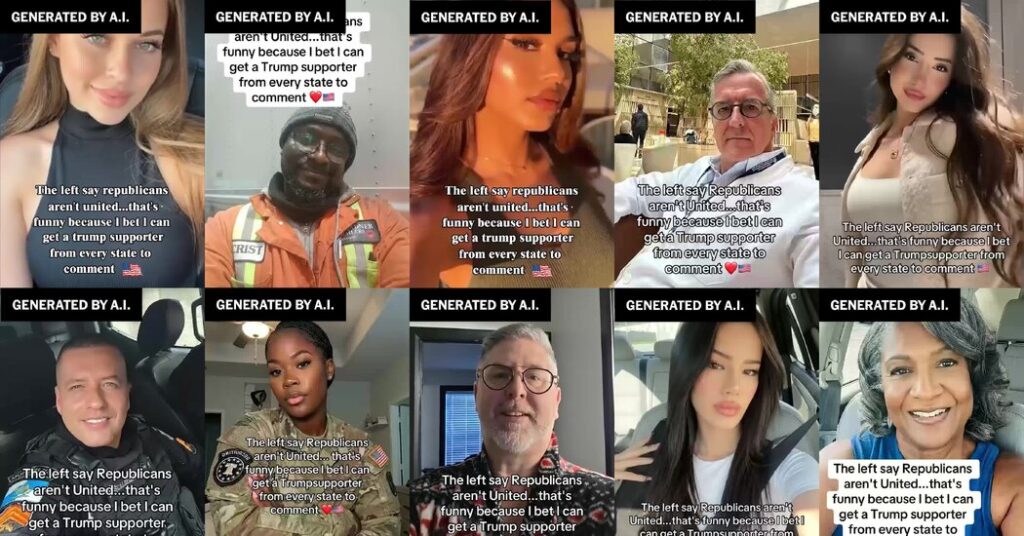
In one TikTok video, a blonde films herself with a group of women at a racetrack. “If you support Trump, you just made a friend,” she says.
In another video, it’s a brunette, this time with a group at a stadium. “If you support Trump, you just made a friend,” she says.
In a third post, a redhead is with a group at a basketball court. “If you support Trump, you just made a friend,” she says.
Each video features an identical, grammatically awkward caption: “I’m new here and love God, America,and Trump!!”
All are the work of artificial intelligence.
In the months leading up to the midterm elections, hundreds of accounts have emerged on social media featuring A.I.-generated pro-Trump influencers posting at a rapid pace about the “radical left” and “America First.” They tend to appear as ordinary — if very good-looking — men and women, gazing flirtatiously at the camera while pontificating about the war in Iran, abortion or Bad Bunny.
President Trump has reposted content from at least one of the accounts — a platinum blond avatar making unfounded claims about California’s governor.
The New York Times began tracking MAGA-boosting, A.I.-generated TikTok posts in January and discovered at least 304 accounts sharing the content, some of which have since disappeared. Researchers with the Governance and Responsible A.I. Lab at Purdue University, known as GRAIL, found another dozen accounts across TikTok, Instagram and Facebook. Eric Nelson, a special investigations analyst from Alethea, a digital threat mitigation company, identified another nine accounts on YouTube.
Several accounts have already amassed more than 35,000 followers. Some of the posts have more than half a million views. The accounts reviewed by The Times were not identified as A.I.-generated.
It’s not clear who created the A.I. accounts, and determining whether they are the product of a hired content farm, a foreign influence operation, an experiment or something else is difficult, experts said. They all agree, however, that creating such avatars is becoming easier, especially for contractors and marketing companies that now specialize in developing and dispatching A.I. avatars in bulk for increasingly low prices.
The emergence of the A.I.-generated political avatars, researchers said, suggests a sweeping effort to hook conservative voters, a demographic primed by the president and his circle to accept memes, influencers, deepfakes and other digitally packaged messaging. Neither The Times nor the researchers it consulted found any similar left-leaning networks.
“People gearing up for the midterms should expect that they might see some of this content on their accounts, that it might be crafted to be particularly engaging or exciting to them,” said Kaylyn Jackson Schiff, a co-director of GRAIL.
TikTok said in a statement that it conducted a careful review of the 304 accounts and found “zero indication of covert influence operations.” The company concluded instead that the accounts were spammers attempting to mine engagement — what it called “an unfortunate regular occurrence across phones and social media.” TikTok said it was in the process of removing the accounts.
In election years, politics chatter always increases online, much of it propelled by automated bots, trolls and other inauthentic accounts. But now, A.I. is giving that murky underworld a new face — swarms of new faces, actually, along with realistic voices, personalities and talking points, enough to populate the mirage of a political movement.
At least for now, some of the A.I. accounts appeared to be focused less on politics than on inflating their engagement metrics by soliciting followers and comments. Several accounts looked like romance catfishing scams; others sold hair removal creams or tours to China, and they padded their posts with artificially generated content about entertainment, sports, religion and other nonpolitical subjects. Many of the A.I. accounts, however, seemed intent on manipulating the audience’s political opinion.
“This really is the first time I have seen something like this,” Mr. Nelson said.
Many of the accounts are clearly linked, with several clusters sharing identical language, imagery, profile pictures and sound effects. The same characters appear across multiple accounts: a blonde in braids and a billowy dress on a farm at golden hour, a woman in a purple top seated in a wheelchair, a Black woman in a red MAGA hat and aviator sunglasses. Several of the accounts follow one another.
It is difficult to tell exactly when or where the accounts were created. On nearly all of them, the first visible video was posted within the past year. Most claim to hail from various American states but use stilted or ungrammatical English. Mr. Trump is their favorite “presidont,” they wrote in captions, describing themselves as “sharing you the truth” and urging viewers to “follow me first if like my live.” The bios of at least 13 accounts state “Republican&Proud Of you support Trump let me know 


 .”
.”
The A.I. avatar reposted by Mr. Trump, which has more than 51,000 TikTok followers, spoke in a heavy foreign accent in her first two posts on Jan. 15. The next day, she had adopted an American accent.
A.I. avatars already promote unproven wellness supplements, host misinformation-laden news programs and dispense dubious medical advice. In politics, A.I. can meaningfully shift voter opinion. A huge volume of pro-MAGA posts, mixed in with content from human creators in a fast-moving social media feed, could lay the groundwork for viewers to think more favorably about Republicans and Mr. Trump — “spray mode” instead of precision, as one expert put it.
“They’re trying to spread political messages and give an illusion of a consensus,” said Andrew Yoon, a member of the technical staff at CivAI, a nonprofit that educates people about A.I.’s capabilities and consequences. “Flooding the zone here with tons and tons of videos seems geared to give a false sense of a majority opinion.”
Dr. Schiff of GRAIL said some of the accounts might be trying to target certain audiences by making tiny changes to the avatars. The Times began tracking one account in early February, right after it started posting as a brown-eyed, brunette avatar in a car. Since then, the account has posted 37 videos. The avatar has morphed six times; her hair turned blond, her eyes turned blue and so on.
Often, the avatars appear in military settings or dressed as immigration agents, as if trying to capitalize on recent conflicts. An Instagram account examined by The Washington Post, showing an A.I. avatar of a blond soldier posing with Mr. Trump and other world leaders, picked up more than a million followers.
Over one week this spring, 10 different accounts posted a similar line of women in military fatigues using the same unnatural cadence to say, “If this offends — you good — keep scrolling,” before urging viewers to “hit — follow.” Other posts show warped American flags and other A.I. tells.
Although the quality of some of the accounts edged toward slop, and engagement may be inflated by bot activity, researchers said the comments on the posts suggested that many users believed that the avatars were real people.
Meta said it requires users, under threat of penalties, to disclose when posts featuring photorealistic content are made or edited using A.I. However, it noted that A.I.-generated content can be challenging to identify, especially as the technology evolves. YouTube said in a statement that it was reviewing the channels with political A.I. avatars and was terminating those that violated the platform’s policies covering spam and deceptive practices.
Each post featuring the pro-Trump avatars probably costs around $1 to $3 to generate, according to Zuhair Lakhani, a co-founder of an Andreessen Horowitz-backed A.I. advertising start-up called Doublespeed. The company, which runs smartphone-powered bot farms that deploy hordes of synthetic influencers, boasts online that “one person can now orchestrate what used to take a 30-person creator team and $40,000 at 10 percent of the cost.”
Mr. Lakhani said Doublespeed declined work with political campaigns despite being solicited by Democrats, Republicans and foreign parties — a refusal born of “a moral compass thing,” he explained. However, he said, “there are a lot of companies out there that are taking those contracts, and those contracts are honestly bigger and very tempting.”
The Republican National Committee is not involved in the accounts, according to Zach Parkinson, the communications director for the group. He said Republican campaigns should use every tool possible in their races, including artificial intelligence, but stressed that the technology was “not a silver bullet.”
“Nothing will replace a winning message or a great candidate on the positive side, or real audio, video and visuals in an attack ad,” he said. “Authenticity is still king.”
Tiffany Hsu reports on the information ecosystem, including foreign influence, political speech and disinformation
The post Hundreds of Fake Pro-Trump Avatars Emerge on Social Media appeared first on New York Times.