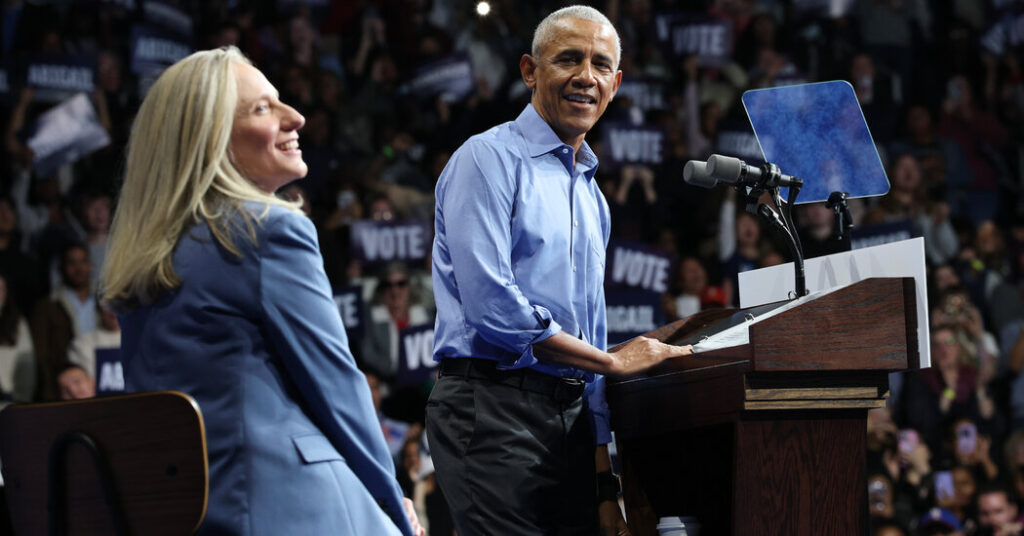
Virginia voters could be forgiven for wondering where Barack Obama stands on gerrymandering.
The former president is appearing in videos and ads pushing Virginians to vote “Yes” on a Democratic-backed referendum next week on whether to redraw the state’s House map to give the party more seats. But the Republican-backed “No” side is running TV ads that highlight his past opposition to partisan gerrymandering.
The dueling Obama ads have confused voters, according to the referendum’s Democratic supporters, who have grown increasingly anxious about the vote in the final days before Election Day on Tuesday.
If the referendum passes, Democrats would have a stronger chance of winning back the House in the midterm elections in November. The party now controls six of Virginia’s 11 House seats, but the proposed map could pave the way for it to win as many as 10 of them. The vote is part of the nationwide gerrymandering arms race that President Trump and Republicans instigated last year in Texas.
Democrats in Virginia say that the “Yes” side may well win — the state is light blue, and the national environment is darkening for Republicans. But while other states have swung away from Republicans during Mr. Trump’s second term, Virginia appears to be moving back toward them since Gov. Abigail Spanberger, a Democrat, took office in January.
Worried Virginia Democrats point to falling approval numbers for Ms. Spanberger, low grass-roots energy and muddled messaging in a campaign that has failed to capitalize on lavish funding. Even if the “Yes” side wins, state Democrats believe it could be by significantly less than Ms. Spanberger’s 15-point margin of victory last year, sending a warning signal to otherwise energized Democrats ahead of the midterms.
“There are going to be Democrats that vote ‘No’ on this. People are confused,” said Representative Suhas Subramanyam, a Virginia Democrat whose district covers Loudoun County and other Northern Virginia suburbs. “Some are confused about what Democrats like Barack Obama and Abigail Spanberger think about redistricting. Republicans have used their images to convince people that they should be voting ‘No.’”
Mr. Obama appears to be trying to clear up the confusion.
On Friday, he released a new get-out-the-vote video urging voters to back the measure, after recording previous direct-to-camera spots that the Democratic side has used in advertising.
“By voting ‘Yes,’ you can push back against the Republicans trying to give themselves an unfair advantage in the midterms,” he says in the video, referring to how Mr. Trump and Texas Republicans kicked off the country’s redistricting battle last year.
Over the course of the 48-second video, Mr. Obama uses the word “Yes” five times.
Republicans who oppose the referendum are running ads with old footage of Mr. Obama lamenting that gerrymandering makes it “harder and harder to find common ground.”
Both sides are also heavily featuring Mr. Obama’s elastic views on gerrymandering in a flood of direct mail to voters.
Complicating the “Yes” argument is the fact that Virginia Democrats are asking voters to overturn a state constitutional amendment enacted just five years ago that created a bipartisan commission to draw the state’s congressional map.
Some plugged-in Virginia Democrats worry that their party’s voters have been turned off by the idea that the referendum is a power grab.
Nationally, many Democrats have shifted their views on the merits of aggressive partisan gerrymandering since Republicans began their unusual mid-decade redistricting push last year. These Democrats argue that it was bad when Republicans did it, but that they must fight fire with fire and control the cartography wherever they can.
Now, the potential Virginia gerrymandering is central to the party’s hopes of retaking a majority and checking Mr. Trump’s power. Aiming to become speaker, Representative Hakeem Jeffries of New York, the minority leader, has encouraged the effort.
“They were all against gerrymandering before they were for it,” said Jeff Ryer, the chairman of the Republican Party of Virginia, said of Democrats. “The fact that we are pointing out that they used to be against it — that just points to their, shall we say, sliding scale of convenience.”
Mr. Ryer said the referendum had energized grass-roots Republicans and united moderate and Trump-aligned factions that have long been at war. If the “Yes” margin is in low single digits, he said, Republicans will claim momentum in the state.
Mr. Ryer and his Republican allies are blanketing Virginia mailboxes with glossy literature showing anti-gerrymandering quotes from Mr. Obama and Ms. Spanberger and photos of Black families — a clear attempt to depress turnout from core Democratic voters.
Prominent Democrats are trying to push back.
“They are lying about President Obama and Gov. Spanberger,” former Attorney General Eric H. Holder Jr. said in a video on social media. “They are trying to use these lies to suppress the Black vote.”
Ms. Spanberger’s role in the race has proved to be complicated.
The “Yes” campaign stopped running TV ads featuring her, and in recent days she has drawn online criticism from L. Louise Lucas, the Democratic president of the State Senate, who was instrumental in pushing an aggressive 10-to-1 map and has been feuding with the governor over the state budget.
A Washington Post poll released this month found that Ms. Spanberger’s approval rating had dropped to 47 percent, with 46 percent of voters disapproving.
“Governor Spanberger has continued to be a vocal supporter of this opportunity for Virginians to take direct action in response to what we’re seeing in other states,” said her spokeswoman, Libby Wiet.
Democrats began the referendum campaign with a huge financial edge. During the first six weeks of advertising, the “Yes” campaign spent 21 times as much on advertising as the “No” side did, according to data from AdImpact, a media tracking firm. But in the final week before the election, the “No” side has spent nearly as much on advertising as the “Yes” effort.
Both sides have been powered by an extraordinary amount of funding from dark-money nonprofit groups that do not disclose their donors.
Of the more than $64 million raised by the main Democratic-backed redistricting group, Virginians for Fair Elections, at least $55 million has come from groups that do not disclose their donors. The largest donor has been House Majority Forward, a nonprofit group aligned with Mr. Jeffries, which has given about $38 million.
The largest Republican-backed group opposing the redistricting push, Virginians for Fair Maps, has raised just $22.3 million. But 96 percent of that money came from secret donors. Another Republican-aligned group, Justice for Democracy, has raised a little over $9 million, exclusively from dark money nonprofits.
A rally on Wednesday in Loudoun County, a liberal-leaning suburb of Washington, illustrated Democrats’ challenge in generating enthusiasm. Four members of Congress and a handful of state legislators gathered in the parking lot of a Korean day spa, in front of a replica of a 16th-century warship. But just a few dozen supporters came to hear them speak.
The event followed weeks of internal briefings for congressional Democrats that suggested their party’s turnout in early voting was well behind that of the November elections.
“I hear that voter turnout has been low and slow,” said Representative Marilyn Strickland of Washington State, who made an hourlong trek from the Capitol to participate in the rally.
In the campaign’s final days, the “Yes” effort has focused much of its energy on telling Virginians that the referendum is meant to fight Mr. Trump. At the Loudoun rally, signs read “Vote Yes to stop the MAGA power grab.” The campaign’s final-week TV ads urge voters to push back against Mr. Trump.
“The referendum is all about controlling and restraining the president’s worst impulses,” Representative Eugene Vindman, a Virginia Democrat, said in an interview.
Mr. Trump has so far been quiet about the Virginia campaign. Mr. Ryer said state Republicans had not asked for his help.
“The Republican Party of Virginia would always welcome the president of the United States and his active participation,” he said. “We certainly understand why at the present time he has many other concerns.”
Theodore Schleifer contributed reporting.
Reid J. Epstein is a Times reporter covering campaigns and elections from Washington.
The post How Obama Became a Main Character in Virginia’s Gerrymandering Battle appeared first on New York Times.