This is the year of Mary Cassatt.
The beloved painter of mothers and children — the only American, and one of just a handful of women, to have been welcomed into the French impressionist boys’ club — did have a moment in the sun two years ago. The Philadelphia Museum of Art’s 2024 exhibition “Mary Cassatt at Work,” coinciding with the 150th anniversary of the first impressionist exhibition, exploded the notion of Cassatt as little more than a painter of sentimental “Mother’s Day card clichés,” in the words of one critic.
But this year, the centennial of Cassatt’s 1926 death, promises a new round of museum attention. Potential blockbusters include the Art Institute of Chicago’s “Mary Cassatt: After Impressionism” (opening Sept. 6) and the Musée d’Orsay’s “Mary Cassatt: The Choice of Independence” (opening Oct. 6). The Musée d’Orsay show, which will feature about 80 paintings, pastels and prints, will be the first major exhibition devoted to Cassatt in a French national museum.
Setting the stage for these large surveys is “Mary Cassatt: An American in Paris,” a more modestly scaled curtain-raiser now at the National Gallery of Art in Washington. Featuring just 14 oils on canvas alongside two tiny rooms dedicated to the artist’s ambitious printmaking work in drypoint, aquatint and softground etching, it’s nevertheless a worthy if concise reminder of what it is about Cassatt that remains so fascinating 100 years after her death.
The National Gallery defines her strength as “in betweenness”: Cassatt was an American who worked in France, an academy-trained painter who was not afraid of innovation, and a woman who, despite the subject of so much of her work, chose not to marry or have children.
When she turned her attention to the theater, like so many of her peers, it was not to look at the women onstage, but at the ladies in the audience. When she set scenes in domestic interiors — dressing rooms and the like — as her colleagues did, including her friend and sometime collaborator Edgar Degas, they are drained of eroticism. The striking subject of the National Gallery’s “Girl Arranging Her Hair” — more Pippi Longstocking than conventionally pretty — is a case in point.
There is also a persistent “scholarly allergy” to calling Cassatt a feminist, as art historian Nicole Georgopoulos has observed. Cassatt’s most familiar subjects are still too easily dismissed as sentimental. And such prints as “Mother’s Kiss,” “Maternal Caress,” “Woman Bathing” and “The Coiffure,” part of Cassatt’s series known as the “Set of 10” — her greatest printmaking achievement — do little to persuade viewers of her feminist leanings.
But there is one work in the National Gallery show that makes a strong argument for just that.
‘Woman With a Sunflower’
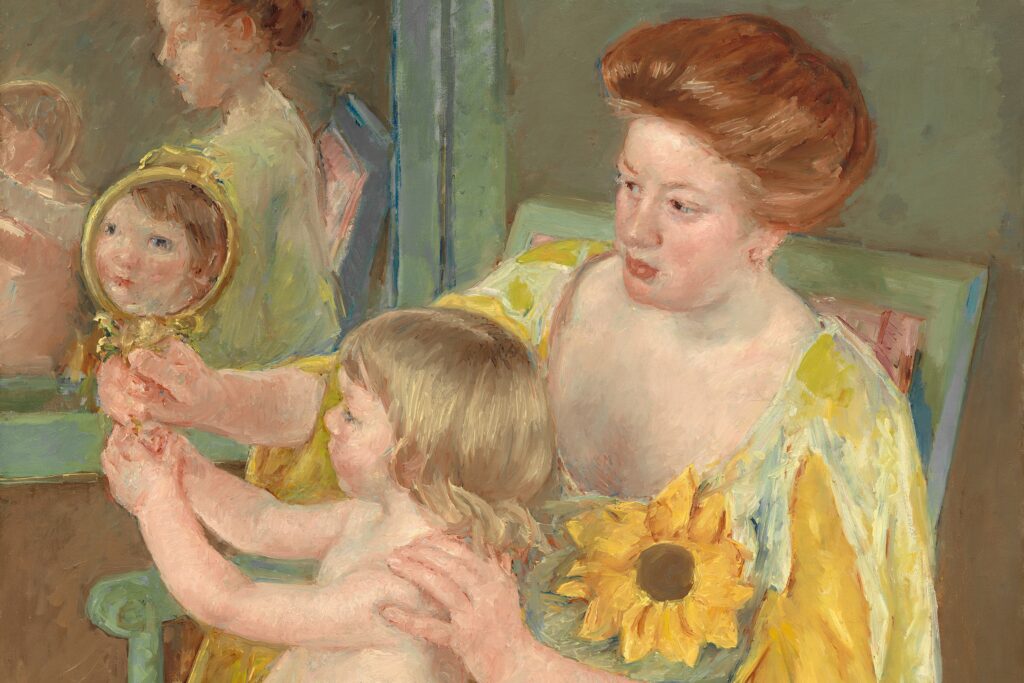
Painted circa 1905, this work shows a naked girl sitting on a woman’s lap, a hand mirror held up to reflect the child’s face, and a large sunflower pinned to the woman’s gown, the sleeves of which echo the vibrant gold of the flower.
Just another tender mother and daughter scene? Perhaps not, though this painting came to the gallery in 1963 (a gift of collector Chester Dale, like several of the works in this show) with the title “Mother and Child.” (NGA regulars probably know it best by that name, although the museum changed it in 2019 to “Woman With a Sunflower,” the title Cassatt gave it when it was first exhibited.)
There is no firm evidence that its subjects are even related, Georgopoulos has noted, and each appears in other Cassatt paintings with other people. Maybe the picture does not center a maternal relationship after all, Georgopoulos argues, but rather an intergenerational metaphor: Tomorrow sitting on the lap of the Today.
Georgopoulos’s research, laid out in a 2020 blog post published when she was a postdoctoral curatorial fellow at the gallery, lends credence to this idea.
Could that sunflower, rather than being a mere ornament — several of Cassatt’s women wear blooms — be sending a message? Georgopoulos thinks so. When Cassatt made the painting, the sunflower was the official symbol of the National American Woman Suffrage Association, and gold was one of the colors associated with the movement. Their inclusion by Cassatt, a fierce advocate for the women’s suffrage movement — which was, by 1905, in full flower — is probably no accident.
As for the mirror, held at such an angle that the girl is gazing at us, the viewers, Georgopoulos sees it not as a symbol of vanity, but of “female creative potential.”
In 1914, on the eve of World War I, Cassatt wrote to a friend, the feminist art collector and philanthropist Louisine Havemeyer: “If the world is to be saved, it will be the women who save it.” American women — or at least White American women — would not get the vote until 1920. But looking at Cassatt’s powerful painting, you can see, in the face of that girl, a reflection of Cassatt’s fervent hope, if not conviction, that the future would be female.
Mary Cassatt: An American in Paris is on view through Aug. 30 at the National Gallery of Art, Sixth Street and Constitution Avenue NW. nga.gov.
The post A turn-of-the-century Mary Cassatt painting subtly hints at a female future appeared first on Washington Post.