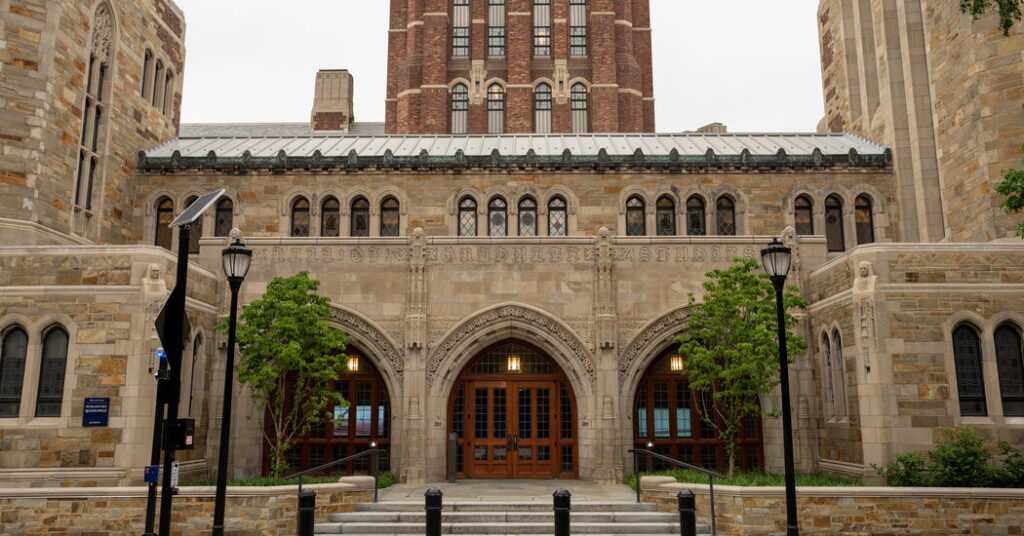
American colleges and universities bear significant responsibility for plunging public trust in higher education, a Yale University committee suggested in a report released on Wednesday.
High costs, murky admissions practices, uneven academic standards and fears about free speech on campuses, the committee said, are among the reasons for widening discontent over higher education’s worthiness.
The findings reflect misgivings that Americans have described across years of polling and interviews. But the report, from a 10-professor panel at one of the nation’s most renowned universities, amounts to a damning depiction of academia’s role in cultivating the political and cultural forces that are reshaping higher education’s place in American life.
“Trust is earned by doing what you say you’re going to do — and, ideally, doing it well,” the committee wrote, describing “widespread uncertainty about the fundamental purpose and mission of higher education.”
Universities have faced pressure to help address societal problems, the committee noted, saying they were “expected to be all things to all people: selective but inclusive, affordable but luxurious, meritocratic but equitable.”
But, the professors added, “without a clear mission and purpose, it becomes difficult to judge whether colleges and universities are living up to their fundamental commitments.”
Most American schools are far removed from places like Yale, where the estimated annual cost of attendance for undergraduates exceeds $90,000 before financial aid. Administrators at many institutions, most of which cost far less and admit far more students, complain that their schools are unfairly tied to selective universities.
But those broad perceptions are driving debates about academic offerings, taxpayer support for universities, and President Trump’s attacks on a higher education system that predates the nation itself.
Friction around colleges is not new. The committee, though, pointed to a congruence of contemporary practices to help explain why academia’s standing has declined so far, so fast. Gallup reported last September that 35 percent of Americans regarded a college education as “very important” — half the number who thought that in 2013.
Yale commissioned its report last April, as the Trump administration pelted elite universities with criticism and funding cuts. Yale avoided the worst of the administration’s wrath, but its president, Maurie McInnis, said academic leaders needed to better understand public sentiments.
In its report, the Yale panel extolled the aims of higher education, but was unsparing in suggesting how schools, including Yale, had harmed public views of it.
For example, Yale and many other schools now rely on a model that regularly dilutes high tuition prices with generous aid packages. Although many students pay nowhere near sticker prices, the committee wrote that the approach had exacted “a disastrous impact on public trust.”
“By its nature, the system is complicated, unpredictable, secretive and highly variable,” the report said. “These factors tend to reduce trust rather than increase it.”
(Some efforts are clearer: Yale announced in January that it would not charge tuition for undergraduates from families making less than $200,000 annually.)
Undergraduate admissions procedures, well-intentioned as they might be, are often opaque, the committee added, devoid of decipherable standards for matters as fundamental as academic achievement. Yale is among the schools with no minimum test score requirement.
“When selective admissions seem so inexplicable — or, worse, tilted in ways that benefit the already advantaged — it should come as no surprise that many Americans do not trust the process,” the committee wrote.
And the group warned about how other issues, such as grade inflation and increases in university staff, were undermining academia’s stature.
“Our goal in the report was to take the long view and to acknowledge that public skepticism and distrust is something that’s built over time and will take some time to reverse,” Beverly Gage, a historian who was the committee’s co-chair, said in an interview. “But we were very committed to the idea of self-scrutiny, and we’re very committed to the idea that, moving forward, the strategy needs to be not just one of changed communications but one of real, substantive action and self-critique.”
The committee offered dozens of recommendations, like expanding financial aid, reducing admissions preferences, zealously protecting free speech and adjusting grading policies. People in academia, the committee said, “must be willing to admit where we have been wrong and where we might improve, even as we defend what is essential about higher education and its academic mission.”
The other co-chair, the sociologist Julia Adams, said committee members hoped their recommendations would upend perceptions. But she added that “change is necessary for its own sake.”
In a campus email on Wednesday, Dr. McInnis said people at Yale had been “certainly more than mere bystanders” as public confidence collapsed.
“We must acknowledge how we have fallen short,” wrote Dr. McInnis, who was not on the committee.
Dr. McInnis did not immediately implement all of the panel’s recommendations, though she appeared open to many of them. In an interview, she said that there was an appetite for public debate about higher education that she hoped the report would deepen.
“Really, everywhere I go in my engagements with the public more broadly,” she said, “it is a topic that people wish to be discussing.”
Alan Blinder is a national correspondent for The Times, covering education.
The post Yale Report Finds Colleges Deserve Blame for Higher Education’s Problems appeared first on New York Times.