
You’ve (finally) made an appointment with a therapist. Just getting the appointment took some legwork. This is an in-person appointment, so you walk from the nearest metro station, or step out of the ride share, or park your car. If you’re really fortunate, you were able to walk there. You arrive to the therapist’s office, perhaps anxious, flustered, maybe numb.
What do you see when you walk in?
You might enter a lobby. It might be windowless. Neutral carpeting, overhead lighting. There might be a bank of small buttons on the wall, and with one press, the button signals to the therapist in the room that you’ve arrived. That’s old school, though. You might enter an old apartment building that’s been rezoned for offices with no waiting room to speak of. Or you might enter directly from the street into an office, without the pacifying liminal space of a waiting room.
As a client of therapists in Los Angeles (one Jungian analyst in a big Westside office building, another in a home office in my neighborhood — and yes, I got to walk there), and as a therapist myself, I’m often thinking about The Room. The fantasy of the contemporary therapy room is often based on images planted by pop culture: The dark wood paneling and furniture of Dr. Melfi’s office in “The Sopranos” comes to mind, or the most recent season of the L.A.-based home office of “In Treatment,” with its distinctive view of the city and its well-appointed and colorful interior. Between just these two shows, one can see how the therapy space and how we perceive it is subtly changing.
The first office where I sought therapy was in a small town in the Pacific Northwest. I took an elevator and approached a door with frosted glass. The building was historical and aptly named the Security Building. I was in my early 20s. It was in that office where I began untangling some of my own history, much of which would later appear in my first book. My weekly processing of the past eventually migrated to another building when my therapist moved her practice to a house rezoned for offices in a residential neighborhood. Both locations served as a particular kind of refuge, places where I came to new understandings and occasional epiphanies. In each office, I sat across from my counselor on a couch, held in a space that she created.
“If the unconscious is structured like a language, the design of a therapist’s consulting room is also a language,” Deborah Levy writes in a recent Granta essay. As a writer/therapist, I can appreciate this — including when Levy later notes that therapy rooms are “often beige” and that even if the “room’s mood attempts to be entirely neutral, someone has art-directed its blandness.” When I think of the various therapy rooms I worked in as an associate therapist in a busy community clinic, I recall the attention to having a somewhat blank canvas across many rooms, that each could be outfitted with donated furniture, random books and an occasional piece of art. If you’ve been in therapy for as many years as I have, you probably recognize this blandness.
Up until the 1980s, there was not as much attention given to the decor of the room where patients/clients met. In the U.S. in the early ’90s, elements such as windows, plants and even aquariums were considered choices that might serve as symbolic material for the client. And with the easing of the concept of the therapist as “a blank slate,” shifts have continued to occur in therapy room decor. Where there was once an insistence on an impersonal space, there is now an acknowledgment that the therapist does not have to cloak their identity in a benign anonymity.
I am not a “neutral” therapist, and so my self-designed therapy room is not a neutral, or beige, space. In 2021, more than a year after I had stopped seeing clients in person in rented offices due to the pandemic, I had the opportunity to furnish and decorate my own home office. I thought about how best to create a container — a place where someone would cross the threshold and feel. Therapy can obviously generate loads of feelings, but the best container allows the client to feel it all, in a safe, comfortable environment.
In an episode of “Conan O’Brien Must Go,” O’Brien, dressed as Freud in a wig, fake beard and suit, visits the Freud Museum in Austria. O’Brien, gamely holding a cigar, introduces the museum director, who begins by noting that Freud’s office couch is actually housed in London. Upon hearing this, O’Brien abruptly leaves the room. Since The Couch is not in the Freud Museum, O’Brien returns to the room and does a whole bit using a blow-up mattress.
When I was buying a couch for my own therapy office, I did not think of The Couch. I did, however, think about the various therapy offices I’ve sat or reclined in. There was crying, complaining, dissociating and even laughing on those couches. No particular couch sticks in my memory, so perhaps these were neutral couches awaiting my emotions to spill out over them. When I try to remember sitting across from my therapists in their respective offices, I do remember whether there was carpet or wood floor under my feet, what the bookshelves in the room offered, and whether or not the lighting was natural, lamps or overhead.
Before I designed my own office space, I met my most recent therapist in a room of her home. The bookshelves in the room were a rich mix of cookbooks and psychology books. Occasionally my therapist would have a delicious-smelling soup on simmer in another part of the house — not a design choice, but a pleasant sensory experience in the background. When the pandemic forced us to meet outdoors, her back patio, with its tiled floor, pergola and garden became the room (albeit one with occasional mosquitoes).
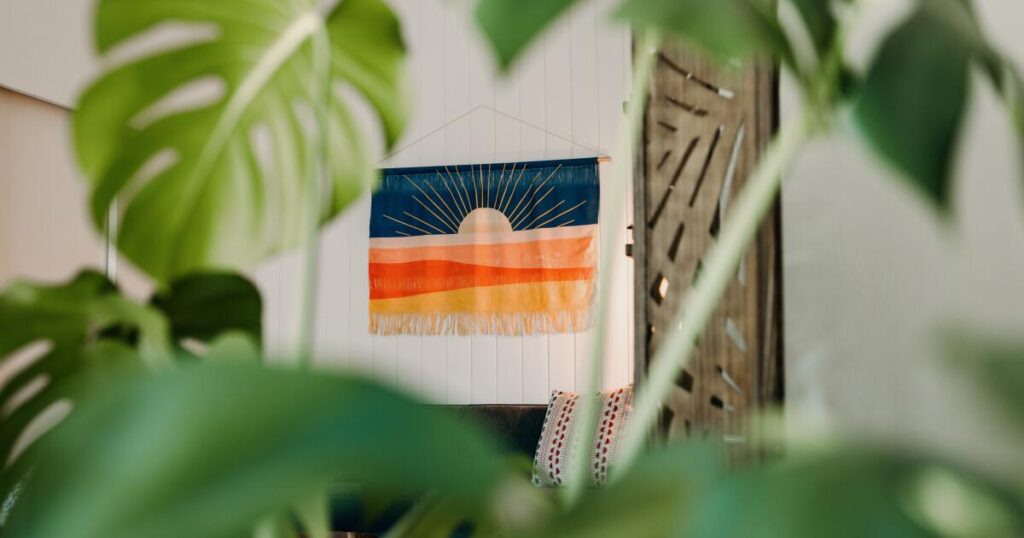
My therapy office is a 350-square-foot ADU behind my home. When a client enters, the first thing they see is a glass door with a bright yellow frame and behind it, a large monstera plant, which has grown along with them session by session. On the wall behind the couch where clients sit, I hung a tapestry that features a sun rising over an abstract landscape of pinks and yellows. Since the tapestry is in my eye line as I face clients, I think of it as a constant reminder that each person sitting in front of me has the potential to feel renewal and the possibility of change on a continual basis. The blinds on the east-facing window filter in natural light. From where my client sits on a slate blue couch, their eye might fall on the hanging bookshelves, where I’ve placed a few select volumes, such as the therapy-favorite “Waking the Tiger” by Peter Levine, as well as a few unexpected titles, like “Love in a F—Up World” by Dean Spade, and “Grapefruit” by Yoko Ono.
Above the book shelf is another shelf with more whimsical items: a container of various sea animal toys, for an imagined future where I offer clients sand play, as well as two varieties of cat tarot card decks. My desk, where I perch my phone atop a stack of old and new psychology tomes to see remote clients via Zoom, is its own sacred space: orange and blue dishes of honey and orange calcite, abalone shells, a stub of palo santo, and a deer figurine that reminds me of the animal images I conjured as a client doing the work of EMDR. A Himalayan salt lamp emits a soft orange light.
My therapy room is, quite literally, an extension of my home. Far from an institutional feel, the room’s colors, lighting and furnishings are meant to elicit a sense of warmth, connection and solace. And like my home, the language of this room wants to invite and beckon. It can hold the spectrum of emotions evoked in therapy, as well as the silences.
A common refrain we return to in therapy is that “everything is temporary.” Change is constant. In my ideal therapy room, plants live in the room when no one else is in it. Seasonal flowers are brought in, and when they die, composted. The scent of coffee or chai might linger. A client’s fingers might clutch a smooth black onyx, or a jagged rose quartz, or tissues. We are changed, both client and therapist, in the process. As my clients embark on the private journey that is therapy, in a room thoughtfully arranged to contain everything, the room itself is the reliable axis around which meaningful and deep changes can occur.
Wendy C. Ortiz is the author of three books and is a therapist in private practice in Los Angeles.
The post Why I rejected the “neutral” aesthetics of therapy rooms appeared first on Los Angeles Times.