As the United States imposes a blockade of Iranian ports, pressure is mounting on Beijing to push Tehran to accept terms that will end the war and the global energy crisis. In reality, there is little that Beijing could or would do to pressure its partner in the Middle East.
This week, as an array of leaders including the crown prince of Abu Dhabi and the prime minister of Spain visited Beijing, the question of what China could do to help resolve the crisis was the inescapable backdrop to every meeting. In these talks, China’s leader, Xi Jinping, condemned the flouting of international law as a “return to the law of the jungle” — a not-so-veiled dig at President Trump — and offered “a Chinese solution” in the form of a four-point plan to resolve the crisis.
But that plan offers little more than a call for all to respect the principle of sovereignty and international law. It reflects how China, even as it grows more concerned about the war’s impact on its economy, has avoided becoming too entangled in the crisis. That includes being noncommittal in its response to Tehran’s calls for China to guarantee its security, as well as not using its influence as Iran’s largest trading partner to push the country to accept U.S. demands.
Asking China to pressure Iran is to “misread China’s foreign policy and position,” said Ding Long, a professor at the Middle East Studies Institute of Shanghai International Studies University. “Helping the United States or Israel is not China’s intention because China opposed this war from the very beginning.”
China, which has long claimed that it does not interfere in other countries’ affairs, wants to be viewed as a global leader on its own terms. Unlike the United States, which has long maintained its dominance through its defense alliances, China has only one treaty ally, North Korea.
And China’s rulers have little desire to commit to another nation’s defense and risk being dragged into a costly war that ultimately undermines their own country’s strength.
“Chinese leaders tend to view U.S. interventions in the Middle East as a key driver of American decline and they have no interest in following that model,” said Patricia Kim, a senior fellow at the Brookings Institution’s John L. Thornton China Center.
Yes, the Iran war hurts China too.
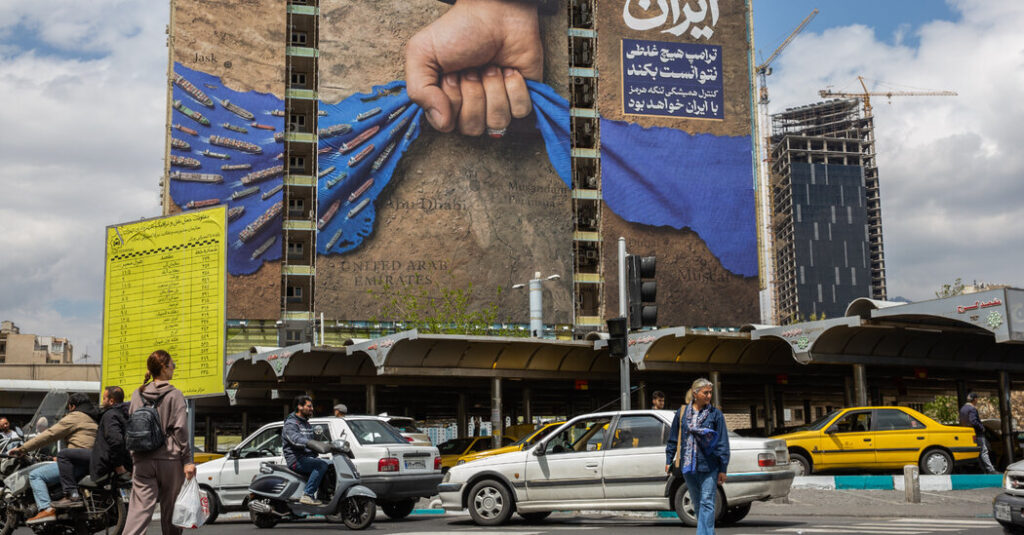
China has a lot to lose if the conflict in Iran continues. The Strait of Hormuz is a critical route for China’s energy and goods — about a third of its total crude oil imports come from the Persian Gulf. At a time when China is especially reliant on exports to prop up its economy, higher energy costs will cut into demand for Chinese goods.
“They have strategic reserves, but it’s not going to last forever,” said Yun Sun, a scholar at the Stimson Center in Washington, referring to oil reserves that China began stockpiling before the war began. “They don’t like instability. They don’t like a war that’s basically hanging over their head,” she added.
In a sign of growing concern, Chinese officials engaged in a flurry of diplomatic activity this week after talks between the United States and Iran failed to produce a peace agreement.
China’s foreign minister, Wang Yi, called on his counterpart in Pakistan, which hosted the talks, to help sustain the “hard-won momentum” of the temporary cease-fire struck last week. Speaking with Iran’s foreign minister on Wednesday, Mr. Wang said that China continued to support Iran, but he also urged that the Strait of Hormuz be reopened, saying freedom of navigation should “also be guaranteed.”
But Washington’s distraction is also an opportunity.
In some ways, the war also benefits Beijing. The United States is bogged down in the Middle East rather than focused on the Indo-Pacific, or deterring China’s threats to take Taiwan, which Beijing claims as its territory.
And China has been able to use America’s military actions as a way to cast itself by contrast as a peaceful nation that champions global stability.The war also means that more countries, frustrated with Mr. Trump, are turning to China as a more predictable partner.
“I think its 50-50 good and bad,” said Xin Qiang, a U.S.-China expert at Fudan University in Shanghai. He said that while rising energy costs hurt China’s economy, dissatisfaction with Washington is pushing countries to strengthen ties with China, which helps expand Beijing’s global influence.
“It shows that China is — at least as we see it — a more responsible country than the United States,” he said. “We’re more trustworthy, more rational and more peaceful.”
China doesn’t want to be blamed if peace talks fail.
When Iranian officials credited China for helping push through the cease-fire agreement last week, Beijing did not confirm or deny a role. A foreign ministry spokeswoman said only that China was “working actively” to bring about an end to the crisis.
That sidestepping suggests that Beijing, wary of the possibility that the cease-fire might fail, played only an indirect role in the talks, according to some analysts, and at most encouraged the sides to come to the table. (Iran may be overstating China’s role in an effort push Beijing to be more vested in any agreement with the United States, according to Dr. Sun.)
“I think it is highly unlikely China took an active role in that mediation attempt. The risks are high. It fears being blamed,” said Sarah Beran, a partner at Macro Advisory Partners who served as senior director for China and Taiwan affairs in President Biden’s National Security Council.
China argues that every country has the right to govern itself without outside meddling and positions itself as a power that does not bully others. (Yet, when it comes to what it considers China’s own interests — such as its claims over Taiwan and in the South China Sea — China has used trade bans, tariffs and sent its military and Coast Guard to apply pressure on other countries.)
Also, China lacks the military might to enforce its will.
Part of China’s reluctance to get more involved in the crisis in the Middle East is also a question of capability.
China’s rapidly expanding military does not have an expansive network of overseas bases like the United States does, though its navy has stationed an antipiracy task force in the Gulf of Aden since 2008. So far, it has not been deployed to guard Chinese vessels, a step experts say would be unlikely unless Chinese ships came under direct attack.
“China can definitely play a role, but that role remains limited,” said Dr. Xin of Fudan University.
“If Iran needs security guarantees, it’s very difficult for China to provide them,” he said. “If the U.S. wants Iran to abandon its nuclear program, China has no way to force Iran to give it up.”
While Beijing is eager to push for peace, it is also constrained by competing priorities. It needs to manage the economic fallout of the energy crisis, reset its relationship with Washington ahead of a summit between Mr. Xi and Mr. Trump, and maintain its ties with both Iran and the Gulf states, which have come under attack from Tehran.
As the prospect of a quick victory over Iran by the United States and Israel appears less likely, Beijing’s calculus has shifted.
“Had the U.S. been victorious within a week or two, the Chinese would have gone with it,” said Dr. Sun.
Now, China’s current strategy is to seek a cease-fire as quickly as possible, she said, and try to “maximize China’s role, although indirect, in the mediation so that China gains more credibility.”
Pei Wu and Berry Wang contributed reporting.
Lily Kuo is a China correspondent for The Times, based in Taipei.
The post Why China Won’t Lean Hard on Iran appeared first on New York Times.