When I was younger, I was so shy that I worried myself sick at even the thought of making eye contact. My shoes were the loudest thing about me: sneakers that squeaked as I ran across linoleum, Mary Janes with light-up soles and bows on the buckles.
My parents approved of loud shoes. The noise and flashing LEDs helped them keep track of me if I wandered too far.
Then one day my father found a shoe that made it even easier to identify me in a crowd: a pair of pink-and-white Heelys, sneakers with retractable wheels that allowed me to glide rather than walk.
I began to feel nostalgic for those days when I learned that the inventor of Heelys, Roger Adams, had died on March 24 at 71.
In 1999, Mr. Adams had the brilliant idea of removing the soles from a pair of Nike running shoes with a hot butter knife and inserting wheels. His creation turned into a pop-culture craze that made him a multimillionaire. Though the shoes were intended for children, their appeal eventually reached adults. Usher wore them onstage; Shaquille O’Neal ordered six custom-made pairs in size 22.
Before Heelys gained social cachet in my town outside Atlanta, I was in second grade and struggling to make friends. I had become obsessed with the Rev. Dr. Martin Luther King Jr. and his “I Have a Dream” speech, which we had watched in class. I memorized my favorite part — his hope that his children would “not be judged by the color of their skin but by the content of their character” — and repeated the line to anyone who would listen, hoping they would see the content of my character and want to be friends.
That didn’t work. But soon my luck changed, when my father presented me with a pair of Heelys.
The shoes were chunky and cartoonish, and whenever I put them on I felt like a cyborg. To stabilize myself, I would grab lamp poles, railings, my parents’ arms — whatever was nearby. I fell down so often my knees turned swollen and purple, but my father seemed unconcerned.
“You hurt yourself even without wearing Heelys,” he said, bathing my scrapes with disinfectant.
He watched from the door as I practiced on the street, but I could tell he was glad that I had a new hobby that might help me make friends.
A week later, I could glide for 20 seconds at a time. The memory of the wind chafing my cheeks as I sped past foliage thick with blurred light stays with me even now.
I debuted my Heelys at my Chinese after-school program, eliciting muted reactions of awe and envy. A few girls got their own Heelys, and we would heel together during our 15-minute break between Mandarin lessons, our wheels clicking in unison.
Propelling ourselves across the hot pavement felt like being in free fall.
Talking wasn’t necessary. Our proximity was enough.
As I grew older and more socially adept, I ditched the flashy shoes. Now, I mostly wear the same pair of ratty black sneakers; one friend jokes that I dress fashionably only as far as my ankles.
The popularity of Heelys waned around 2009, but recently they have seen a resurgence, as objects of nostalgia and kitsch. Whenever I spot someone heeling across my screen on social media, I remember the thrill of making friends for the first time.
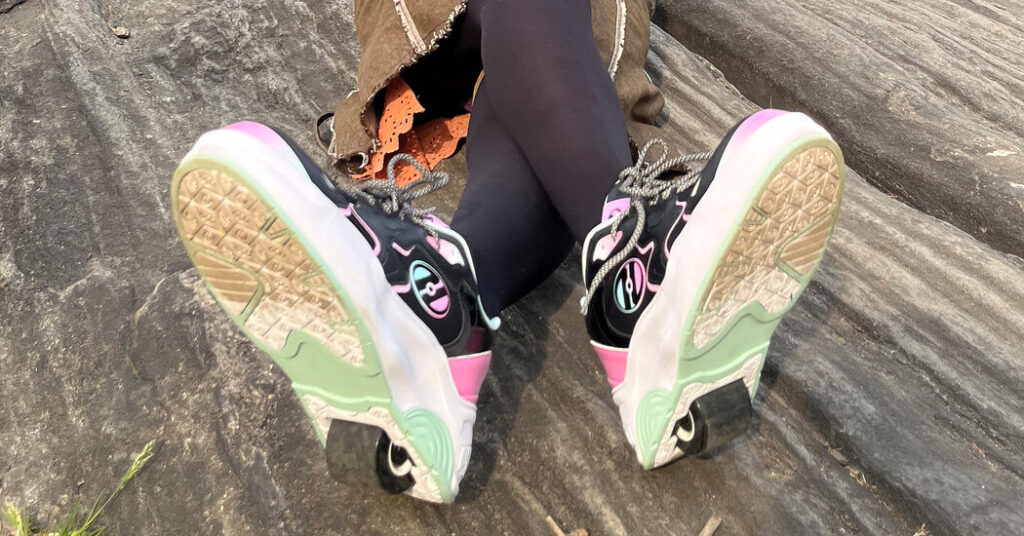
Recalling those first exhilarating moments of gliding down the street, I decided to try heeling again. On an unusually warm spring day in New York, I put on my new pink-and-green roller shoes and glided down to Bethesda Terrace in Central Park.
I’m more stable on my Heelys now than I used to be. But even so, I was reminded that nothing beats the pleasure of being able to fall down, brush off the dirt and get back up again.
The post What Heelys Taught Me About Momentum appeared first on New York Times.