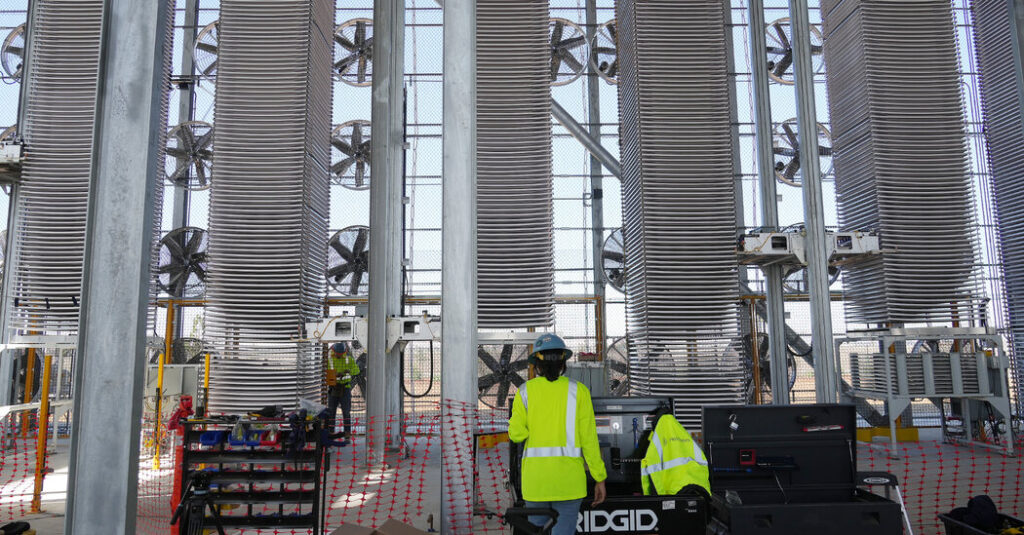
Microsoft has been the biggest supporter of the much-hyped market for carbon removal technologies, which are designed to remove a key planet-warming gas from the atmosphere.
But now, the tech giant is stepping back from an industry it almost single-handedly was propping up. With the company now telling some partners that it is pausing future purchase commitments for carbon removal credits, the outlook for the hundreds of companies looking to sell those credits is grim.
In an article I just published, I take a close look at Microsoft’s retreat and what it means for an industry that, its proponents say, is destined to play an important role in beating back global warming.
In the short term, there’s little to celebrate.
Microsoft has been the largest funder of carbon removal efforts, accounting for 79 percent of the purchases made to date, which are worth a combined $11.9 billion, according to CDR.fyi, a data provider.
And this is only the latest in a series of setbacks. Ever since President Trump returned to office, the federal government has slashed support for the field and companies have backed off their sustainability commitments.
But, seen another way, the market for carbon removal is just getting started. The industry’s backers are, in other words, trying to create a brand-new market for technologies that are still in their infancy.
A theory of change
Proponents of carbon removal say that there is so much carbon dioxide in the atmosphere that it won’t be enough to simply reduce emissions. In the long term, we will need to actively scrub CO2 from the sky and find ways to store it. Right now, the world’s carbon removal capacity is minuscule.
But if the world is able to meaningfully reduce emissions in the decades ahead, and if the carbon removal industry can scale up, the technology could be a key tool to help achieve a net-zero world in which humanity is not adding more planet warming gasses to the atmosphere.
Microsoft and the other buyers of carbon removal credits understand as much, and say they are playing the long game. Hannah Bebbington, head of deployment at Frontier, a coalition of companies buying carbon removal credits, said her group’s intention was to nurture an industry that could make a big difference down the road.
“We know the world is going to need permanent carbon removal at scale to meet global net zero goals, and yet carbon removal doesn’t necessarily have a natural buyer,” she told me. “Without a clear source of demand, it was hard for carbon removal companies to attract investment, great entrepreneurs. Basically, it was hard to start a carbon removal company.”
Frontier, Bebbington said, was trying to “put out a loud demand signal.” The message to entrepreneurs was, “Please go and build the idea that you have, and we’ll be here to buy.”
A nascent field
Judging by the sheer amount of money heading into the industry, Frontier and Microsoft have had some success. Over the past several years, hundreds of carbon removal companies have cropped up, raising more than $5 billion in funding.
Among the most popular are start-ups pursuing direct air capture, which uses giant machines to absorb the gas; biochar, a form of charcoal that stores carbon dioxide; and enhanced rock weathering, which involves spreading finely crushed stone on agricultural land.
Many are showing promise, but most are still extremely expensive.
Frontier, which counts Stripe and JPMorgan as members, has made more than $600 million in purchase commitments from more than 50 companies.
“For this industry that basically didn’t exist six years ago, we’ve made remarkable progress,” Bebbington said.
Deliveries of verified carbon removal, while still sparse, are starting to increase, and many companies are building out large scale projects around the world. I’ve visited direct air capture plants in Iceland and Texas. Biochar is big in Bolivia. And enhanced rock weathering is catching on in India and Brazil.
But now, Bebbington said, “the question that we’re all asking ourselves today is: Can demand keep pace with the technology development?”
Microsoft’s retreat is not a good signal on that front. Nor is the fact that, while a handful of big brands have agreed to buy carbon removal credits, most big corporations have so far stayed away from what is still a nascent, unproven market.
Trump Administration: Live Updates
Updated
- Trump will nominate a doctor who has publicly supported vaccines as the C.D.C. director.
- The House votes to preserve deportation protections for Haitians, rebuking Trump.
- Panel advances Trump’s triumphal arch, even as key member suggests changes.
That could change as more companies take the threat of climate change seriously or if governments begin requiring big polluters to offset their emissions.
But for now, it’s an open question as to whether the industry can stay alive until the hoped-for demand arrives.
Renewable energy
Solar and wind power are booming in India, but they may not be getting to customers
Last year, after years of building solar parks and wind farms, India said it could generate more than half of its electricity from renewable sources.
Getting that electricity to homes and businesses is a whole other challenge.
The war in Iran has exposed the limits of the country’s outdated, rickety grid, which is struggling to deliver reliable, affordable power for its 1.4 billion people.
India’s critical challenge is storing surplus energy from peak production and delivering it consistently when people need it. Battery systems and transmission lines can’t be built fast enough.
Only about a quarter of the power generated by India’s new sources actually reaches consumers, compared with more than half in China. As a result, India is still relying on oil and gas imported from the Persian Gulf to bridge the gap, a vulnerability rippling across the economy as supplies are disrupted. — Alex Travelli and Suhasini Raj
Conservation
Senate votes to allow mining near Minnesota wilderness
The Senate voted on Thursday to allow mining upstream from Minnesota’s Boundary Waters Canoe Area Wilderness, one of the largest and most visited expanses of federally protected lakes and forests in the United States.
By a vote of 50 to 49, senators passed a resolution that would repeal a moratorium on new mining across more than 225,000 acres of the Superior National Forest, which includes the Boundary Waters.
The vote was a victory for Twin Metals Minnesota, a subsidiary of the Chilean mining giant Antofagasta. Environmentalists have fought for years to block the proposed mine, saying it could contaminate the region’s interconnected lakes and streams with heavy metals, sulfuric acid and other toxic substances. President Trump is expected to sign the Republican-led measure into law. — Maxine Joselow Read more.
Quote of the day
“If the closure of the Hormuz Straits continues into May or June, then we cannot rule out risks to fuel supplies at some airports in Europe.”
That’s from a statement this week from Ryanair, the low-cost European airline, warning that Europe could face shortages of jet fuel in a matter of just weeks.
As the war in Iran lingers on, ships carrying jet fuel have been blocked from traveling through the Strait of Hormuz, a key waterway. Niraj Chokshi reports that Europe is by far the biggest consumer of jet fuel shipped through the Strait. Europe is heavily reliant on imported jet fuel because many of its oil refineries have shut down in recent decades.
More climate news from around the web:
-
To help bring down oil prices, Energy Secretary Chris Wright and Interior Secretary Doug Burgum plan to ask the chief executives of several U.S. oil companies to increase drilling, Politico reports.
-
44 percent of American adults worry a great deal about global warming or climate change, according to Gallup, which is near a record level in polling data that goes back to 1989.
-
Claudia Sheinbaum, Mexico’s president, said this week that the country may consider using fracking techniques to increase domestic energy production, Bloomberg reports.
-
A critical ocean current system is more likely to collapse than previously thought, according to new research highlighted by The Guardian. (Read our previous reporting on how climate change may be altering the current system, which is known as the Atlantic Meridional Overturning Circulation, or AMOC.)
Read past editions of the newsletter here.
If you’re enjoying what you’re reading, please consider recommending it to others. They can sign up here.
Follow The New York Times on Instagram, Threads, Facebook and TikTok at @nytimes.
Reach us at [email protected]. We read every message, and reply to many!
David Gelles reports on climate change and leads The Times’s Climate Forward newsletter and events series.
The post The Long-Term Plan to Scrub Carbon From the Sky appeared first on New York Times.