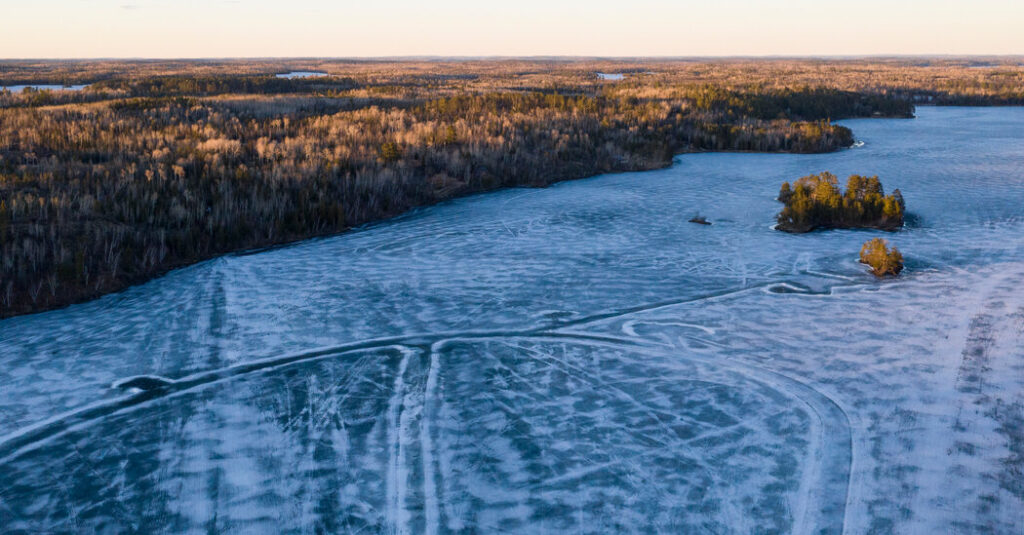
The Senate voted on Thursday to allow mining upstream from Minnesota’s Boundary Waters Canoe Area Wilderness, one of the largest and most visited expanses of federally protected lakes and forests in the United States.
By a vote of 50 to 49, senators passed a resolution that would repeal a moratorium on new mining across more than 225,000 acres of the Superior National Forest, which includes the Boundary Waters. The House already passed the Republican-led measure, which now heads to President Trump, who is expected to sign it into law.
The vote was a victory for Twin Metals Minnesota, a subsidiary of the Chilean mining giant Antofagasta. The company wants to build a copper and nickel mine about five miles southwest of the wilderness area, and the Biden administration complicated its plans by banning mining there until 2043.
Environmentalists have fought for years to block the proposed mine, saying it could contaminate the region’s interconnected lakes and streams with heavy metals, sulfuric acid and other toxic substances. Native American tribes fear the runoff from mining could devastate a watershed that they rely on for fishing and wild rice harvesting. Fishing and hunting groups have also been opposed.
“The Boundary Waters belong to all Americans,” said Senator Martin Heinrich, Democrat of New Mexico, in an impassioned speech before the vote. “The Boundary Waters are our public lands, all of ours. President Teddy Roosevelt, who had the incredible foresight to protect this beautiful place, he had it right when he said, ‘We should see to it that they are preserved for our children and our children’s children forever, with their majestic beauty unmarred.’”
Four descendants of President Theodore Roosevelt, who established the Superior National Forest in 1909, urged senators to safeguard the landscape in a rare letter in February.
“As T.R. said at the Grand Canyon in 1903, we now reiterate with the Boundary Waters today: ‘Leave it as it is,’” said the letter, which was organized by Ted Roosevelt IV, an investment banker and great-grandson of Theodore Roosevelt.
The Boundary Waters’ boreal forests provide crucial habitat for hundreds of species including the black bear, Canada lynx and gray wolf. Its lakes are home to one of the largest concentrations of lake trout in the contiguous United States.
Deep underground lies another kind of riches: an estimated four billion tons of copper and nickel ore. The area is believed to hold one of the world’s largest undeveloped mineral deposits.
The U.S. Forest Service released an environmental assessment in 2022 concluding that the proposed mine posed significant risks, including potential water and soil contamination. A study by Harvard researchers also found that such contamination could harm the region’s economy by discouraging tourism and outdoor recreation.
Trump Administration: Live Updates
Updated
- A powerful health task force is in Kennedy’s cross hairs.
- The Justice Department is appealing a surveillance court ruling amid a congressional impasse.
- Robert F. Kennedy Jr. will testify before Congress for the first time this year.
Senate Republicans introduced the resolution to allow mining in the area under the Congressional Review Act of 1996, which lets lawmakers reverse recent federal regulations with a simple majority vote. Ahead of the vote, many Democrats and legal experts argued that the moratorium on mining was not a regulation, and thus the 1996 law did not apply.
Two Republicans, Senator Thom Tillis of North Carolina and Senator Susan Collins of Maine, joined Democrats to vote against the resolution. The only senator who did not cast a vote was Josh Hawley, Republican of Missouri.
Senator Tillis said in an interview that he objected to such an expansive use of the Congressional Review Act. “I think we are setting a precedent here,” Senator Tillis said, adding, “Some of my colleagues are going to live to regret it.”
Kathy Graul, a spokeswoman for Twin Metals Minnesota, said in an email that the company was “very appreciative” of the senators who supported the resolution. She rejected the notion that the proposed mine would cause ecological damage, saying it would comply with Minnesota’s strict standards on water quality.
The Biden administration, Ms. Graul said, “locked out a significant domestic source of critical minerals, which are needed now more than ever.”
Copper is a crucial component in countless products including cellphones, electric vehicles and military aircraft. The United States is heavily reliant on imported copper from Chile, Canada and other countries.
Conservationists said they were open to new domestic mining, but not in such a pristine place. “Two things can be true: You can support domestic mining and also oppose this mine, given the location of it,” said Corey Fisher, a former wilderness ranger in the Boundary Waters who is now the public lands director at Trout Unlimited, a conservation group.
Senator Tina Smith, a Democrat of Minnesota, said the move was “the opposite of the ‘America first’ strategy’” promised by Mr. Trump. “It’s creating a path for this Chilean mining conglomerate to pollute the Boundary Waters, take the copper and send it to China,” Ms. Smith said in a recent interview in her office, which is decorated with a wooden sign from an entrance to the Boundary Waters.
Twin Metals has said it hasn’t yet decided where to send the copper extracted in Minnesota for processing. As of last year, China controlled more than half of global copper refining, according to data from Benchmark Mineral Intelligence, a research firm.
The fight over whether to allow mining near the Boundary Waters has prompted political whiplash in Washington for more than a decade.
The Obama administration began an environmental review of a potential 20-year moratorium on mining in the region in 2016. The first Trump administration called off the review and renewed federal leases critical to Twin Metals’ proposed mine. After President Joseph R. Biden Jr. took office, his administration canceled the federal leases in 2022 and then imposed the 20-year ban on mining in much of the Superior National Forest in 2023.
The vote on Thursday increased the chances that Twin Metals Minnesota would build the mine, though the project still faces other obstacles, including expected legal battles and the need to obtain federal leases and state permits.
Maxine Joselow covers climate change and the environment for The Times from Washington.
The post Senate Votes to Allow Mining Near Minnesota Wilderness appeared first on New York Times.