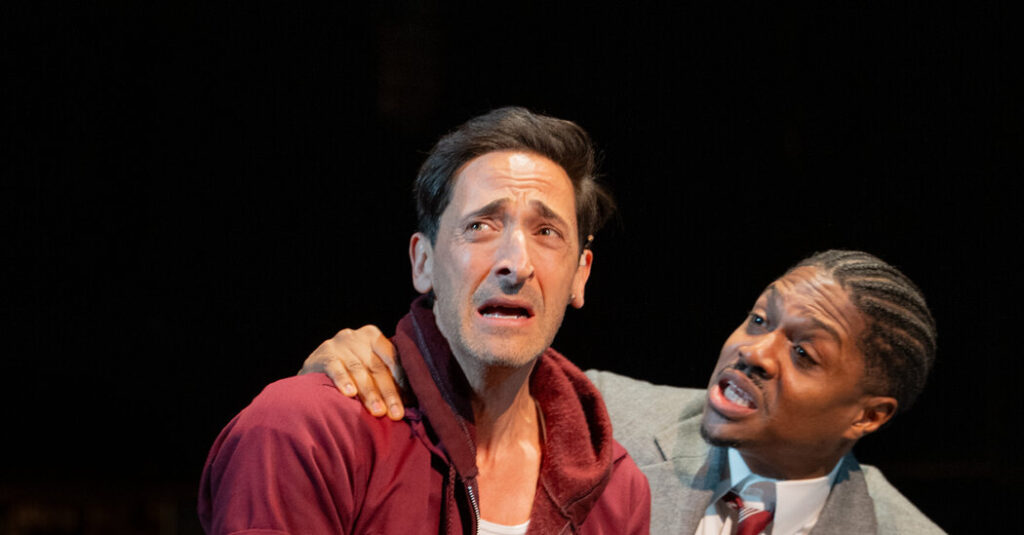
Even if you have no idea of the back story behind Lindsey Ferrentino’s oddly uneven prison drama “The Fear of 13,” a London transfer to Broadway that opened on Wednesday at the James Earl Jones Theater, you might choose to see it for its stars: Adrien Brody and Tessa Thompson, both making their Broadway debuts, which they handle with easy confidence.
At first glance, Ferrentino’s play seems like a chance to see the pair in a shadowy, troubling romance, one unfolding between a man languishing on death row in Pennsylvania, Nick (Brody), and a sympathetic volunteer advocate, Jacki (Thompson). It’s an unlikely place for a love story, but this production makes their intimate isolation its whole atmosphere: Arnulfo Maldonado’s simple set of a wall of cell doors is sunk in ink-black gloom by the lighting designer Heather Gilbert; the deft director David Cromer encourages us to believe we are watching one 110-minute-long waking dream.
“Time can be a blisteringly fast thing, where in the blink of an eye, 10 years are gone from your life, but the next week is agony,” Nick says at one point. “It’s like you look at your watch, and instead of a face, it’s a calendar and it flips. But then you look out the window … and it takes all day for the sun to go down.” He’s referring to solitary confinement, where the mind abridges time in order to skip the unthinkable, but we’ll also see this melted time signature in the text itself, in which one set of events distends over decades.
Nick’s resigned desolation brightens the moment he meets Jacki. Brody, his narrow body jangling like a struck piano string, vibrates the more she leans toward him, a dead man reanimated by a woman’s simple act of listening. When the two begin meeting weekly in the visitors’ room, after he’s already been in the pen for 16 years, he woos her with stories: Nick’s own swaggering tale of an unlikely escape, say, or an account of separated prison lovers singing to each other through the bars.
To illustrate the latter, the Nick-and-Jacki narrative pauses, and the play draws back to consider the rest of the men in the solitary block, where a vicious warden has prohibited any noise at all. For a precious few minutes, an underused Ephraim Sykes plays Wesley, a thinly sketched inmate who sings “I Wish It Would Rain” in a tone of excruciating heartbreak. Wesley’s sweetheart (Michael Cavinder) then chimes in, as does the whole prison choir, every man in a separate cell, all risking their lives to sing. This close-harmony chorale is the finest moment in the play: Ferrentino and Cromer show us a kind of defiant salvation cutting through hell.
The play quickly returns to the central pair, however, who are comparatively mismatched. Nick exults in his own ability to spin a yarn: “I know how to tell a story,” he assures Jacki, while gleefully admitting to acts of youthful stupidity and violence. (Thompson nods adoringly, as she must throughout.)
Nick has spent his time inside reading and educating himself; he claims to have read 1,000 books in three years, and we note that he sometimes borrows their plots as his own. Brody, a puppyish presence, has a particular capacity for bent sweetness, but Nick raises red flag after red flag. Thompson, who begins as the play’s narrator before fading away into a loving nullity, addresses the audience, reassuring us that she’s not incautious. “Look, I’m not that person, okay?” (She is.)
All of these indications of narrative slipperiness, though, are misdirection. Ferrentino has adapted her play from David Sington’s 2015 documentary of the same name, a film that consists mainly of the real Nick Yarris talking directly to the camera. Ferrentino’s script delays the details of Nick’s case as long as it possibly can, but it must eventually churn through Yarris’s actual 21-year slog toward freedom, which involved one of the first exculpatory uses of DNA for a man condemned to death. (According to the Death Penalty Information Center, innocent death row inmates in 2024 were waiting for an average of 38.7 years before exoneration, thanks to slow-walking procedures and the resistance of state officials.)
Yarris was a notable early success of the Innocence Project, as well as the author of several books about his liberation. This, rather than the romance with Jacki, is what’s interesting here. In Sington’s film, Yarris uses his storytelling ability to convey the suffering he faced, the justice system’s Kafkaesque logic that delayed his appeal and the paradoxical positivity that he says many exonerated prisoners find on the outside. Much of the text’s best language is, in fact, taken directly from Yarris — the line “it takes all day for the sun to go down,” for instance, is all his.
Ferrentino’s choice to make Nick look like he might be an unreliable narrator thus becomes bizarre; it certainly works against the clearer passions of the documentary. If you don’t know the back story, then the play’s irresolute (and then abandoned) hints that Nick might be untrustworthy create a certain slack tediousness. And if you do know that Yarris was (famously) exonerated, then they feel like time wasted. Ferrentino’s dramatic interpolations, particularly the wan attempt to expand Jacki’s character, sap the directness of the original account, and perhaps even harm it as advocacy.
The play’s root-deep confusion on how to adapt the documentary crystallizes in the title. No one in Ferrentino’s plot mentions any particular nervousness around numbers, and none of the key factual values — Nick’s years in prison, for instance — add up to 13.
There is an answer, though. In Sington’s film, when Yarris is talking about his reading jags, he delightedly reels off several obscure vocabulary words he learned while inside, including triskaidekaphobia, or the fear of the number 13. Sington apparently named his project after the line as a tribute both to Yarris’s logorrheic eloquence as well as to the way terror and erudition keep meeting in his tale. Ferrentino, almost perversely, chooses not to include the one detail that explains the phrase. Why?
“The Fear of 13” is Ferrentino’s second documentary theatricalization this season: She also wrote the book for the musical adaptation of “The Queen of Versailles,” from 2012, which became another oddly paced exercise. (I don’t know why the phrase “based on a true story” doesn’t send a shudder down a playwright’s spine.) She has certainly written strong work in the past, like “Amy and the Orphans.” It may simply be that her gifts are destabilized by contact with the real.
Another mystery remains: How this production, so clumsy here, could have been so rapturously greeted in England. I can imagine that when it was at the comparatively small, 250-seat Donmar Warehouse in London, with Brody’s electric presence only a hairbreadth away from the seats, faults in narrative drive and characterization might have seemed less intrusive. But at the James Earl Jones, which is four times the size, the distance makes those wrong notes echo. The farther away we are, the louder they clang. Each one feels like a door slamming shut between the audience and Yarris’s extraordinary, real-life story.
The Fear of 13 Through July 12 at the James Earl Jones Theater, Manhattan; thefearof13broadway.com. Running time: 1 hour 50 minutes.
Helen Shaw is the chief theater critic for The Times.
The post Review: ‘The Fear of 13’ Doesn’t Entirely Add Up appeared first on New York Times.