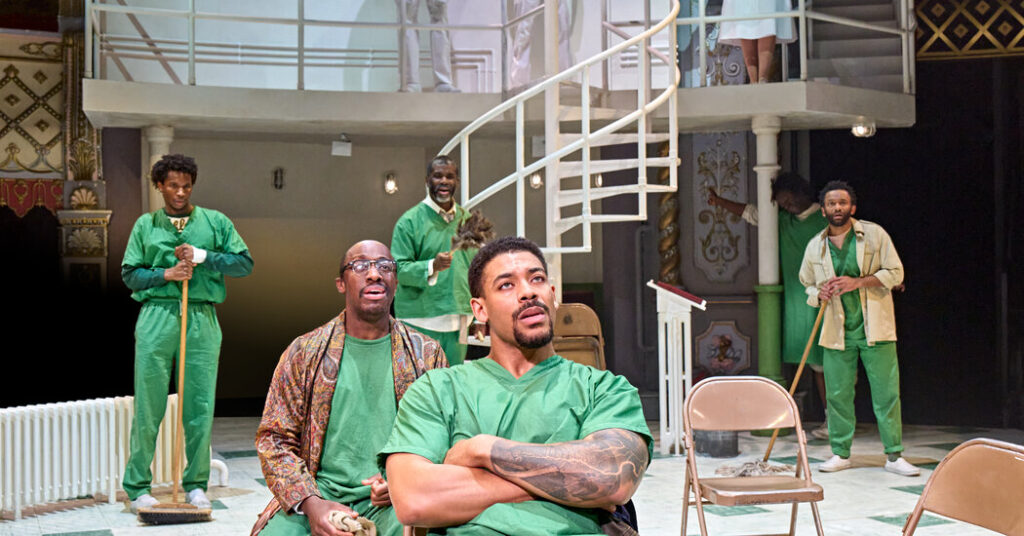
“Sin while ye may, for tomorrow we shall be tranquilized.” That’s how Dale Harding gives his blessing to fellow mental-asylum inmates as the men enjoy an illicit midnight party. Under Nurse Ratched’s austere regime, they can’t even watch the World Series on TV, but they’ve been rallied to revolt by a new resident on the ward who has smuggled in women and booze for the occasion. Finally, the patients can let off some steam.
This joyous high point of a London revival of “One Flew Over the Cuckoo’s Nest,” running at the Old Vic theater through May 23, is quickly followed by its saddest scene when the insurrection’s ringleader, Randle McMurphy, emerges vegetative, lobotomized on Nurse Ratched’s orders.
McMurphy’s demise is all the more affecting because, as played by Aaron Pierre, he had seemed indestructible. Pierre gives him a chest-puffing, childlike boisterousness, inflecting the character’s machismo with a disarming dash of camp. A violent offender, McMurphy has feigned insanity to avoid penal labor, and his preening, mock-haughty charisma makes a delightful mockery of the institution.
By contrast, Giles Terera’s wide-eyed Harding, whose nervously pedantic diction recalls that of a young Woody Allen, exemplifies the other residents’ cowed submission. But Harding is there voluntarily, whereas McMurphy can leave only at the asylum’s discretion. It is only when he learns this that McMurphy realizes perilousness of his situation.
A lot has changed since this play by Dale Wasserman, based the 1962 novel by Ken Kesey, premiered on Broadway in 1963. The deinstitutionalization process in the United States started under President John F. Kennedy in the 1960s and culminated in the Reagan administration’s funding cuts in ’80s. It resulted in the closure of hundreds of asylums in favor of community care, which turned out to be a chimera. Health care companies stepped in to the resulting vacuum, and their commercial interests don’t always align with patient welfare. Today, when it comes to mental health, the private sector may be of greater concern than the state. Still, “One Flew Over the Cuckoo’s Nest” remains a potent parable about power and social conditioning.
Here, the director, Clint Dyer, has sought to tease out the story’s racial element, which was clear in Kesey’s novel but underplayed in Milos Forman’s multiple-Oscar-winning movie adaptation in 1975. The Native American patient, Chief Bromden, seemingly catatonic after repeated electroshock therapy, is given a voice through intermittent flashback scenes in which the stage falls dark and a spot-lit Bromden — played by Arthur Boan with a hunched posture and a crumpled, reproachful countenance — relates the story of generational dispossession that led to his incarceration.
All the patients apart from Bromden are played by Black actors, and the production is bookended by brief dance routines performed by the ensemble to beating conga drums. To contextualize this, several lines of text appear on a screen at the start of the play, outlining the historical links between African Americans and Indigenous peoples.
Dyer is inviting us to consider the parallels between Black experiences and the erasure of Indigenous culture. That’s not a stretch, but given the semi-allegorical quality of the original material, the racializing of the inmates has the muddled feel of a mixed metaphor. Is the madhouse, in this telling, a stand-in for the white power structure? Or does the concept of sanity itself represent whiteness — and, if so, what are the implications of that?
Despite these nods, the tale told here is largely the same as in the movie. Bromden’s brief monologues are mere punctuation; to more fully realize his back story would have required a longer run time. Dyer has sacrificed an artistic risk for watchability, and that’s perhaps for the best: The racial framing doesn’t feel too overbearing, and the show flies by in two hours and 20 minutes.
Ben Stones’s in-the-round set has an appropriately panopticon-like aspect, with an all-seeing Nurse Ratched, played by Olivia Williams, looming over her patients on an elevated section and addressing them via loudspeaker. The furnishings are grimly utilitarian: two long, curved radiators, a rocking chair, some plastic seats, a tiled floor. One character says nothing throughout, just clutches at a pillar and quivers erratically — a sinister foreshadowing of McMurphy’s fate.
Williams, regrettably miscast as Nurse Ratched, lacks the necessary aura of stringent menace. She is supposed to embody power but too often has the helpless aspect of a substitute teacher losing control of the class. The result is chaos rather than tension, sometimes sailing close to outright farce. It’s a significant blot in an otherwise taut production.
Some key aspects of this play sit uneasily with today’s sensibilities: its reveling in the antics of the mentally unwell; its exaltation of untrammeled sexuality as a cipher for true liberty; and its demonization of buzz-killing, overbearing women. The trouble is, it’s also very funny and emotionally arresting. I came away thinking about how much of human experience is increasingly off-limits in drama. Are we in danger of replicating Nurse Ratched’s regime? Perhaps the 21st-century theater needs its own Ken Kesey.
One Flew Over The Cuckoos Nest Through May 23 at the Old Vic theater in London; oldvictheatre.com.
The post ‘One Flew Over the Cuckoo’s Nest’ Returns With Contemporary Bite appeared first on New York Times.