When terrible things happen, we’re often left wondering why.
For reporters and editors, other questions soon follow: Who was responsible? What exactly took place? When will we know more? Where did things go wrong? And how can we prevent it from happening again?
Who, what, when, where, why and how.
Sometimes the answers reveal complexity about the lives of victims. Sometimes they unlock surprising, even sympathetic details, about suspects. Either situation can be uncomfortable for readers who ask why we do these stories, who see the circumstances differently or who dislike what they see as efforts to humanize violent people.
To explore how we approach this work at The New York Times, I turned to three senior editors with deep experience leading teams in such coverage: Marc Lacey, a former correspondent and a managing editor; Nikita Stewart, who runs the Metro desk; and Nestor Ramos, the National editor.
These are edited excerpts from our conversation.
Let’s start with our goal when writing about suspects and victims of major violence. What are we seeking to do?
MARC LACEY: We try to help readers get to know those behind the headlines through portraits pulled together quickly. Beyond the names, ages, hometowns and occupations of those involved, we attempt to give snapshots of the lives of perpetrators and victims alike.
NIKITA STEWART: We have been grappling with this in Metro lately, particularly when we are writing about teenagers. I’m looking to get beyond stereotypes, the preconceived notions of readers when they see the headline.
A good example is a recent story on teenagers who were playing with a gun, and one unfortunately lost his life. Some people on the desk wanted to run with a first-day story that had no names, with little explanation of what happened. We were going to be left with: A 16-year-old shot and killed another 16-year-old in Brooklyn. If you read that headline, what would you think? I decided to delay publication until we could learn more about what happened. We ended up having a much better story.
NESTOR RAMOS: After a significant attack, our reporters and editors have a lot of questions they’re trying to answer. Among the first are always, “who did this, and why?” Those are inevitably some of the first questions readers ask, too.
Our goal is to tell the unvarnished truth about what happened. That means learning as much as we can about the perpetrator. It also means capturing authentic portraits of the victims. That knowledge is the only way to really reckon with tragedy.
There’s sometimes concern among readers that we give too much attention to killers. How do we think about, say, naming a gunman in a mass shooting or showing the suspect’s picture?
LACEY: Those who commit mass shootings are often in search of notoriety. The last thing we want to do is glorify them, or have our journalism inspire copycat attacks. So we take steps to keep the names of suspects out of headlines, to avoid gratuitous photographs and to take care in publishing their twisted manifestoes. We believe we can inform readers without inspiring more violence.
RAMOS: Our role as journalists, at a fundamental level, is to help readers understand the events that shape the world. Gathering insight into why someone committed a terrible act is foundational to that effort, even if the reasons are upsetting, or offensive, or don’t make sense. If society doesn’t understand why people do what they do, how will we ever stop it?
STEWART: Though we must be careful about lionizing a gunman, we are journalists and we are trying to let readers know everything we can about the subject. We have a job to do.
Our most recent example of this duty has played out in the random machete attack at the Grand Central subway station. We, of course, have tried to reach the three victims who were slashed, but we also believed readers deserved to have more information about the machete-wielding man who was fatally shot by the police.
That can mean moving quickly. How does live coverage, with the perpetual demand for new information, change our approach?
LACEY: Live coverage is what we call our effort to share with readers news as it’s happening. This continuous feed of updates brings readers who are hungry for the latest news back to our site again and again. We have teams of editors who ensure that the raw material filed by our reporters is scrutinized and contextualized. That said, we have to be cautious with what we report because the authorities often do not know the full picture in the initial hours after an attack.
Even when we slow down to dig deeper, we can face criticism when reporting about suspects of violent crime. What are the essential elements of a responsible profile? Do you recall wrestling with what to include or take out?
STEWART: This is a frequent complaint of readers: Why are we describing people accused of heinous crimes in a normal way? I actually think it’s important to include those descriptions, either to uncover missed clues or to show how your ordinary neighbor could be responsible for horrible things. I can recall covering Dylann Roof, the white supremacist who killed nine Black parishioners in a Charleston, S.C., church in 2015. Readers were upset with how we described his physical appearance: “the bug-eyed boy with a bowl haircut.” Looking back, would we maybe pull back and not put it in the lede?
RAMOS: I sometimes hear criticism that we are “humanizing” someone who has committed a horrible crime. But in some sense, this is our job — if you want to understand why someone did what they did, you need to dig into that person’s life.
LACEY: Deadlines are looming when we are putting our profiles together. We run into trouble when one or two neighbors say they did not know the suspect and we opt to portray them as “quiet.” Snap judgments on their personalities are rarely helpful.
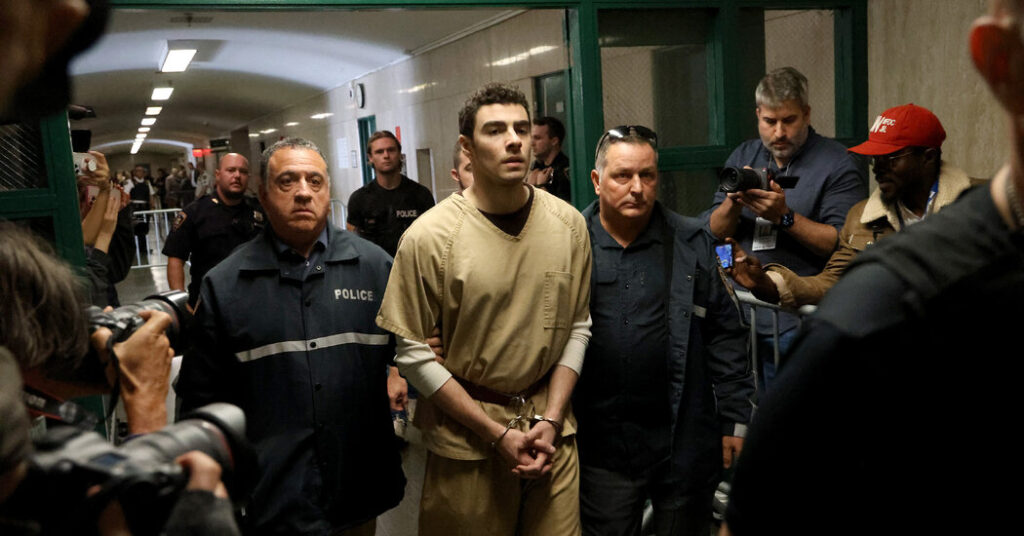
The arrest of Luigi Mangione in the killing of the UnitedHealthcare chief executive, Brian Thompson, prompted a national conversation. Some were fascinated by Mr. Mangione. Others were horrified. Do these debates affect our coverage?
RAMOS: Debates like that don’t affect our coverage so much as they are an important subject of it. Helping people make sense of what happened is not just about the who-what-when of a killing in Midtown Manhattan, but about everything that led to it and everything that followed. In the Mangione case, the divergent reactions were themselves a story about America in this moment — but explaining that reaction, or Mangione’s stated motivations, is not the same as justifying what he was charged with doing. Explanations are not excuses.
STEWART: I agree with Nestor, whom I succeeded as Metro editor. Now that I’m in charge of picking up where he left off, we are digging into the people who are part of a sort of cult of Mangione. That’s a story. It reveals something about our society.
How do we report these articles?
LACEY: We talk to anyone and everyone who might have crossed paths with the person we’re writing about. Neighbors, teachers, relatives, friends, co-workers — all of them are fair game to interview.
STEWART: What Marc said. This is a little bit of a tangent. But you’re seeing now in a real way with Jeffrey Epstein, right? People who said they didn’t know him really did. And their interactions with him give us insight into power structures and our society or a segment of our society.
Some readers criticized our early headline reference to Ayman Mohamad Ghazali as a “quiet restaurant worker.” They thought it signaled sympathy for the man accused of attacking a synagogue in suburban Detroit in March. Can you walk us through the process of writing a headline, and why we might change it after publication?
RAMOS: Headlines like these are always challenging — you’re trying to capture complex, nuanced subject matter in 70 or so characters (including spaces!) and you’re trying to do it fast. Often we reach for what little we know about the suspect based on the first scraps of reporting, and the reality is that those things can sound somewhat similar. He was quiet and kept mostly to himself — that kind of thing. Headlines often evolve as we learn more. The story changes, the picture gets more detailed.
In a fast-breaking situation with a lot of moving parts — separate stories about suspects, victims, places, scenes — we’ll look through all of our coverage as it’s unfolding and see headlines on stories that look too similar, or seem like they don’t quite work. It’s not uncommon to take another crack at a headline if it’s too simplistic or familiar or just not quite right.
Readers occasionally say our coverage villainizes victims. Our profile in 2014 of Michael Brown, who was fatally shot by a police officer in Ferguson, Mo., included reporting on his struggles in life and described him as “no angel.” Some readers argued that we were essentially blaming him for the shooting. What do we consider when working on these stories?
LACEY: Certainly victims should not be turned into villains. But noting the ups and downs of the lives we’re writing about makes the subjects human.
STEWART: Our job is not to paint a sympathetic victim. Our job is to show the totality of a person. The wholeness of a person includes achievements and flaws and mistakes. I think if you leave out flaws, a person becomes flat. They’re not real. That’s a disservice to the reader.
Mike Abrams is the deputy editor for Trust, working to help readers understand The Times and its journalistic values.
The post How The Times Covers Attackers, Suspects and Victims of Violence appeared first on New York Times.