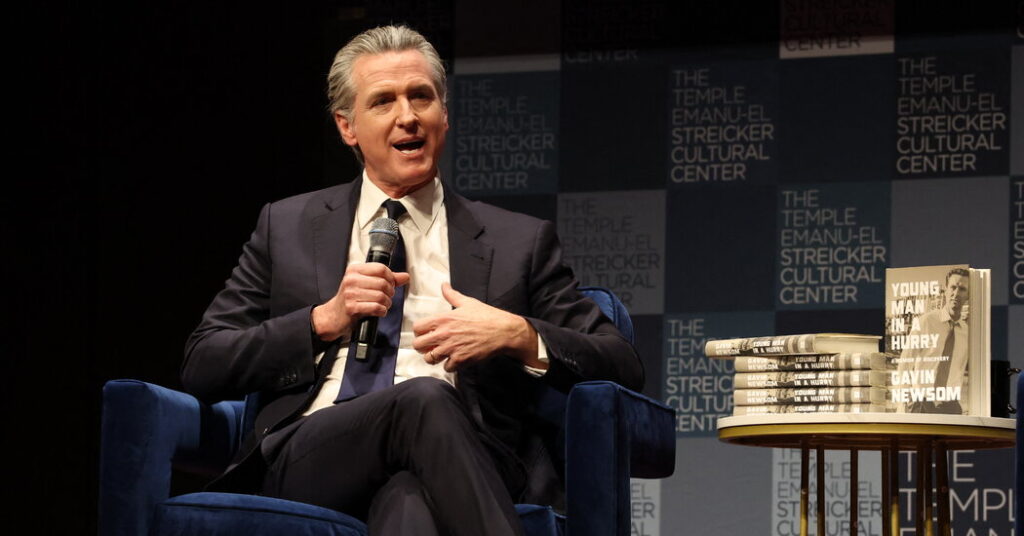
In November, Gov. Gavin Newsom of California rolled out an intriguing offer to his formidable email list of supporters: Donate anything to his political group, and he would send them a copy of his forthcoming book: “Young Man in a Hurry: A Memoir of Discovery.”
“Make a contribution of ANY AMOUNT today and I will send you a copy,” he wrote.
It turned out about 67,000 supporters did just that. The books those donors received account for roughly two-thirds of the print copies of the memoir that have been sold.
On Wednesday, new federal records revealed that Mr. Newsom’s political action committee paid $1,561,875 to buy and distribute copies of his book through the donation program.
A spokesman for Mr. Newsom, Nathan Click, said his PAC, the Campaign for Democracy Committee, wound up netting more money from contributors attracted by the book offer than the cost of 67,000 copies of the book that the PAC provided. Mr. Newsom does not receive royalties for books sold through the program, he said.
“We were thrilled with the response,” Mr. Click said. “Our goal was to deepen the relationship between him and the millions of folks who have already expressed support for Governor Newsom’s work. And as it turns out, the tactic more than paid for itself.”
The Newsom team said that the 67,000 books that supporters received after sending donations were part of the 97,400 print copies of Mr. Newsom’s memoir that have been sold since publication, a total provided by Circana BookScan, a book industry sales tracker.
Mr. Newsom’s team had hailed his book sales back in March, including a map in a news release showing all the sales by location across the country. “With more than 91,000 copies sold through organic, in-person and online, non-bulk purchases in the United States, the memoir surged on bestseller lists within hours,” the release said.
The governor’s PAC made two payments totaling more than $1.5 million to the Porchlight Book Company, listing the purpose as “books at cost.” The money was by far the biggest expenditure for the governor’s federal PAC in the first quarter of 2026.
Mr. Newsom’s PAC had first offered his book to supporters in November, days after California voters passed a redistricting ballot measure that he had championed called Proposition 50. The measure redrew California’s map to allow Democrats to pick up as many as five extra House seats.
“We just spent a bunch of money on passing Prop 50,” he wrote in the email, “so now I need to refill that coffers at my Campaign for Democracy for the fights ahead — including helping other states pass redistricting to stop Trump from rigging the next election.”
Many ambitious politicians write books, hoping for attention and to draw in new supporters. “It’s a good book,” Mr. Newsom teased in his email. “Very personal. Not your normal political book at all.”
Mr. Newsom’s PAC, whose stated mission is to “confront and defeat unAmerican authoritarianism,” renewed the book offer in January. It was included in the fine print of several other email solicitations, as well.
It’s not uncommon for political committees to dangle books for donations.
In 2019, the Republican National Committee spent nearly $100,000 on copies of a book by Donald Trump Jr. — at a time when his father was president. And in the 2024 election, records show that the R.N.C. paid Winning Team Publishing, which Mr. Trump Jr. co-founded, $217,402.32 for “printing/graphic services.”
Still, the scale of the book purchases by Mr. Newsom’s PAC is noteworthy.
One other federal committee made a payment to Porchlight this year: Fight for the People PAC, the main political group for former Vice President Kamala Harris, who released her own memoir in 2026. She paid the publishing house $97,524 in January.
She, too, had offered supporters in an email a chance to receive a copy of her book if they made a donation of any size. The offer came months after her book had already been a best seller.
John Maher contributed reporting.
Shane Goldmacher is a Times national political correspondent.
The post How Newsom Boosted His Book Sales With $1.5 Million From His PAC appeared first on New York Times.