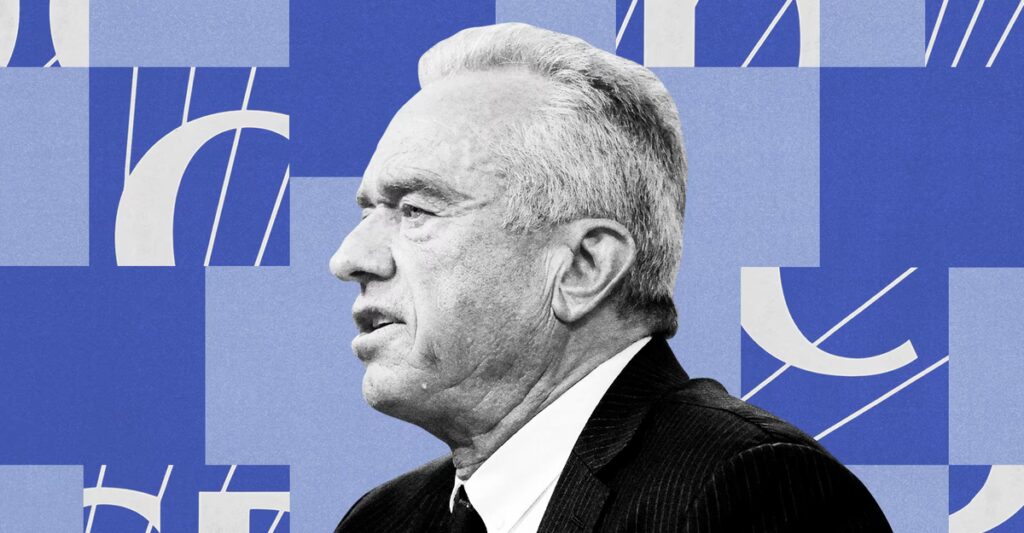
The White House has reportedly urged Health and Human Services Secretary Robert F. Kennedy Jr. to avoid talking about vaccines, but this morning he had no choice. When he appeared before the House Ways and Means Committee—the first of seven congressional testimonies that he’s scheduled to give in the coming days as part of the 2027-budgeting process—members pressed him on the issue, which he has written and spoken about nearly nonstop for two decades.
He mostly sidestepped those questions, declining to repeat claims he’s made before about the supposed links between vaccines and autism (no such links have been found), or about how contracting measles might boost a person’s immune system (the opposite is true). When asked whether an unvaccinated girl who died of measles in Texas last year might have been saved by the shot, the health secretary responded: “It’s possible, certainly.”
Kennedy recently seems to be steering clear of public statements about vaccines because the White House fears his anti-vaccine agenda will tank Republicans in the midterms. Instead, he’s touted the government’s new inverted food pyramid and the return of whole milk to school cafeterias. The first episode of his new podcast, released this week, features the celebrity chef Robert Irvine—the man “making my dream come true,” Kennedy says, by revamping military meals—who sits with Kennedy in front of shelves displaying several of Kennedy’s conspiracy-theory-laden books and a picture of his father. (Irvine has a history of embellishing his resume, which he’s called “errors in my judgment.” A Health and Human Services spokesperson did not respond to a request for comment on the department’s recent moves.)
This more restrained version of Kennedy is appearing as the Trump administration is making moves to tamp down turmoil at HHS. Two months ago, Chris Klomp, the head of Medicare, became the department’s chief counselor, reportedly to keep Kennedy in line. And today, after months of confusion and chaos, President Trump nominated a new director for the Centers for Disease Control and Prevention: Erica Schwartz, a former deputy U.S. surgeon general and a retired rear admiral in the Commissioned Corps of the U.S. Public Health Service.
If Schwartz’s nomination is confirmed by Congress, she would step in as head of an agency that, over the past year, has dealt with several high-profile resignations and flagging morale. The CDC has had a confirmed director for only 29 days since Kennedy took office. Right now—at least officially—it has no director at all. The Trump administration missed a deadline last month to nominate a new one, which means the previous acting director, Jay Bhattacharya, can no longer claim that title, even though he appears to remain in charge. Bhattacharya, whose other job is serving as director of the National Institutes of Health, has seemed intent on winning over employees at the beleaguered agency, telling them at an all-staff meeting last month that they needed to “focus on what we know how to do” rather than getting caught up in politics. This month, though, Bhattacharya, who is known for his contrarian views on the public-health response to the coronavirus pandemic, reportedly delayed the publication of a CDC study showing that the COVID vaccine reduced the likelihood of hospitalization. (An HHS spokesperson told The New York Times that Bhattacharya “wants to make sure that the paper uses the most appropriate methodology.”)
[Read: RFK Jr. is losing his grip on the CDC]
Schwartz’s selection could signal a move toward stability. She has a long public-health track record, including serving in the first Trump administration during the coronavirus pandemic. She holds a medical degree from Brown University and a law degree from the University of Maryland. (The acting director who preceded Bhattacharya, Jim O’Neill, has no medical background and was viewed internally as a Kennedy loyalist.) Several current and former CDC employees I contacted welcomed the news of her possible selection.
A number of other key CDC roles that have been vacant for months, including chief medical officer and principal deputy director, may also soon be filled with qualified officials—among them, The Washington Post reported earlier this week, Jennifer Shuford, an infectious-disease specialist and Texas’s health commissioner who emphasized the importance of measles vaccination during the state’s outbreak last year, and Sara Brenner, a physician who is currently serving as the principal deputy commissioner of the Food and Drug Administration. (Brenner has leaned into at least some of Kennedy’s agenda, posting a “MAHA mom” workout challenge in September.) What their exact roles might be at the CDC remains unclear. In a statement, the White House spokesperson Kush Desai said that reporting about unannounced personnel changes “should be considered baseless speculation.”
Such selections, should they pan out, by no means guarantee that the agency will return to normal. The CDC’s last permanent director, a longtime government scientist named Susan Monarez, has testified that she lost her job because she refused to rubber-stamp Kennedy’s agenda or to get rid of certain public-health experts. (Kennedy has said she was fired because she denied being a trustworthy person.) If Schwartz in fact becomes the next director, she, like Monarez, could find herself standing between agency staff and Kennedy, who has repeatedly called the CDC corrupt. Daniel Jernigan, the former director of the National Center for Emerging and Zoonotic Infectious Diseases who resigned in protest over Monarez’s firing last year, told me he believes that, for the next director—whoever that turns out to be—acquiescing to Kennedy’s anti-vaccine views is “likely a necessary job skill.”
If Kennedy was circumspect about his own views today, the actions he’s already taken on vaccines as HHS secretary are still bearing fruit. Last summer, he stacked the agency’s vaccine advisory board with allies; this spring, a judge temporarily blocked changes that the board made to the childhood-vaccine schedule and declared most of its members illegitimate. But last week, seemingly in response, Kennedy signed off on changes to the board’s charter, which now says that, among its duties, the board will work on identifying “gaps in vaccine safety research including adverse effects following vaccination.” It’s hard not to read that as code for continuing to cast doubt on vaccines.
[Read: A new level of vaccine purgatory]
When Trump made Kennedy health secretary, he famously promised to let him “go wild.” Lately, Kennedy seems to have been tamed. But that doesn’t mean he’s abandoned his anti-vaccine agenda, or that he won’t push it from behind the scenes.
The post HHS Wants to Be Done With Drama, for Now appeared first on The Atlantic.