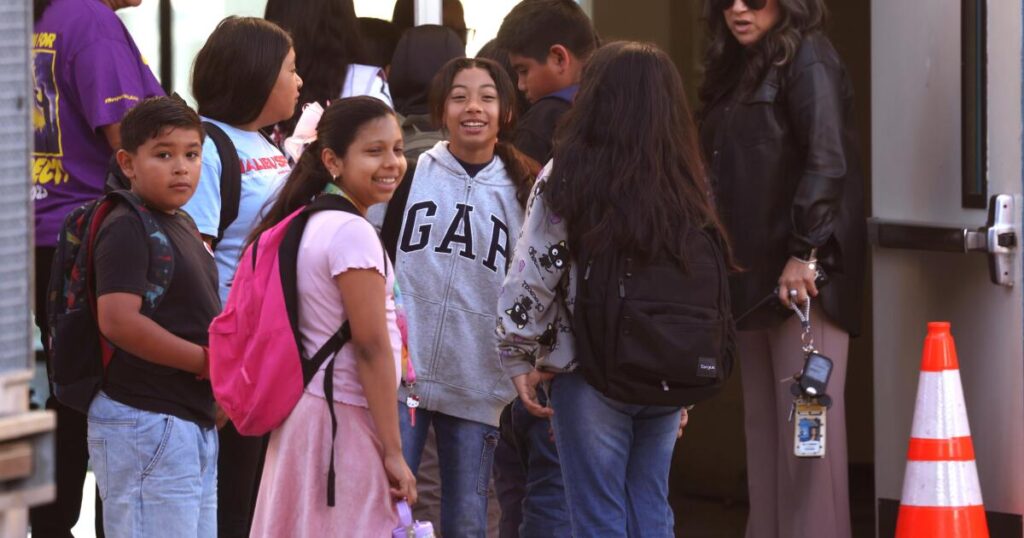
Schools in Los Angeles County and especially those in the L.A. Unified School District are seeing the steepest decline in enrollment in California, based on new state data posted Thursday.
Across California, enrollment dropped by 1.3% — about 75,000 students — over the last year, a percentage decline that is about average compared with 39 states that have so far released enrollment figures for the current school year. All 39 have recorded enrollment decreases, based on an analysis by the California Department of Education. States with a larger percentage decline include Hawaii, New Hampshire and New York.
“Declining school enrollment in California reflects the national trend,” said Elizabeth Sanders, a spokesperson for the state Department of Education. In addition, “the data shows that some California families are relocating to less expensive suburban communities like Elk Grove and Vacaville.”
The statewide figures correlate to declining birth rates nationwide, although other factors are in play locally, including in Los Angeles County, such as housing costs, a decline in immigration and aggressive federal efforts to deport undocumented immigrants.
“There are some surprises in these data, but the decline itself shouldn’t be surprising,” said Thomas J. Kane, director of the Center for Education Policy Research at Harvard. “Declining birth rates inevitably mean declining enrollment. The size of the decline should be manageable — but only if schools adjust their plans now, rather than wait.”
Typical ways of coping with declining enrollment including closing schools and reducing the number of employees. Both are painful measures for school communities and have been resisted in the Los Angeles Unified School District and elsewhere.
This week, LAUSD officials just barely headed off a strikeby agreeing to significant employee raises as well as by rescinding about 200 layoffs and agreeing to hundreds of new hires of counselors, school psychologists and other student support staff. The school system has not identified campuses that could be closed.
Los Angeles County, with 80 school districts, has far more students than any other California county, so its effect on statewide enrollment always will be significant. Over the last year enrollment drops were pronounced, pulling down statewide numbers.
Los Angeles County public school enrollment for the 2025-26 academic year decreased from the prior year by 32,953 students, or 2.6%, to 1,242,816. That drop would equate to the disappearance of the entire Moreno Valley Unified School District, which is one of the 25 largest school systems in the state.
The county decrease represents 44% of the statewide decline. By comparison, the county comprises about 22% of the state’s students.
For L.A. Unified, the decline was 16,765 students, or 4.5%. L.A. Unified’s share of the statewide decrease is 22.4%. The district has about 7% of the state’s public school students.
Per the state numbers, the L.A. Unified enrollment is 353,065 and was 369,830 last year.
L.A. Unified has a different and larger enrollment figure based on a different tabulation system, but the percentage decrease is similar to what the state calculated — and it was no surprise to district officials when asked for their reaction.
District officials also noted state figures showing that enrollment is lower, too, for homeschooling, private schools and charter schools. Charters are privately operated public schools.
“Los Angeles Unified’s enrollment trends reflect the same broader demographic shifts impacting school systems across California and the nation,” officials said in a statement. “Enrollment declined across all school types this year, driven largely by long-term factors such as declining birth rates and changes in migration patterns due to cost of living.”
“Like other large urban districts, Los Angeles Unified is also navigating additional local pressures, including housing affordability and the impact of federal immigration enforcement policies, which have contributed to a more pronounced decline in our communities.”
School district critics say the management of the school system itself must bear some blame, although demographic experts lend support to the district analysis.
It’s “quite possible that some of this decline is driven by the increased scale and intensity of immigration enforcement,” said Stanford University professor Thomas S. Dee. “I’ve found in prior research that immigration enforcement reduces enrollment by causing some to flee and deterring newcomers.”
In terms of raw numbers, Santa Ana Unified, which lost 2,291 students, follows L.A. Unified in declining enrollment. That’s a 6.4% drop since last year. Immigration enforcement also has fallen heavily on families in that school system.
School systems with higher enrollment include Elk Grove Unified, which gained 1,097 students, a 1.7% increase. Vacaville Unified enrolled 557 more students, a 4.9% increase. Counties with higher enrollment included San Joaquin, Placer and Sutter.
Mixed picture for private and home schooling
There was a year-over-year decline across all school types.
Schools operated by traditional school districts dropped 1.4%, almost exactly the same as the statewide numbers. This reflects that most students, about 5.73 million, are in public schools.
Charter schools dropped slightly statewide, about 0.3%.
The number of students being homeschooled dropped 3.7%. For data purposes, a home school is defined as a private school with fewer than six students. Before the COVID-19 pandemic, in the 2018-19 school year, there were just under 25,000 homeschoolers. The number peaked in 2020-21, at the height of the pandemic campus closures, at nearly 60,000. The current figure is 49,365.
Private school enrollment dropped 6.6% compared with last year; it’s now a little less than before the pandemic.
In 2018-19, private school enrollment approached 500,000. Enrollment dropped early in the pandemic, then peaked in 2022-23. The current enrollment is 461,650 students, a decrease of 32,814 from last year.
In the big picture, said Stanford’s Dee, “we see continued evidence that the families that left the public school system during the pandemic haven’t really returned.”
UC Berkeley education professor Bruce Fuller focused on the recent private school decline, noting that “fewer parents appear able to afford private schools.”
He also was drawn to another figure — an increase in the number of families taking advantage of transitional kindergarten, which became fully available across the state to 4-year-olds for the current school year.
That enrollment figure is 213,313, up 20.1% over last year.
“Free TK is growing in popularity, especially among middle-income Angelenos who earlier faced daunting child-care bills,” Fuller said. “The downside is that scores of nonprofit preschools have gone under after losing their 4-year-olds.”
Overall, the declining birth rate “continues to wreak havoc with the fragile vitality of public schools,” Fuller added. “The irony is that steadily rising education attainment, notably enjoyed by young Latina mothers, leads to bearing fewer children.”
The post California’s ongoing drop in public school enrollment is steepest in LAUSD and L.A. County appeared first on Los Angeles Times.