Good morning. It’s Thursday. We’ll look at MoMA PS1, which moved into an abandoned school building in Long Island City 50 years ago and began holding its “Greater New York” shows 25 years ago. We’ll also get details on a vote to authorize a strike by apartment house doormen.
The “Greater New York” show at MoMA PS1 is — in the words of Jody Graf, an associate curator — about “what’s happening in New York now.” But the show, which opens today, also serves as a reminder of two anniversaries, a 50th and a 25th.
It has been 50 years since the predecessor of MoMA PS1 moved into the building the museum still occupies, a former public school in Long Island City, Queens. And the first “Greater New York” show opened 25 years ago.
“It was such a different time” when the PS1 Center for Contemporary Art opened, Graf said. The neighborhood “wasn’t that residential — there were a lot of factories here.” The New York Times described it as “shabby but comfortable.” Manufacturing plants hummed near homes, and trains rumbled in the Long Island Rail Road yards close by.
The PS1 center was the creation of Alanna Heiss, who had founded an organization to help artists find space in which to work. Talking with her this week, I asked the obvious question: In 1976, did she think PS1 would last this long?
“I wasn’t really interested in how long it would last — I was interested in could we get it open,” she said. “We had no water, and we had no installed electricity. We ran electricity from cables — light posts, AC-DC, and I’m not talking about the rock band.”
For the opening, “we had a very good marching band come down the street,” and a “high school dance band” played inside. “I’m not telling you that the Ramones did the opening,” she said. “However, the Ramones were at the opening.” It was a word-of-mouth event, and they had gotten the word.
PS1 merged with the Museum of Modern Art in 1999, a marriage that The Times called “the Modern meets the ultramodern.” Heiss left some years later, and the area “has been hyper-gentrified,” Graf said.
Still ‘thinking about its immediate surroundings’
But — on the way to a preview of “Greater New York” — another associate curator, Elena Ketelsen González, said that PS1 was still “thinking about its immediate surroundings and the cultures and labor and energy and the people that animate the city.” Max Lakin, reviewing the show for The New York Times, noted that the “commonality” was that the 53 artists all work in New York, “a pluralism that gamely reflects the makeup of the city itself, in all its noise and collisions.”
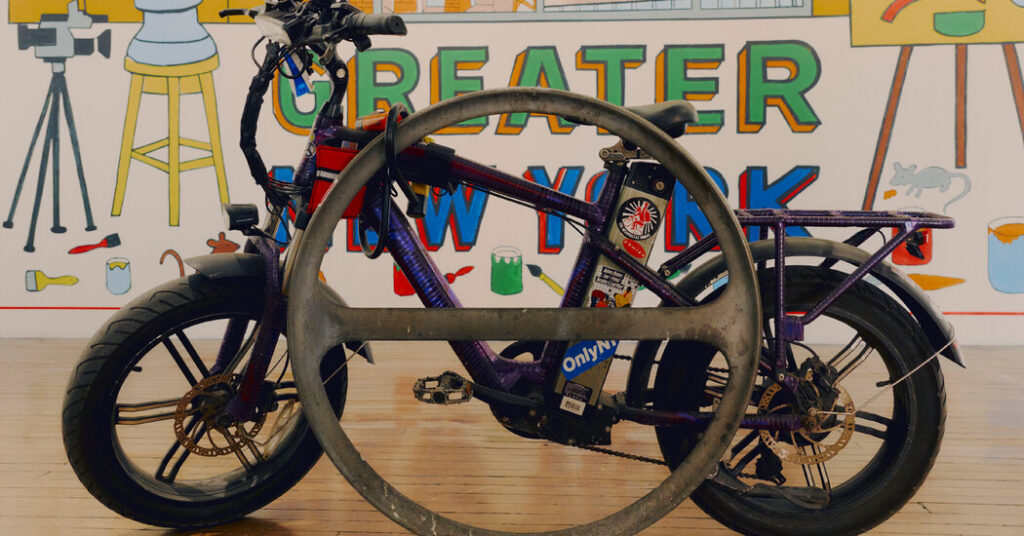
The first installation in “Greater New York” is called “Unfree Free Time.” It’s a bike rack. Sometimes an e-bike is chained to it, sometimes not. Sometimes an alert sounds on an audio speaker in the gallery, an alert that a food app delivery worker would recognize — the notification that there is a pickup from Uber Eats, DoorDash or Grubhub.
The photographer fields harrington — he prefers his name to be lowercased — designed “Unfree Free Time” after meeting Gustavo Ajche, a food app delivery worker and organizer with the nonprofit group Deliveristas Unidos.
It’s Ajche’s e-bike that is chained to the rack in the gallery, and for every hour that it is, he is paid $21.44, the hourly wage for delivery workers when harrington had the idea for the installation. (The wage rose to $22.13, not including tips, on April 1.)
Harrington, who had biked around the city for years, said the pandemic — and the surge in delivery workers — had changed his view of the streetscape. “A bike lane, for me, is like a space for commuting, for leisure,” harrington said, but for delivery workers, “it’s office space. It’s a workplace.”
A group of his photographs upstairs at PS1 show e-bikes but not their owners. “Me taking their photos, not giving them any compensation, would have been furthering the exploitation,” he said. But he said that workers were “represented in the stickers that are on the batteries and the bikes themselves, or if there’s a stuffed animal or a rosary” on the e-bike.
“All of that,” he said, “still speaks to who these people are who are doing this work.”
Weather
Expect another sunny day with temperatures near 87. Tonight will be mostly cloudy with a low around 67.
ALTERNATE-SIDE PARKING
In effect until May 14 (Solemnity of the Ascension).
QUOTE OF THE DAY
“It’s not the ideal race. Anthony is obviously everyone’s first choice.” — Peter King, a former Republican congressman on Long Island, on Anthony D’Esposito’s decision to stay on as the inspector general in the Labor Department. He had vacillated for months over whether to run against Representative Laura Gillen, a Democrat from Nassau County. The Republican candidate will be Jeanine Driscoll, a little-known local tax receiver.
The latest New York news
-
Prosecutors say SantaCon leader’s a con artist: Stefan Pildes was accused of siphoning off more than half of the $3 million donated to the annual Christmas-themed bar crawl over five years. An indictment said he had spent hundreds of thousands of dollars on “luxury vacations, extravagant meals and a luxury vehicle,” as well as on renovations to a lakefront property in New Jersey.
-
A truce over a key appointment: The City Council speaker, Julie Menin, decided not to block Mayor Zohran Mamdani’s nomination of Nadia Shihata to lead the city’s Department of Investigation. Menin had had concerns about Shihata’s independence.
-
Seeking accountability from eXp: The state comptroller said the real estate brokerage firm eXp should fix its company culture instead of moving to Texas. Two former eXp agents have been accused of sexual assault.
-
A redesign for one of Brooklyn’s most iconic landmarks: Mayor Zohran Mamdani is expected to propose linking Grand Army Plaza with Prospect Park by closing a dangerous stretch of road between them.
-
Who will turn out the lights?: The Sisters of Charity, an order of Roman Catholic nuns whose convent is in the Bronx, decided it would cease to exist when the last sister dies. The nuns’ average age is 87.
-
New exhibit honors fossil hunters: In a new exhibition, the American Museum of Natural History highlights the findings of Mark Norell and other fossil hunters responsible for its most important discoveries.
-
A play about Roald Dahl’s antisemitism: In the new Broadway play “Giant,” John Lithgow has received glowing reviews for his portrayal of the truculent children’s book author Roald Dahl.
Doormen vote to authorize a strike next week
Will people who live in doorman buildings find themselves working the front desk, sorting the mail, taking out the trash or hosing down the sidewalk?
Thousands of doormen and other apartment building workers who usually do those tasks voted on Wednesday to authorize a strike if their union could not reach a deal with building owners soon. It would be their first walkout in more than three decades.
Several more bargaining sessions are scheduled before the current contract expires on Monday. But the two sides indicated that they were far from coming to terms on major issues.
The union, Local 32BJ of the Service Employees International Union, wants raises that would keep up with the rising costs of living in New York.
The owners, who are represented in the negotiations by the Realty Advisory Board on Labor Relations, say that they, too, are squeezed by inflation — and must also contend with Mayor Zohran Mamdani’s pledge to freeze rents for about one million rent-stabilized apartments. The group also says that the building workers are among a small minority of employees in the United States who pay nothing toward their health insurance.
Howard Rothschild, the chief executive of the realty board, said that “we respect 32BJ’s right to strike.” And despite a long history of deals being reached at the last minute, building owners and managers have been preparing tenants across the city to share in the daily duties that the workers perform.
Manny Pastreich, the union president, said that he could not predict whether an agreement would be reached by next week. “The tension of last days helps,” he said. “That’s when everyone focuses.”
METROPOLITAN diary
On the way to the Met
Dear Diary:
The stones hold a sadness all their own. Winter cold, pale sun.
What do they make of us? Walking, walking, driving past one another.
Like second hands on clocks whose faces we cannot see.
Turning ourselves, one circle into the next until at some point we don’t.
It’s wild, isn’t it — not knowing exactly where we’ll run out of
whatever it is that kept us going. Through snow, beyond morning.
Past the stone facades, all those buildings we never entered.
— Linda Opyr
Illustrated by Agnes Lee. Tell us your New York story here and read more Metropolitan Diary here.
Glad we could get together here. See you tomorrow. — J.B.
Hannah Fidelman, Ama Sarpomaa and Ed Shanahan contributed to New York Today. You can reach the team at [email protected].
Sign up here to get this newsletter in your inbox.
Want to see more of our expert reporting in your Google search results? Add The New York Times as a preferred source.
James Barron writes the New York Today newsletter, a morning roundup of what’s happening in the city.
The post An Art Museum Has Evolved Along With Its Neighborhood appeared first on New York Times.