It’s been a chaotic few months at Ohio State. The university’s president resigned after he disclosed an inappropriate relationship with a woman seeking public funding for her business. The school’s biggest benefactor is under renewed scrutiny over his close ties to Jeffrey Epstein. And a professor teaching a course on leadership tackled a journalist who had showed up to interview the class’s guest speaker.
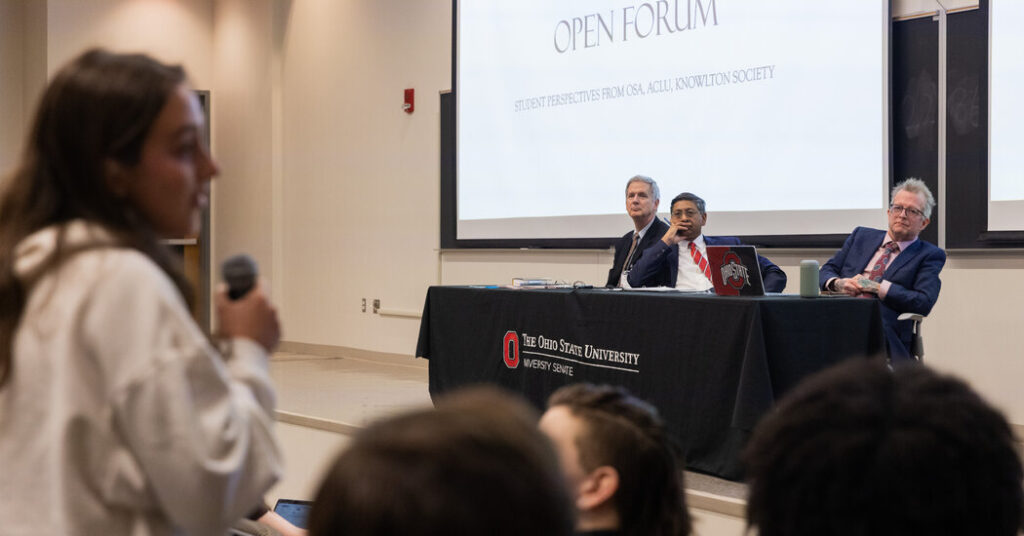
So, when the hastily installed new president, Ravi Bellamkonda, who had been on campus barely a year, addressed the University Senate for the first time after his promotion, it seemed to leave him dizzied.
“I’ve been here a little over 400 years — um, 400 days,” he said last month, to laughter from the audience of faculty, students and administrators.
It is a tumultuous time in higher education, with President Trump slashing federal funding, conservative lawmakers trying to codify sweeping curriculum changes, and existential questions confronting schools about the value of an increasingly expensive college degree.
For many school leaders, the days indeed feel like years.
Universities of all stripes have encountered challenges as political debates rock campuses and public trust in higher education wobbles, including at the School Up North — as the Ohio State rival Michigan is referred to in Columbus. Many have faced attacks from the Trump administration, political strife and their own scandals over Epstein ties. In some places, campuses have rallied around their leadership as they battle outside forces.
But the mounting troubles at Ohio State — often of its own making — are as outsize as its 67,000-student enrollment. The steady drip has led to frustration among students, faculty and alumni, and even concern about lasting reputational damage.
“This is a national embarrassment,” said Tristan Rader, a state representative who is among an increasing number of Ohio politicians who have been critical of the school’s leadership. “It puts a black mark on the entire state.”
Last month, Walter Carter Jr., a former Navy vice admiral who has written about military ethics, resigned as Ohio State’s president after disclosing to the university’s board of trustees the improper relationship, which he said in a statement involved providing “inappropriate access” to school leadership.
After Mr. Carter stepped down, a state economic development agency, JobsOhio, said in a statement that he had introduced the agency to the woman, who hosts a military-themed podcast, and that JobsOhio ultimately provided $60,000 in backing for the venture.
Mr. Carter was the third president in the last six years to leave Ohio State without completing their contractual term. Kristina Johnson left abruptly in 2023, and Michael V. Drake left in 2020 shortly before he was hired as president of the University of California system.
When Ms. Johnson left, The Columbus Dispatch reported that she had butted heads with the school’s biggest benefactor, Leslie Wexner, the retail magnate, who has also served as chairman of the board of trustees. Now, Mr. Wexner is at the center of a new conflict at the school, over his ties to the sex offender Mr. Epstein, who served as Mr. Wexner’s financial manager.
Many on campus are calling for Mr. Wexner’s name be scrubbed from buildings across the school. It is hard to overstate Mr. Wexner’s influence at Ohio State. Mr. Wexner had given more than $200 million to the school, according to a university spokesman. Three of the most prominent buildings on campus bear his name: the Wexner Center for the Arts; the Les Wexner Football Complex; and the Wexner Medical Center.
Calls to remove his name have grown louder as the release of the government documents has prompted fresh scrutiny and criticism of his close personal and financial ties to Mr. Epstein.
Nurses at the Wexner Medical Center have organized protests calling for his name to be removed from campus buildings and a university committee that reviews such petitions has received about 500 requests for removal.
In a play on the university’s custom of placing a red X through any signs on campus with the letter M (it’s that Michigan thing), someone has crossed out the W on a flag outside the Wexner Center for the Arts. Last week, protesters hung a banner with the word “redacted” over Mr. Wexner’s name on the building.
Mr. Wexner, 88, who lives in nearby New Albany, Ohio, denied wrongdoing when he testified before Congress in February. The board of trustees has not signaled any intention to act on the protesters’ demands. The board’s chairman is Mr. Wexner’s former personal lawyer, John Zieger, and the vice chair, Elizabeth Kessler, is the daughter of Mr. Wexner’s former business partner.
“I don’t trust that the process is in good faith,” said Lukas Killian, a nurse at the medical center who is among those demanding that Mr. Zieger and Ms. Kessler resign.
Even in calmer times, being president of a vast university is like being a ringmaster of a circus, said Mr. Drake, who was president of Ohio State for six years after leading the University of California, Irvine.
“My first day at Irvine, I arrived on my bicycle, was met by my chief of staff, put on a tie and went to work,” he said. “My first day at Ohio State, I was greeted by three television networks and a crowd of people.”
The news media have been back frequently, most recently after the resignation of yet another president. Mr. Carter, who did not earn a doctorate, seemed a curious choice for a football school looking to burnish its academic reputation. But he also had appealing credentials for a university battered by political pressures.
Shortly after taking the job, Mr. Carter, a former military leader, cracked down on pro-Palestinian protesters in the spring of 2024, requesting help from the state police, which positioned snipers atop the student union. The deployment terrified some students and rekindled memories of the Ohio National Guard killing four students at Kent State in 1970.
In the next year, the Republican-dominated State Legislature passed a sweeping rollback of diversity initiatives and tenure protections for professors, and was seeking to influence curriculum at state universities. After President Trump started his second term, the federal government also began an inquiry into admissions practices at Ohio State’s medical college, to see if it discriminated against white applicants.
At last month’s University Senate meeting, students and faculty wondered if Mr. Bellamkonda would be more collaborative than his predecessor.
Among the topics discussed was a student survey in which only 21 percent of respondents described the free-speech climate on campus as open and how a ban on sidewalk chalking, which many schools allow as a vehicle for freedom of expression, had driven down participation in student organizations.
As he listened to students and faculty speak, Mr. Bellamkonda occasionally paused to take notes. Jessica Asante-Tutu, the undergraduate student body president, said she had noticed him doing the same thing when he served as provost. “It showed me he’s not just listening to listen, but listening to understand,” she said.
Mr. Bellamkonda’s address to the senate is one of the few times he has spoken publicly. He declined an interview request from The New York Times.
The concerns about free speech and academic freedom go well beyond whether student groups can chalk campus sidewalks.
Last year, the Advance Ohio Education Act became law as part of a wave of legislation in Republican-led states that seeks to assert more government control over public universities. The new Ohio law bans diversity, equity and inclusion programming, prohibits faculty strikes and limits how controversial subjects can be taught. A state law passed in 2023 compelled Ohio State to create a center that would teach the Constitution and be free of liberal ideology.
Gordon Gee, a former Ohio State president, said that legislative mandates like the one in Ohio and others in Texas, which abolished the faculty senate, and Oklahoma, which is doing away with tenure, are signs that universities have lost the public’s trust.
“We haven’t listened,” said Mr. Gee, who returned to Ohio State last year to teach and to recruit faculty to the new unit, the Salmon P. Chase Center. “We’ve been isolated. We’ve been arrogant. We’ve not read the tea leaves very carefully.”
In February, after Mr. Gee finished a seminar, a reporter and videographer who were waiting outside his classroom asked him about the turmoil over Mr. Wexner and other issues. Mr. Gee answered questions from the reporter for a few minutes, and then, as Mr. Gee began to walk away, the videographer tried to asked a question. Luke Perez, an assistant professor at the Chase Center, knocked his camera away and threw the videographer to the ground.
Mr. Perez, who was charged with assault, has pleaded not guilty. He has been placed on leave by the university.
Erynn Beaton, an associate professor of public affairs, said the violent confrontation was a “symptom” of the systemic problems facing Ohio State.
She was among the professors from Ohio State’s branch of the American Association of University Professors who gathered on a recent afternoon to discuss what issues troubled them most.
Presidential turnover. Les Wexner. Free speech. The State Legislature. The Chase Center. The board of trustees.
It was a long list.
The post A Football School Striving to Be More Keeps Dropping the Ball appeared first on New York Times.