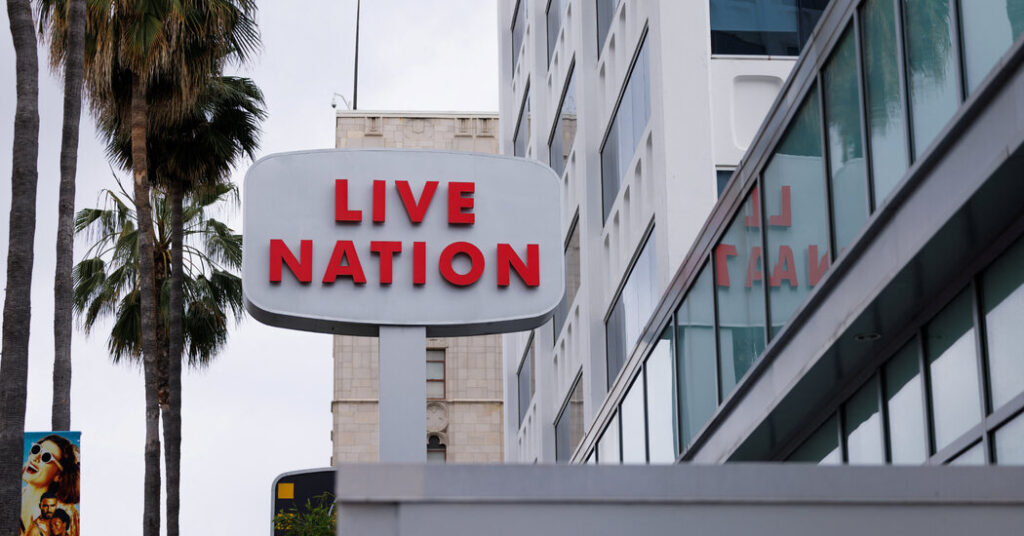
After years of scrutiny and complaints, Live Nation, the concert giant that includes Ticketmaster, has been found to be a monopoly.
On Wednesday, a federal jury delivered a resounding verdict for the dozens of states that continued a case initially brought by the Justice Department. The company had been accused of monopolizing ticketing at large venues and of threatening venue operators, saying they would lose access to Live Nation’s popular concert tours if they did not use its ticket vendor.
A judge will now determine damages and remedies in the case, which could involve divestments or a breakup of the company.
Here are five takeaways from the seven-week trial.
How fans are affected may not be known for months or years.
Music fans expecting an immediate change in their wallets may be disappointed.
Although the verdict was a total win for the plaintiffs — 33 states and Washington, D.C. — it represents the first stage of a process that may continue for months, or even years.
In an antitrust case, the judge has the power to impose injunctive relief, meaning any changes to the company’s structure or how it operates. That may involve selling off parts of its business, or “behavioral” remedies like an agreement with the states. The states may reject that approach because Live Nation had been subject to such an agreement since its merger in 2010, and it was widely criticized as ineffective.
It is within Judge Arun Subramanian’s purview to order a breakup of Live Nation and Ticketmaster, as the Justice Department had called for in 2024. But such a severe remedy is rare — no major American company has been successfully broken up as a result of antitrust litigation since AT&T more than 40 years ago.
The judge will also determine a monetary penalty for Live Nation, using as a basis the jury’s finding that Ticketmaster had overcharged customers by $1.72 per ticket.
The jury heard from only one artist.
The jury of nine heard from various Live Nation and Ticketmaster executives, along with venue operators and business people from rival concert and ticketing companies. There were five expert witnesses who gave detailed testimony about the economics behind ticketing and concerts, and opined about the presence or absence of anticompetitive behavior. And two fans spoke about the hassles of buying tickets.
But artists were barely represented. The sole performing artist heard by the jury was Ben Lovett, a member of the group Mumford & Sons, who in recent years has also been developing a business in concert venues. Mr. Lovett spoke via a video deposition, saying that Mumford & Sons has toured with a variety of promoters, including Live Nation, and that the company had served it well. (Kid Rock, the rap-rock provocateur who has become an outspoken critic of the industry’s status quo, had been on initial witness lists but never testified.)
It was a striking contrast to the Penguin-Random House merger, which drew strong public reactions from authors. In 2022, Stephen King testified in that trial, becoming the star witness for the case.
There are lingering questions about a settlement.
Last month, just days into testimony, the Justice Department stunned the courtroom by revealing that it had reached a settlement agreement with Live Nation. The federal government exited the case, along with six states that joined its settlement.
Weeks later, a complete picture of how that settlement came to be remains unclear. Trump-aligned political figures like Kellyanne Conway and Mike Davis advocated on behalf of Live Nation in Washington, including at the Justice Department, according to multiple people with knowledge of those talks. According to some reports, the settlement document was signed at the White House.
On Tuesday, six Democratic senators, including Amy Klobuchar and Elizabeth Warren, sent a letter to Judge Subramanian, that said the known facts about the settlement “point to a deal made in response to political pressure rather than the public interest.” They added, “This settlement appears to be part of a larger pattern of Justice Department officials reportedly overruling antitrust enforcers for political reasons.”
Judge Subramanian had already begun laying the groundwork for a review of the settlement under a federal law known as the Tunney Act, under which judges have discretion to review antitrust settlements to ensure they were made in the public interest.
The case uncovered how deals are made — or blocked.
Some of the most revealing details in the trial came from internal documents submitted as evidence that showed Live Nation employees discussing potential deals: artists to recruit, venues to rent, ticketing contracts to sign, leases to renew. At such a giant company, there was a constant flow of decisions.
But Live Nation also blocked plenty of deals. At trial, the company acknowledged a longstanding policy of not booking artists for its amphitheaters unless they used Live Nation as their promoter. “You can only play our amps with us,” Colin Lewis, an executive in its touring division, wrote in one email from 2021.
The extent to which Live Nation held to that policy was sometimes eye-opening. In early 2020, top executives discussed a request from an outside promoter to put on a Radio Disney event at an amphitheater in Irvine, Calif. A touring chief emailed Michael Rapino, the company’s longtime chief executive, to recommend the deal, which he said was “kind of harmless” and could bring in up to $400,000.
Mr. Rapino replied tersely: “I would not let them into our venues.”
What really happened at Barclays Center?
One of the trial’s most dramatic moments came when the jury heard a recording of a phone call from 2021, when the head of the Barclays Center in Brooklyn told Mr. Rapino it was dropping Ticketmaster for a rival ticketer, SeatGeek. Mr. Rapino let out a profanity and told the Barclays chief, John Abbamondi, that it was “going to be a tough time” to send Live Nation tours to the arena.
Mr. Abbamondi said he viewed that comment as a threat, and believed that Live Nation had followed through on it by diverting shows from Barclays — including a key concert by Billie Eilish in 2022. Mr. Rapino denied it, and said that the New York market had become more competitive with the arrival of the UBS Arena on Long Island.
Further testimony clouded the question of whether Live Nation had truly retaliated, or whether SeatGeek was just not up to the job, particularly when it came to one of the ultimate tests of a ticketing platform: a Bruce Springsteen concert.
Within weeks of SeatGeek taking over, Laurie Jacoby, another Barclays executive, sent a sharp email to the ticketer’s chief, “putting you on notice” about various problems with the service that, she said, were so severe that they were leading to other promoters avoiding the venue. She said that SeatGeek had allowed “spec tickets” — scalpers’ advertisements for nonexistent tickets — to be listed for an upcoming Springsteen show, which she said had “resulted in Springsteen management potentially pulling the 2023 show.”
Emails from Barclays detail a litany of problems with SeatGeek, including long customer waits. Still, on the stand, Ms. Jacoby said that she, like Mr. Abbamondi, believed that Live Nation had retaliated against Barclays and that Live Nation employees had been “stirring the pot” against them when they spoke to artists’ teams.
The Springsteen show went on as planned. He is scheduled to return to the venue next month — this time ticketed by Ticketmaster.
Ben Sisario, a reporter covering music and the music industry, has been writing for The Times for more than 20 years.
The post 5 Takeaways From the Live Nation Antitrust Trial appeared first on New York Times.