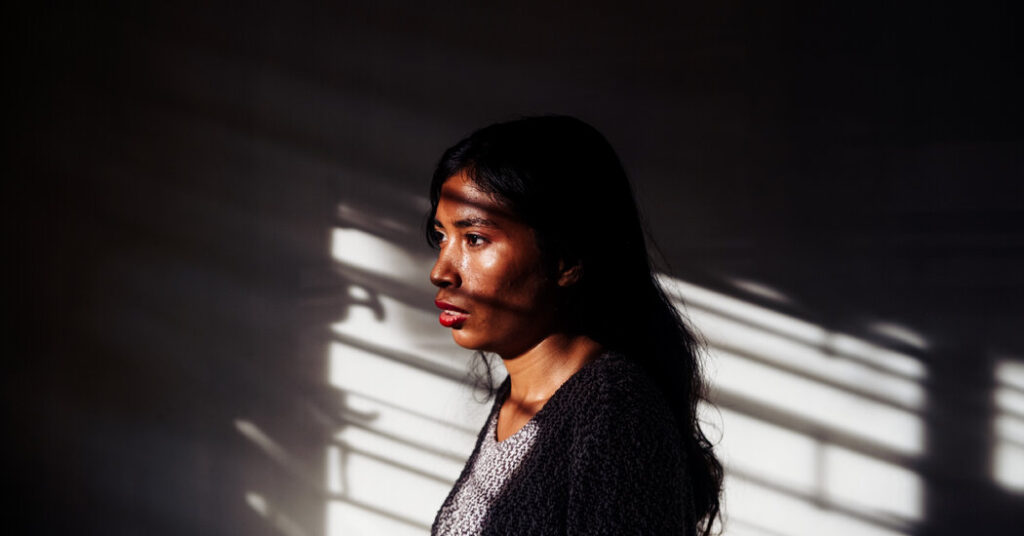
Sugey Amaya spends most of her nights outside a converted movie theater that is now a holding station for people passing in or out of El Salvador’s crowded prison system.
While her mother watches her children, she waits for inmates to be released from the prison facility, which is on the outskirts of San Salvador, the capital.
Ms. Amaya, 29, has become a fixture at the facility, known as El Penalito, retrieving men who are not allowed to leave unless someone is there to pick them up.
Like many Salvadorans, Ms. Amaya first encountered the prison system four years ago, when El Salvador’s government declared a state of emergency to crack down on the country’s vicious gangs, groups like MS-13 that terrorized Salvadorans and had become notorious around the world.
Under the state of emergency, declared under President Nayib Bukele, security forces were ordered to carry out mass arrests, and within months, tens of thousands of people were in custody.
Last year, some police officials said that they had faced intense pressure to meet quotas and had resorted to flimsy evidence to make arrests. They said they believed that innocent people who were detained would later be released. But according to Salvadoran officials, fewer than 10,000 of the roughly 90,000 people imprisoned since 2022 have been released.
Mr. Bukele has credited his crackdown for bringing about a stunning turnaround in El Salvador, which quickly went from being one of Latin America’s most dangerous countries to one where people felt the safest, according to Gallup polls.
Today, the country has one of the world’s highest rates of incarceration, according to Human Rights Watch, with roughly 2 percent of its population of six million in detention — one out of every 50 people.
Salvadorans say their lives changed under the state of emergency: They could run businesses without being extorted, walk to the store at night.
Ms. Amaya moved into a small house on the outskirts of San Salvador in 2022 that she was told had previously been occupied by gang members.
But her beloved brother, the person she was closest to, had been taken away. Alexis Amaya was detained in July 2022 as he made his way home after a shift at a Papa John’s pizzeria, Ms. Amaya said. He was 24 at the time.
Ms. Amaya learned that he had been accused of belonging to a gang and sent to prison, where he remains — a story common for many who belong to El Salvador’s lower classes.
Many families have seen more than one son go to prison under the state of emergency, known locally as “el regimen.” Some do not know exactly where their loved ones are: Prisoners are generally not allowed contact with relatives — no phone calls, no visits, no letters or emails.
The mass arrests have swelled the prison population beyond the capacity of the government to provide inmates with even basic services, rights groups say, from medicine to food.
Prison rations are known to be meager: Families who can afford to do so buy extra food to keep their loved ones fed. At stores near the prisons, they can purchase calorie-rich foods to hand over to the guards, along with basic supplies like toilet paper or toothpaste.
Some Salvadorans travel hours to reach a prison in order just to buy their relative food. Many families say they have sold possessions — a motorcycle, a cow — to pay for the bundles of food and supplies.
When Ms. Amaya’s brother disappeared in 2022, she went to El Penalito, the holding station, only to be told he had been transferred to a massive prison known as Mariona.
As Ms. Amaya was frantically searching for information about her brother, she learned that inmates were not being freed from El Penalito if no one was there to receive them.
The Salvadoran government did not respond to questions about the legal basis for keeping the prisoners detained, but rights groups say that Mr. Bukele has granted the authorities broad discretion over who is released.
Without thinking too much about it, Ms. Amaya started signing for strangers, then taking them to a secondhand clothing stand to change out of their prison-issued white T-shirts, shorts and rubber sandals.
Then she made sure they got home.
The routine has become her life.
Men leave El Penalito carrying their release papers rolled up in their hands, she said. They have no money. Many are disoriented after months or years in prison.
One man had been living in Boston and was back in El Salvador visiting relatives, he said, when he was arrested and charged with possessing false documents; he had been held for nearly two years.
He could not easily find his way home. It was after midnight when Ms. Amaya finally dropped him off in Apastepeque, a town around 40 miles from the capital.
The men are often shocked by her generosity, Ms. Amaya said.
A 35-year-old man who asked only to be identified by his first name, Josué, was released from prison around 3 a.m. on a summer night in 2023, with no family members there to receive him.
When he saw Ms. Amaya — who is 4-foot-9 and weighs less than 100 pounds — it seemed to him as though “an angel” had appeared, he said.
Sometimes, the inmates have nowhere to go. For a time, Ms. Amaya let those men stay overnight at her house, until relatives warned her it could be risky for her and her children.
She never asks the released prisoners what they were incarcerated for. It makes no difference to her, she said.
“I see my brother’s face in them,” she said.
Ms. Amaya’s work has become a full-time job.
She gets by on the donations she receives from prisoners’ families, she said. The funds cover her travel costs, the clothes she buys the men, a bite to eat on the way home.
She has also become well-known among families who live far from the prisons where their loved ones are held — even as far away as the United States.
Some send her money to buy packages of food for their relatives because they cannot deliver them themselves.
These days, Ms. Amaya is taking law school courses, a path she says was influenced by all she has seen. But by nightfall, on most nights, she can be found back outside El Penalito.
She has lost track of how many prisoners she has signed for there. In a bag, she has hundreds of slips of paper with names and prisoner numbers.
They represent the last four years.
When asked by prison employees why she keeps coming back, even when her brother’s name is never called, Ms. Amaya always gives the same reply.
“The ones who come with me — I get to ask them, ‘Where were you held? How do they treat you all in there?’ It helps to understand my brother’s world,” she says.
And she still has faith that one day, Alexis will appear.
Annie Correal is a Latin America correspondent for The Times.
The post When El Salvador’s Prisoners Go Free, She’s There to Pick Them Up appeared first on New York Times.