INTO THE WOOD CHIPPER: A Whistleblower’s Account of How the Trump Administration Shredded USAID, by Nicholas Enrich
In this unstable moment, it’s easy to yell at the headlines, to pine for more hopeful times, to wish Somebody would Do Something. But what if Somebody turns out to be you — what do you do?
In the spring of 2003, Nicholas Enrich was an idealistic 21-year-old college junior studying abroad in Kenya, inspired by that nation’s struggle toward more democratic government and appalled by the ravages of H.I.V. that were plain to see all around him. That same spring, George W. Bush signed the President’s Emergency Plan for AIDS Relief, inaugurating a program that would become one of the most successful global health initiatives in history.
“It felt as if the U.S. government was recognizing the urgency to act at the same time I was,” Enrich writes in “Into the Wood Chipper,” an anguished insider’s account of the last days at the United States Agency for International Development, or U.S.A.I.D., which, among other things, helped managed the U.S. efforts to fight H.I.V. abroad. The young Enrich saw the agency’s handshake logo everywhere in Kenya, and it made him proud to be American. An ambition to work in global health — to be part of a team that was Doing Something — was born.
Until recently, most Americans gave little thought to the organization to which Enrich dedicated his career. “Into the Wood Chipper” is a skillful piece of storytelling that brings U.S.A.I.D. back into the spotlight. Enrich’s account is a propulsive witnessing of the agency’s destruction and an engaging amplification of the author’s whistle-blower memos and congressional testimony detailing its demise.
Through the late fall and early winter of 2025, Enrich, now a veteran U.S.A.I.D. officer, awaited the beginning of the second Trump administration with anxiety, though his concern for the agency was hardly existential. There had always been complaints that U.S.A.I.D. was bloated and bureaucratic, that it failed to support local initiatives and interfered in political regimes. But Marco Rubio, the nominee for secretary of state, was a supporter of the agency, and the Heritage Foundation’s Project 2025 included no suggestion that it be eliminated.
In December, however, a guest on Joe Rogan’s podcast described U.S.A.I.D. as a tool wielded by the C.I.A. to suppress populist politics, especially on platforms like X. Elon Musk, the owner of X and newly appointed head of the Department of Government Efficiency (DOGE), was listening — and reposting — and Donald Trump took his cue from Musk. On Inauguration Day, Trump signed an executive order titled “Reevaluating and Realigning United States Foreign Aid” and brought all of U.S.A.I.D.’s programming to a screeching halt.
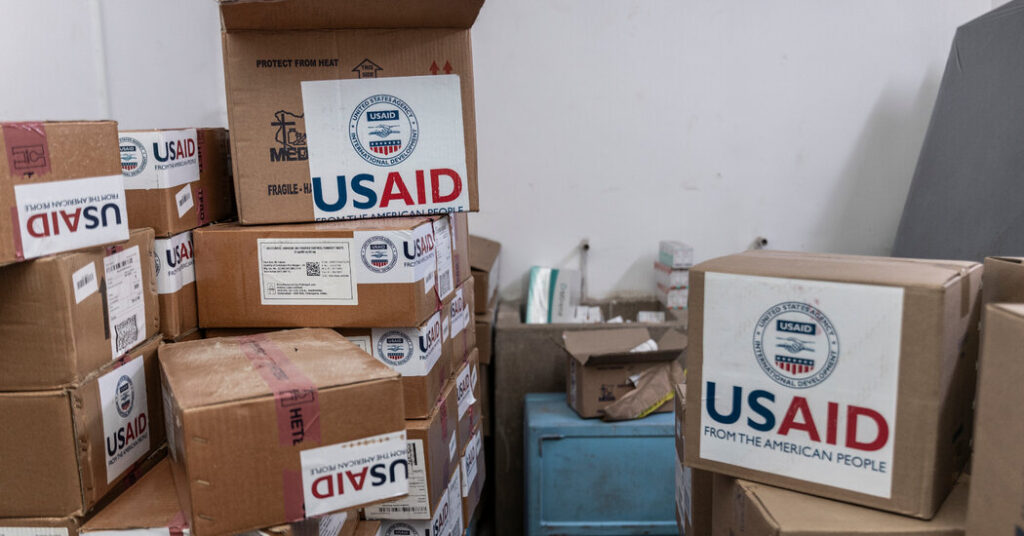
Soon, perishable food and medical supplies were trapped, undelivered; clinical trials were interrupted; contractors in countries around the world were unable to meet payroll. Oh, and there was the news of a fresh Ebola outbreak in Uganda, to which U.S.A.I.D. was now all but powerless to respond. Meanwhile, the agency’s new Trump-appointed leadership effectively prohibited all external communications, leaving the career staff helpless to explain any of this to their increasingly frantic contractors around the world.
And then the purge began. A few dizzying days later, Enrich found himself in the unsought and unwanted position of head of U.S.A.I.D.’s global health efforts. Gen-Z DOGE investigators were already in the building, hunting for evidence that civil servants like Enrich were undermining Trump’s authority. It was rapidly becoming clear that the goal had never been “reevaluation” or “realignment.” “We spent the weekend feeding U.S.A.I.D. into the wood chipper,” Musk wrote on X on Feb. 3.
A debate raged among the remaining staffers: resist, and risk validating Trump’s distrust of civil servants? Or comply, and participate in the elimination of the programs they believed in?
But the choice was no longer between resistance and appeasement, Enrich and a few trusted colleagues realized: U.S.A.I.D. was over. Huddling wretchedly over drinks, they began to focus on what kind of ending they wanted. “We could blaze out,” one suggested. On March 2, just after receiving his own notice, Enrich pressed send on a detailed account of the chaotic dismantling of U.S.A.I.D., and included data on its impact in terms of malnutrition, infectious diseases and unnecessary deaths. Calls from the national media flooded in.
“Into the Wood Chipper” works on two levels. The most obvious, in this moment of agonized frustration on the left, is as a Trump takedown. Enrich describes moments of astounding, unapologetic ignorance on the part of U.S.A.I.D.’s new political appointees, as when one of them suggests he draft a “Barney-style” slide deck to explain the dangers of drug-resistant tuberculosis at the level of kiddie TV. Another insists that Ebola is a scam. “I had no idea you did all this,” exclaims U.S.A.I.D.’s new acting chief of staff. “I assumed it was just, you know, abortions.”
When Enrich’s team tries to enlighten the new arrivals about the nature of humanitarian aid, they are met with skepticism or worse: It becomes clear that some of the appointees, nursing grudges from the first Trump administration, are enjoying the carnage. But even the destruction is carried out inefficiently, with some staffers, including Enrich, receiving emails referring to both their essential-worker status and their imminent firing almost simultaneously.
The story also plays as a miniature bildungsroman. Enrich is an idealist who takes pride in his work, but he’s also a relatable guy, a comfortable middle manager who wants to leave the office in time to make his daughter’s soccer game. He understands the civil servant’s obligation to serve whatever administration is in charge, and he’s never been without a supervisor. The line beyond which he refuses to go keeps shifting, because he’s never had to think very hard about where it is. His journey to the realization that this time the cavalry isn’t coming is frightening, painful and true.
Enrich’s voice is appealingly candid, and despite a blizzard of government acronyms and a parade of personnel, his tale gallops forward. Unapologetically cinematic touches suggest he may already have begun to think in terms of a film adaptation: There’s the MAGA buddy who downplays Enrich’s anxiety and the pragmatic and principled wife who helps Enrich stay focused on what’s right. There’s the Trump appointee who is more excited about flip-charts and dry-erase markers than lifesaving health initiatives, the workman in a cherry picker removing the name of the agency from the front of the building letter by letter, and the dutiful career U.S.A.I.D. official, clinging to a last shred of office normalcy, who suggests going in on a birthday cake for the man who is tearing her workplace apart.
Enrich frames his tale both as a chronicle of dishonorable mayhem and as a manual for others at risk. His epilogue includes a bulleted summary of Trump’s playbook and a detailed list of steps to take if targeted: Document everything, avoid isolation, stay nonpartisan and “don’t wait for someone else to act.” When the full history of this moment is ready to be written, “Into the Wood Chipper” will be a vivid source.
INTO THE WOOD CHIPPER: A Whistleblower’s Account of How the Trump Administration Shredded USAID | By Nicholas Enrich | Summit Books | 209 pp. | $29
The post What It Was Like Inside U.S.A.I.D. Before He Blew the Whistle appeared first on New York Times.