President Donald Trump’s rejection this month of federal support for child care upended significant bipartisan work to address an issue that families emphasize is driving up costs, according to advocacy groups and lawmakers involved in the efforts.
Lawmakers had signed on in record numbers to letters requesting money for early childhood care and education, according to the First Five Years Fund, a nonprofit that advocates for the programs. Trump’s domestic spending package expanded tax credits for working parents to offset child care costs, adopting elements of a bill from Sens. Katie Boyd Britt (R-Alabama) and Tim Kaine (D-Virginia). And the White House budget proposal for 2027 maintained funding for Head Start and the Child Care and Development Block Grant, about $20 billion combined.
“The interactions we’ve had within HHS and OMB have been positive,” said Sarah Rittling, the First Five Years Fund’s executive director and a former counsel to then-Sen. Lamar Alexander (R-Tennessee), referring to the Department of Health and Human Services and the Office of Management and Budget. Advocates and lawmakers also reported encouraging conversations with Vice President JD Vance, Treasury Secretary Scott Bessent, White House chief of staff Susie Wiles and the president himself.
But then a riff from Trump that wasn’t supposed to be public threw doubt on his administration’s position.
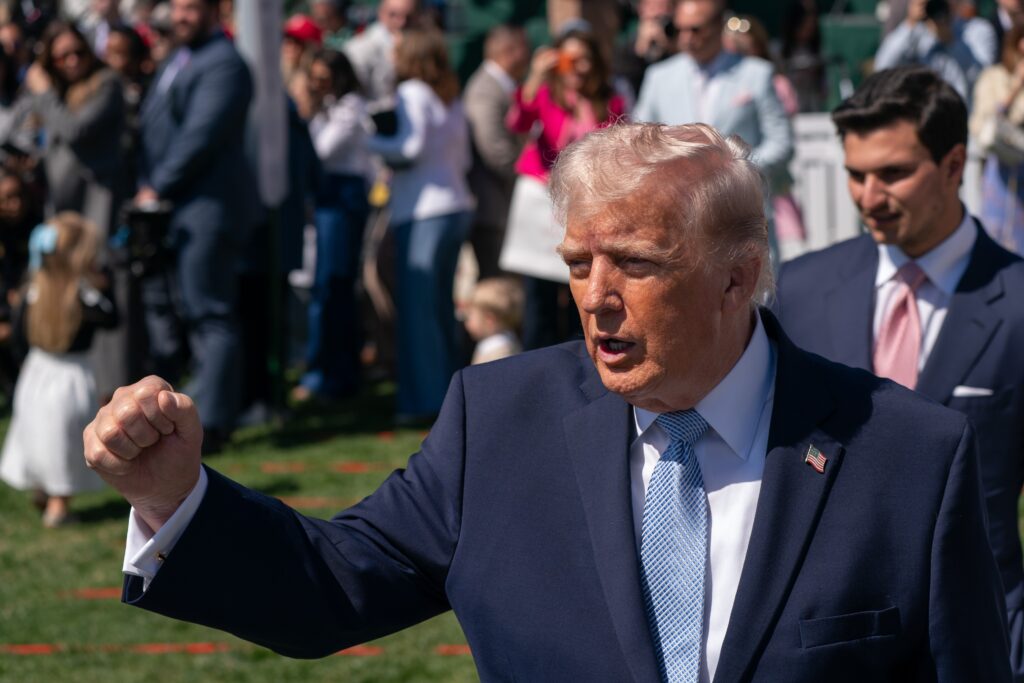
“We can’t take care of day care,” Trump said at an Easter lunch on April 1, according to a video the White House posted online and later removed. “We’re a big country, we have 50 states. We have all these other people, we’re fighting wars. We can’t take care of day care.”
Aides said that despite Trump’s sweeping language, the president was just referring to allegations of fraudulent payments for child care centers in Minnesota. A White House official said a new Vance-led task force to catch fraud in the programs will ensure their “viability for the Americans they’re meant to serve.”
In January the administration attempted to withhold $10 billion in federal grants for child care and other assistance to Minnesota and four other Democratic-led states. A federal judge blocked the freeze in February, saying the administration had provided “no reasoned explanation” for its decision.
The White House declined to elaborate on how Trump plans to make child care more affordable, as he explicitly promised during the 2024 campaign.
“He told me to my face, ‘We have to have child care,’” said Reshma Saujani, the founder and CEO of Moms First, a nonprofit advocating for parental leave and child care. She was quoting Trump’s response to a question she asked him at a town hall at the New York Economic Club in September 2024.
“You have to have it,” Trump said then.
“The facts haven’t changed,” Saujani said. “Americans are still being priced out of parenthood. The only thing that’s changed is the president’s love of foreign wars.”
Child care prices jumped 29 percent from 2020 to 2024, exceeding the rate of inflation, according to Child Care Aware of America. The average price of child care for two children was more than food, transportation, health care and in-state college tuition in every region of the country, the nonprofit group’s analysisshowed. At $13,128, the average annual price of child care amounts to 35 percent of the median income for a single parent, according to the Bipartisan Policy Center.
Proposals to address those costs include increasing the supply of providers and giving money to parents. Almost 4.2 million children lack access to a licensed child care program in their area, according to research by the Bipartisan Policy Center.
During the presidential campaign, Vance and other members of Trump’s coalition highlighted declining U.S. birth rates as an economic, national security and cultural concern. The country’s fertility rate started falling in the 2000s and reached a record low of 1.6 births per woman in 2024.
Since taking office, Trump administration officials have talked about policies to try to raise birth rates. In February 2025, for example, the Transportation Department said it would prioritize highway spending in places with higher birth rates.
Most Americans say the federal government should not have a role in encouraging people to have more children, a Pew Research Center survey in September 2025 found. But large majorities did support specific policies that could lower costs for families, such as providing free child care (64 percent to 21 percent), requiring paid family leave (75 percent to 10 percent) and giving parents more tax credits (82 percent to 7 percent).
Trump’s domestic spending package, known as the Working Families Tax Cut Act or the One Big Beautiful Bill, last year updated several child care tax credits for the first time in decades. The bill initially expanded the credit for employer-provided day care for the first time since 2001. In the Senate, Britt has pushed to add provisions that she first introduced with Kaine in 2024, including an expansion of tax credits for families and flexible savings accounts for child care.
Unlike the Britt-Kaine bill, however, the final version of Trump’s legislation did not make the credit refundable, meaning it doesn’t help the poorest 40 percent of households that owe no federal income tax.
“I wish the White House would focus on partnering with Congress to get that done — instead of saying it’s ‘not possible’ to address the child care crisis because of Trump’s unnecessary and unpopular wars,” Kaine said.
The cost of employees being distracted, missing work or quitting their jobs because of child care disruptions totals $35 billion to $45 billion a year, according to a new McKinsey & Company research report released today for Moms First and companies including Hilton and Chobani. Families with children under 5 lose $172 billion annually in earnings and productivity, according to a February study for the First Five Years Fund.
In his New York Economic Club remarks in 2024, Trump said the U.S. could easily pay for child care using tariff revenue. His tariffs raised $287 billion in 2025, but the Supreme Court struck down most of themin February, ruling that in levying them, the president had exceeded his authority. Companies are now demanding refunds. Universal child care through age 4 would cost an estimated $175 billion to $200 billion annually, according to Moms First, while universal pre-K would cost an estimated $40 billion to $60 billion per year.
The post Trump’s reversal on day care upends a bipartisan push to lower costs appeared first on Washington Post.