In 2007, my father was dying in Bridgetown, Barbados from intestinal cancer. Dying in Barbados was long a part of his plan; though he lived in Poughkeepsie, NY, my father wanted to be somewhere beautiful in the company of my mother and his closest friends.
After an arduous plane ride from New York City, with the oxygen tank on the seat next to him, my father asked, “Can I finally let go?”
“That’s why we are here,” my mother answered. “To let go.”
They each might have had different ideas about what that question meant to them, and what its answer truly signaled. He was asking her permission to die. He was 55 years old.
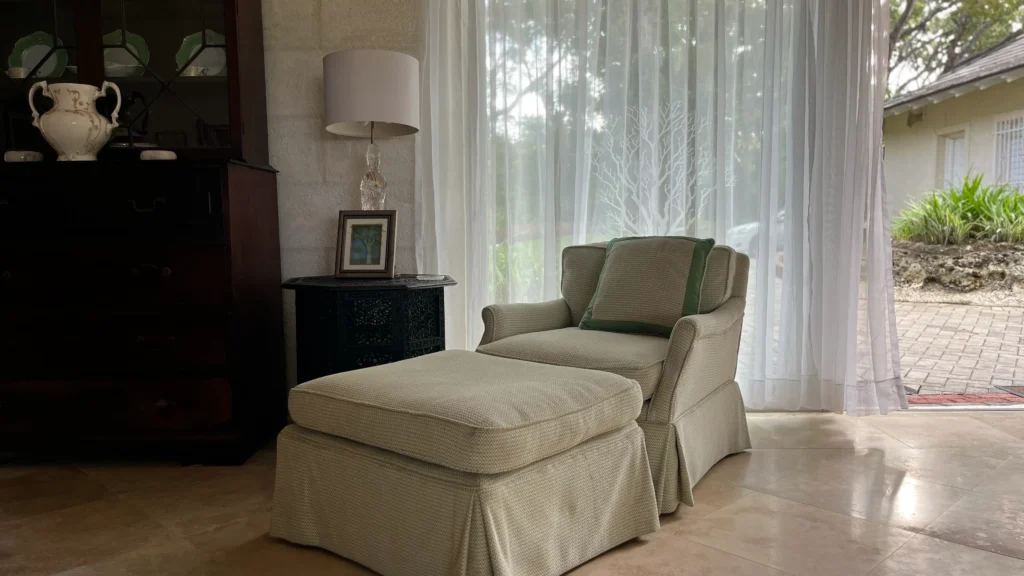
Letting go, for my father, meant arriving back to one of the few places he had vacationed over the last few years, the home of one his closest friends. He settled into a familiar, comfortable chair, the one that was upholstered green and white with a soft, low saddle. It was well used, and its springs sunk deep.
On the second night of his stay, Dad called my cell phone. He rarely did that. I was in the middle of my finals week of the spring semester of my first year at graduate school studying architecture. I was running between class and dinner, but I answered.
“Hey, are you having fun?” I said, in denial of the truth that he was dying. “I’ll see you after my final, when you get back.”
“I love you, Michael,” he replied weakly. “I am proud of you.”
Then my phone’s battery died before I could respond, and I had to run home to charge it. But he never answered when I called back. By the next day, he was gone.
Life had taught me that architecture was the business of making and designing structures. But my father showed me that architecture is brought to life through the stories we tell ourselves, and in the memories of the consequential acts that take place in and around the buildings we share. In this way, architecture becomes more verb than noun as it shapes us. It is a living thing.
Maybe this is why my mother later said, all things considered, that my father had “built a beautiful death.” He had also built a beautiful life.
On his last day, May 17, 2007, he breathed to my mother, “You are surrounded by your closest friends. You will be taken care of.” He then fell into a sleepy fog in his chair, in and out of consciousness. The friends moved him to his bed, and a few hours later he passed. This was his last room.
When, 17 years later, I visited this home and sat in that chair, I wondered about his death. Was the space where he died a form of self-medication? Of palliative medicine?
A palliative care physician named B.J. Miller would make the case that it was. Aesthetics and sensory inputs are healing to patients, he confirmed to me, and often as important as medical or scientific inputs as life fades toward the end. When I told Miller about my father’s story, he called my father’s quest the search for “the last room.” It was something not all can achieve, but to achieve it is a beautiful death.
“What would it look like,” he asked me, “if we could design the last room as we want it to be?” Could we create centers that gave people choices to die with dignity and closure? It was, of all the architectural ideas I had heard, one of the most novel—and most beautiful.
Typically, in hospice care, Miller told me, we get one choice. One can die in the hospital or one can die at home. Homes can be complicated and leaden, and hospitals sterile and institutional.
Palliative healthcare facilities and hospices are uncommon in many communities, and while there are some thoughtful examples, most are small spaces, and many resemble the clinical spaces families were trying to avoid.
But what if we had a different set of choices? Why couldn’t we design centers where our last place to live or to die was a choice we made, of the type of spaces, services, and conditions we wanted before exiting this world? It would bring such calm to so many patients and assist them as they experience and approach whatever comes after this life. It would give them peace to know these choices were available.
When faced with death, patients often prefer to make aesthetic choices over rational or scientific ones. Modern medical environments are “anaesthetic” or devoid of design. Miller describes them as “more numbing—deadening—than invigorating.”
Palliative medicine and hospice, done well, can become a bridge between the sterile, ascetic, efficient spaces of the medical hospital and the soft, comforting, and familiar spaces of home. Somewhere in this middle space, the choices of patients at the end of life show how effective the world of perception, aesthetics, and sensory input could be in reducing harm. Many aspire to feel a sense of “wholeness” that only aesthetic experiences can provide.
My father had been lucky, despite his early diagnosis and early death, to be able to choose the pathway he’d take out of this existence. His home or the hospital was not how he wanted to go out. And after such a trying two-and-a-half year battle with cancer, he chose a home overlooking the sea in Barbados, the one place he knew he could let his spirit go, far from the things he knew, far from my siblings and me, surrounded by his wife and best friends—a beautiful place where he could leave the world he knew with ease.
The last room is not only a place we might design, but also a set of choices we could be offered to consider a more well-lived life. It is about having the choice to select locations, sounds, tastes, sights, perceptions, and senses that may give us the most peace, the most wholeness.
When we talk about death in this way, we build a vocabulary—a set of awarenesses and expectations of the built environments and sensory experiences we want to be in for all our days, not only at the end of life.
In this way, facing the end is our notice to begin living today.
This excerpt was adapted from Our World in Ten Buildings by Michael P. Murphy with permission from One Signal Publishers, an imprint of Simon & Schuster.
The post The Room Where My Father Died Changed How I See Architecture appeared first on TIME.