It’s a scene that sounds like it was lifted from Alien—a researcher interested in extraterrestrial life descends into the depths of a cave, where a droplet filled with creepy crawlies lands smack dab in her eye.
“I was like, ‘OK, I’m pretty sure that something alive fell in my eye,’” says Penelope Boston. She is now a portfolio scientist at NASA, but experienced this mortifying episode deep inside New Mexico’s Lechuguilla Cave in 1994.
Spelunkers often refer to their passion as catching the “cave bug.” In Boston’s case, the idiom was literal. Despite the injuries and harrowing moments she endured in her initial foray to the underworld—and the microbes that had to be carefully extracted from her peepers afterward—Boston came away “well and truly hooked.”
“After the pain and the pizza-sized bruises and all that healed, what I remembered was having seen this breathtaking environment with all of these spectacular mineral deposits, giant rooms, and bizarre sulfur deposits that looked like nothing I’d ever seen on the surface,” she says. “I always wanted to go to other planets. It didn’t seem like we were going to do that anytime soon, but [caves] were my own private set of planets under our feet.”
In the decades since, Boston has pioneered the study of caves as ideal spaces to advance astrobiology, a field focused on the possibility of life in extraterrestrial environments. What began as a niche topic has since flourished into a thriving hub in the search for alien life as well as the possible expansion of humanity beyond the Earth, attracting attention from interdisciplinary researchers all around the world.
“The subject of life in a cave or life in an interstitial lake is the most probable way of expanding our knowledge of life in the universe, currently,” says Joshua Sebree, an associate professor of astrobiology at the University of Northern Iowa who specializes in cave environments. “There are lots of ideas across all the different government and nongovernment space agencies that are trying to figure this stuff out.”
Why Should We Look for Cave-Dwelling Aliens?
Caves on Earth are home to an astounding variety of habitats, from spectacular limestone karst caverns to dried basaltic lava tubes to marble hollows carved out by glacial retreat to underwater lairs and ice reservoirs.
They are often perfect shelters for animals such as bats, birds, crocodiles, or bears; indeed, our own human ancestors frequently used them as protective spaces from predators and weather, and eventually as hubs of rituals and social gatherings. But even in the darkest and deepest passages of caves, where sunlight can’t reach and the air might be toxic to humans, there are rich ecosystems of weird organisms eking out a living on chemical energy.
“What I was originally expecting was that these harsh environments, and that we’d see low biodiversity because you have to work hard to make a living,” says Boston, who is the former director of NASA’s Astrobiology Institute. “But they were quite the reverse—extremely high biodiversity.”
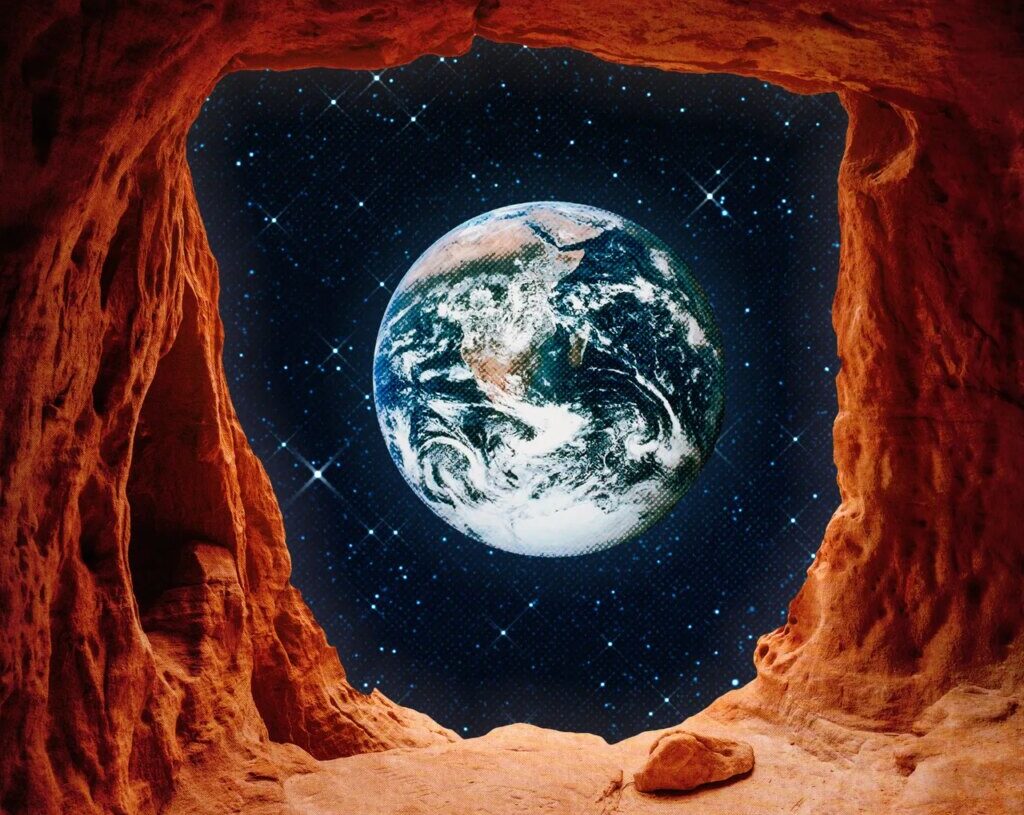
The revelation that life can flourish even in sunless and otherworldly cave environments raises the question of whether alien life on Mars, or elsewhere, could find refuge in these subterranean structures, known broadly as “planetary caves.”
“There’s this heavy component of understanding how air flow affects cave temperature that feeds in the potential for life,” says Jut Wynne, a cave scientist and ecologist at Northern Arizona University who has extensively studied extraterrestrial caves. “A shallow cave is presumably going to be less stable than a deeper cave. All of those factors will similarly impact or affect whether or not life could exist in a planetary cave.”
A benefit of caves is that they can provide protection from dangerous conditions on a planet’s surface, such as exposure to cosmic radiation or harsh temperatures. For example, it may be that caves deep under the Martian soil could be warmer, wetter, and more conducive to life.
“The queen of questions, from my point of view, is our prediction from 1992 that there could be a remnant microbial biosphere on Mars at depth,” says Boston.
What’s the Best Way to Search for Cave Aliens?
Over the past few decades, scientists have discovered hundreds of caves on the Moon and Mars, often by looking for “skylights” that expose cave entrances. In February, a team announced the discovery of a colossal lava tube under the surface of Venus that is several thousand feet in height and width.
Scientists have also speculated that ice caves filled with water, known as interstitial lakes, may be common in the frozen shells of moons like Europa, which orbits Jupiter, or Enceladus, which orbits Saturn. While these ice moons are famous for their subsurface oceans, the lake environments could provide potentially habitable pockets that may even receive a safe amount of sunlight, and which could be much easier to sample with future landers than the moons’ deep oceans.
These lakes are “the most inhospitable place you can think about for multicellular life on Earth,” says Sebree. “Yet in space, this is a completely protective environment where the radiation from the Sun or from Jupiter or whatever planet is nearby is not going to shred DNA. You’re protected from the vacuum of space, so you can actually have liquid water chemistry.”
“The worst place to live on Earth is actually the safest place to live on another planet,” he adds.
In order to explore these caves, scientists will need to build advanced robots and plan missions carefully to optimize the best sites for extraterrestrial spelunking. On rocky planets like Mars, skylights may lead to deep pits with no other connected passages. With that in mind, it would make sense to target regions with lots of visible skylights to avoid getting stuck with dead ends.
And while sealed-off or highly remote spaces may be difficult to access, they could be the most promising areas to search for signs of alien life, known as biosignatures. Such hints of life could be very subtle, and it’s unlikely we’ll stumble into a habitat packed with Martian megafauna.
“If life ever evolved on Mars and it still exists as extant life-forms underground, it’s going to be microbial,” says Wynne, who is an expert on bats (the Earth kind). “As much as it breaks my heart to say this, Martian bats are probably not going to be discovered.”
While the dream of finding Martian bats may well be dashed, biosignatures in these cave environments could potentially be detected by specialized equipment, such as spectrometers that can expose tantalizing mineral trails and complex compounds.
Have you had an experience that has made you question the possibility of extraterrestrial life?Leave a comment at the bottom of this article.
Sebree has extensively used these instruments in cave environments, especially Wind Cave in South Dakota, where he first caught the cave bug in 2019—fortunately not a literal one, in this case. “Seeing the cave from the tour trail is beautiful, but once you’ve actually had to do the sweat and the crawling to get somewhere even better looking, for me, that was an immediate addiction to it, and I’ve been doing it ever since,” he says.
Sebree and his colleagues use spectrometers to identify nutrient trails and other mineral buildups on cave walls that can sustain ecosystems in the dark. Similar instruments could be packed onto robots to look for biosignatures in extraterrestrial caves of all varieties.
“The idea of sending a spectrometer to explore some of these caves is a very high-priority idea,” says Sebree, noting that the Mars rovers have already pioneered spectroscopy on the surface of the red planet.
“We’ve been working on analog projects that show, as we take those same compounds that are important for life on Earth and move them into cryogenic ice, similar to Europa and Enceladus, they’re going to give off very unique fluorescent signals,” he continues. “We’re starting to create a type of database that matches that idea.”
Planetary Caves as Future Human Homes
Even if we never find aliens in the caves of other worlds, we could potentially occupy them ourselves one day. Caves on the Moon or Mars could serve as handy shields from radiation and other surface hazards for future astronauts that make the trek to these worlds.
Sebree points out that there could be downsides to off-Earth cave life, such as the lack of sunlight, and possible hazards, such as seismic activity. Moreover, it’s unlikely that crews would be able to completely seal off planetary caves to make livable spaces, so it would make more sense to bring an inflatable habitat that could be constructed inside a cave.
“We’ve only mapped maybe 5 to 10 percent of Wind Cave, and there’s nowhere in the cave where we could set up a seal to all exits, or make an airtight seal, so that’s going to be an issue with any type of natural lava tube,” he says. “But can we find a lava tube with a large enough chamber where maybe we could just erect a pressure dome instead?
“Now, we have all of those beautiful radiation protections from the cave itself.”
NASA and other institutions around the world are actively studying these possibilities for future human missions. For Boston, who blazed the trail in this field and is proud to see it thriving, the exploration of extraterrestrial caves as sites for either alien or human life is thrilling on its own merits, and she hopes it also helps the public appreciate the diversity of cave environments here on Earth.
“We have a long history as a species with caves as habitat shelters, temporary shelters, burial sites,” she says. Catching the cave bug beyond Earth will be “an exciting new world.”
The post The Caves That Could Help Us Find, or Become, Aliens appeared first on Wired.