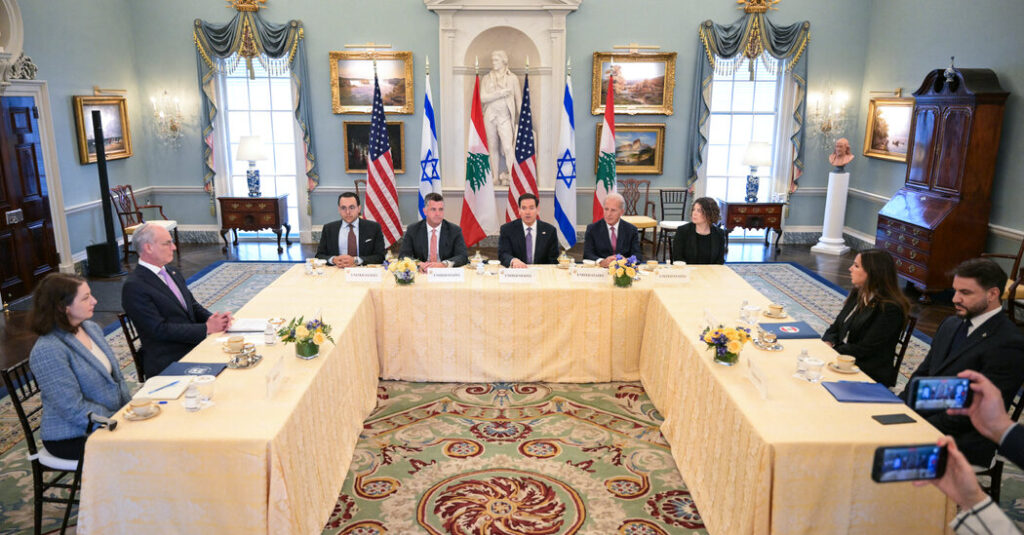
Israeli and Lebanese officials held rare direct talks on Tuesday, as the Trump administration convened neighbors who share one of the Middle East’s most violent borders as it tries to roll back Iranian influence.
The talks, hosted at the State Department by Secretary of State Marco Rubio, concluded with encouraging words and talk of further meetings, albeit no firm commitments and no change in Israel’s refusal to halt its punishing military campaign against Iran-backed Hezbollah militants in the country.
But the very fact of the gathering underscored the degree to which Israel and Lebanon have come to share the goal of disarming Hezbollah, the militia group based in southern Lebanon. Neither Iran nor Hezbollah was part of the talks, which both oppose.
“We are on the same side, we and the Lebanese, that the evil of Hezbollah must be eradicated,” Israel’s ambassador to Washington, Yechiel Leiter, said after meeting with his Lebanese counterpart, Mr. Rubio and other U.S. officials for more than two hours. Mr. Rubio said the talks were a step toward “bringing a permanent end to 20 or 30 years of Hezbollah’s influence in this part of the world.”
Although Lebanese officials used more cautious language, they were sympathetic. A person familiar with the discussions said they reiterated their desire to force Hezbollah to lay down its weapons and asked for American aid for Lebanon’s underequipped armed forces to carry out the dangerous task.
The meeting on the State Department’s top floor was officially separate from President Trump’s diplomatic efforts to reach a peace agreement with Iran, and U.S. and Israeli officials made clear they do not consider Lebanon to be part of those negotiations.
But Iran disagrees. Iranian officials insist that an April 7 cease-fire agreement between their government and the United States also included Lebanon, where Israel has mounted weeks of heavy attacks against Hezbollah targets. Pakistani mediators of the deal support Iran’s position.
Iran is more generally hostile to the idea of cooperation between Israel and Lebanon that might defang Hezbollah, said Firas Maksad, the managing director for the Middle East and North Africa practice at Eurasia Group.
Mr. Maksad noted that a State Department summary of the meeting said that “any agreement to cease hostilities must be reached between the two governments, brokered by the United States, and not through any separate track.”
“By insisting that this be an American-led process, separate from ongoing U.S. talks with Iran, the U.S. is signaling its refusal of continued Iranian influence over Lebanon,” Mr. Maksad said. “Iran and Hezbollah will surely resist and attempt to sabotage this effort.”
Lebanon has been a battleground for the fight between Israel and Hezbollah since the militant group was formed to fight a 1982 Israeli invasion of southern Lebanon ordered to root out Palestinian operatives.
The two sides have clashed along their border ever since, with Israel frequently bombing and occupying Lebanese territory in what it calls a response to the group’s cross-border rocket attacks into Israel. Too militarily weak to fight back, Lebanon’s government has mainly resorted to denouncing Israel as an aggressor and appealing for international support.
But with both Hezbollah and Iran severely weakened by devastating U.S. and Israeli attacks, Lebanon’s government has taken bolder steps against Hezbollah, which has operated as a kind of independent army within Lebanon’s borders. (Hezbollah is also a Lebanese political party that holds a minority of seats in its Parliament.)
Last year, Lebanon’s government voted to require Hezbollah to surrender its weapons, in keeping with a United Nations resolution that also mandates an Israeli withdrawal from Lebanese territory. For Lebanon’s leaders, disarming Hezbollah is the best hope for ending years of Israeli attacks against the group — attacks that have escalated since March to include heavy airstrikes on the capital of Beirut, killing hundreds of civilians.
Prime Minister Benjamin Netanyahu of Israel agreed last week to the talks with Lebanon in Washington as Iran warned that it could withdraw from the cease-fire unless Israel stopped attacking Lebanon. Israel and Lebanon do not have diplomatic relations and have technically been at war since 1948.
A group of nearly two dozen European and Western nations, including France and Britain, threw their weight behind the talks, urging both sides “to seize the opportunity presented by the U.S.-Iran cease-fire,” according to a joint statement.
But the talks are emerging as a flashpoint inside Lebanon, exposing political divisions in a country with no unified position on engaging with Israel. Supporters of Hezbollah have taken to the streets in Beirut to protest the move in recent days, and regardless of the outcome, the fact that Israeli and Lebanese officials are meeting has raised fears of instability.
Mr. Rubio acknowledged the long history of conflict leading up to the latest outbreak of fighting.
“This is a process, not an event,” he said at the start of the talks on Tuesday. “All of the complexities of this matter are not going to be resolved in the next six hours.”
President Joseph Aoun of Lebanon told Italy’s foreign minister, Antonio Tajani, that his nation was hoping that a cease-fire would be reached, after which longer-term negotiations could begin, according to a statement shared by the Lebanese presidency on Monday. Mr. Aoun said that any solution must entail Israel’s heeding the growing international calls for it to stop attacking Lebanon.
Hezbollah’s leader, Naim Qassem, said in a televised speech on Monday that his organization had categorically rejected Lebanon’s planned talks with Israel. He called on the Lebanese authorities to cancel the talks, urging them not to become “a tool of Israel.”
Proceeding with the talks would represent “capitulation and surrender” to a country intent on occupying Lebanon, Mr. Qassem said.
Anushka Patil contributed reporting.
Michael Crowley covers the State Department and U.S. foreign policy for The Times. He has reported from nearly three dozen countries and often travels with the secretary of state.
The post Rubio Hosts Israel and Lebanon for Rare Meeting Shadowed by U.S.-Iran War appeared first on New York Times.